
An HR assistant interview is often about doing everyday administrative work carefully: confirming details, organizing paperwork, explaining the next step, and protecting information that should not be shared. Prepare examples of accuracy and respectful communication. Do not suggest that knowing a file location gives you authority to disclose everything inside it.
Here is the practical approach: identify the decision behind the question, choose a genuine example, state your role, and give the outcome or lesson without stretching it. For behavior-based questions, the University of Washington STAR guide recommends explaining the situation, task, your actions, and the result. Interview questions differ by employer; the examples here are explicitly hypothetical practice material, not transcripts of real hiring interviews.
What Employers Need to Learn About Hr Assistant Work
O*NET describes HR assistants as workers who maintain personnel records, process documents, assist with policies and support onboarding. The job is not equivalent to being the employer’s HR legal counsel or the hiring decision maker. Interview responses should show you understand how permissions, checklists, and verification protect both workers and the organization.
Use the primary occupational or professional guidance alongside the related professional source to ground the responsibilities, but do not assume the same interview sequence at every employer. Read the advertised duties carefully: is this a support role, an individual contributor, a supervisory appointment, or a licensed position? The stronger an answer is tied to that role’s actual authority, the less likely it is to become vague or overstated.

Five Questions Worth Practicing With Real Examples
Question 1: What would you do with a request for a confidential employee record?
What the question tests: This reveals whether you can distinguish access to a system from permission to disclose information. Start by clarifying the setting and the responsibility you actually held. If the interviewer asks for a specific past incident, answer with something that really happened to you. A practice response may be hypothetical, but your final interview story should never pass a constructed situation off as lived experience.
Build your answer: Identify the requester and purpose, check authorization under the employer’s procedure, share only permitted information, and escalate uncertainty. Mention an observation or concrete work product when you have one, and distinguish your own contribution from any decision made by a manager, clinician, school leader, or project sponsor. Avoid: Avoid promising absolute secrecy: authorized colleagues may need access according to role and policy. If the scenario is new to you, explain your reasonable decision process honestly rather than claiming an outcome you have not achieved.
Question 2: How would you correct a mistake in an employee file?
What the question tests: The interviewer wants a repeatable correction process with an audit trail where required. Start by clarifying the setting and the responsibility you actually held. If the interviewer asks for a specific past incident, answer with something that really happened to you. A practice response may be hypothetical, but your final interview story should never pass a constructed situation off as lived experience.
Build your answer: Compare the disputed entry with a permitted source, note the discrepancy, obtain required approval, correct it through the official system, and recheck. Mention an observation or concrete work product when you have one, and distinguish your own contribution from any decision made by a manager, clinician, school leader, or project sponsor. Avoid: Do not silently overwrite a record or assume an applicant’s verbal claim alone resolves every discrepancy. If the scenario is new to you, explain your reasonable decision process honestly rather than claiming an outcome you have not achieved.
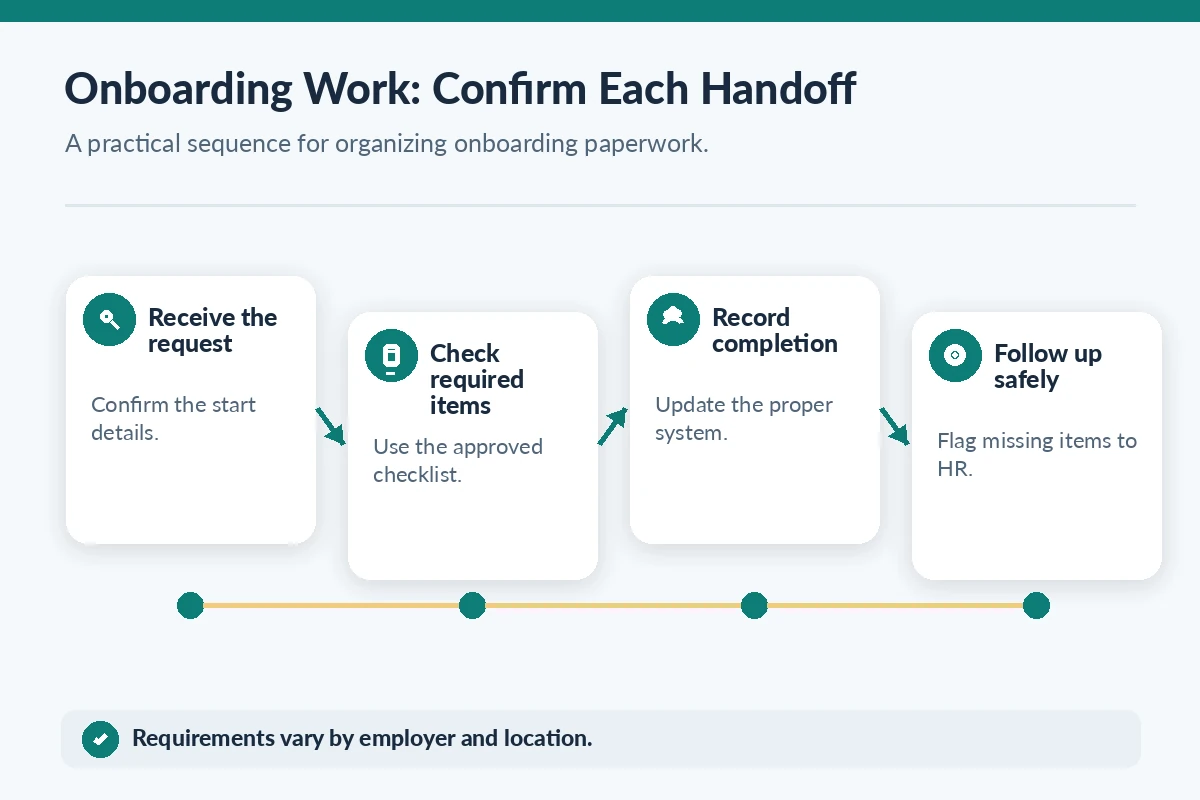
Question 3: How do you keep onboarding tasks from being missed?
What the question tests: This assesses coordination between HR, a hiring manager, facilities and the new employee. Start by clarifying the setting and the responsibility you actually held. If the interviewer asks for a specific past incident, answer with something that really happened to you. A practice response may be hypothetical, but your final interview story should never pass a constructed situation off as lived experience.
Build your answer: Describe a checklist with responsible owners, dates, access and document dependencies, plus a visible follow-up method. Mention an observation or concrete work product when you have one, and distinguish your own contribution from any decision made by a manager, clinician, school leader, or project sponsor. Avoid: Avoid implying every employer has the same forms, background steps or systems. If the scenario is new to you, explain your reasonable decision process honestly rather than claiming an outcome you have not achieved.
Question 4: How would you respond to a benefits question you cannot answer?
What the question tests: A good assistant knows where information comes from and when specialist guidance is needed. Start by clarifying the setting and the responsibility you actually held. If the interviewer asks for a specific past incident, answer with something that really happened to you. A practice response may be hypothetical, but your final interview story should never pass a constructed situation off as lived experience.
Build your answer: Acknowledge the question, verify the approved resource, provide the relevant contact or next step, and follow through if assigned. Mention an observation or concrete work product when you have one, and distinguish your own contribution from any decision made by a manager, clinician, school leader, or project sponsor. Avoid: Do not speculate about eligibility, personal medical details or legal entitlements. If the scenario is new to you, explain your reasonable decision process honestly rather than claiming an outcome you have not achieved.
Question 5: Describe a time you managed competing deadlines accurately.
What the question tests: High-volume record tasks involve prioritization without rushing through sensitive checks. Start by clarifying the setting and the responsibility you actually held. If the interviewer asks for a specific past incident, answer with something that really happened to you. A practice response may be hypothetical, but your final interview story should never pass a constructed situation off as lived experience.
Build your answer: Choose one true example, state which deadlines were fixed, explain the sequence and verification method, and identify the actual result. Mention an observation or concrete work product when you have one, and distinguish your own contribution from any decision made by a manager, clinician, school leader, or project sponsor. Avoid: A hypothetical example may be used to practice but must never be recounted as your own achievement. If the scenario is new to you, explain your reasonable decision process honestly rather than claiming an outcome you have not achieved.
A Hypothetical Practice Answer With Clear Limits
Hypothetical situation — not a real candidate achievement: A manager asks an HR assistant to email another employee’s leave details before a morning meeting. A useful interviewer prompt might be: “What would you do next, and who should make the final decision?” This example is designed to practice an appropriate response, not to claim it happened at an identifiable employer. Your genuine story will differ; replace details only with information you can accurately disclose.
Hypothetical response: “I would confirm what information the manager is authorized to receive, review the employer’s access procedure, and ask the appropriate HR lead if I cannot verify permission. I would not attach the entire employee file merely because the requester is a supervisor. I would document the request according to policy and share only approved information.” Notice that this answer describes a sequence and a boundary, not a guaranteed good outcome. When tailoring it, replace the conditional steps with the actions you actually took. If you have not encountered the situation, say how you would approach it and ask about the organization’s established procedure.
Build a Small Library of Verifiable Evidence
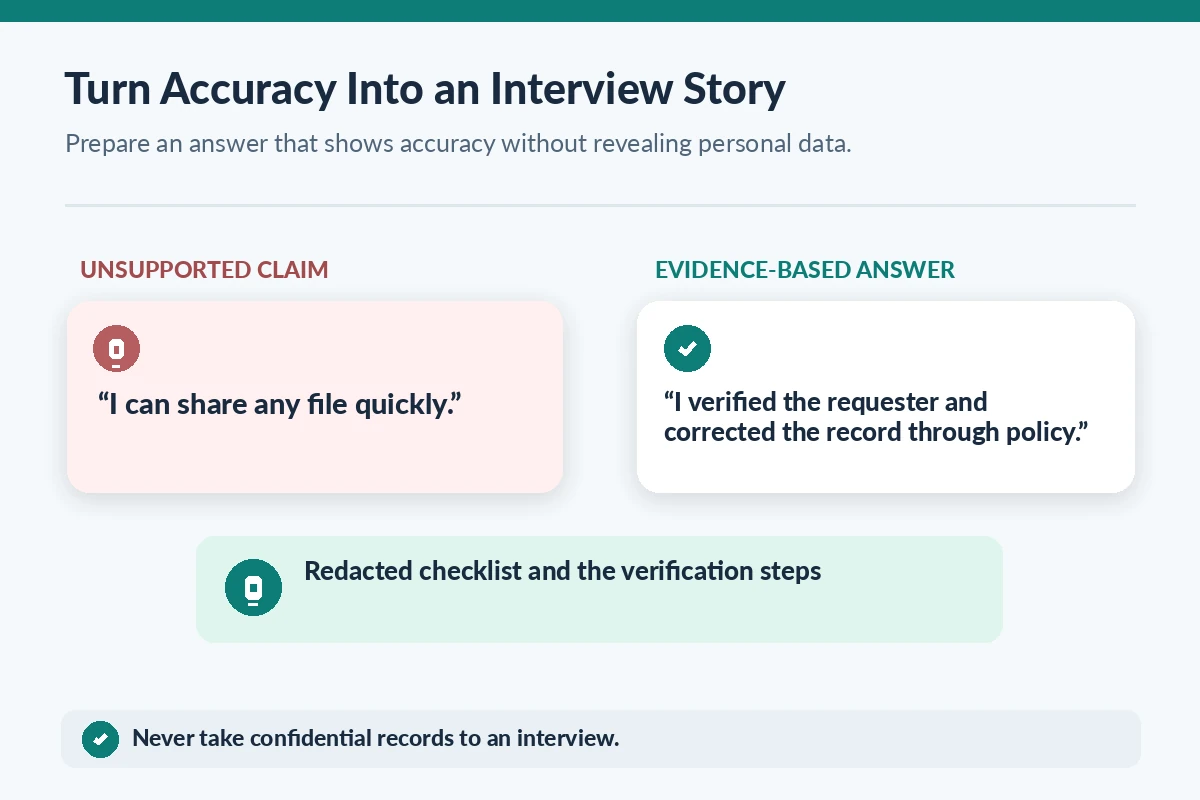
Choose three situations from work, internship, supervised practice, education, or volunteering that clearly match the position. For each, write a one-sentence context, the task assigned to you, two or three actions you performed, and the observable result or what you learned. Relevant evidence for this role could include: A redacted onboarding checklist, a verification log format, or an example of identifying a mismatch in employee records can demonstrate careful habits without exposing real personal data. Use documents only if you are allowed to show them; a precise verbal description is often enough.
Make a quick evidence inventory rather than a script. Label each story with a skill such as accuracy, communication, conflict handling, safety, or planning. Underline statements that imply a promotion, a performance percentage, a regulatory decision, or other measurable impact; remove them unless you can support them. Then rehearse the story aloud with a colleague and ask which decision was still unclear.
Keep Claims, Confidentiality, and Authority Accurate
Never use actual employee medical, payroll, or personnel details in an interview. Speak in generalized terms, redact examples, and describe the employer’s approval process rather than inventing privacy law requirements.
A question may be hypothetical even when the interviewer wants to see professional judgment. In that case, state what you would check first, what rules or instructions control the next action, who you would involve, and how you would record the outcome if authorized. For a behavioral question about the past, use a real story. Never invent an employer, client, patient, student, staffing level, salary outcome, or software capability to sound more experienced.
A Fifteen-Minute Rehearsal Before the Interview
First, spend three minutes reviewing the posting and identify the three duties that appear central to this particular HR assistant role. Next, allocate five minutes to matching one true experience to each duty. Use four minutes to say an answer aloud and notice where your personal action disappears behind “we.” In the final three minutes, prepare two questions about decision rights, training, escalation, or supervision that directly fit the role.
For a remote interview, check the connection and put the question list beside—not over—the camera. For an in-person interview, carry a short, nonconfidential evidence sheet. If an interviewer asks a question outside your experience, acknowledge the limit and offer a structured next step. This is clearer and more credible than memorizing an answer that implies facts you cannot verify.
How We Research Interview Preparation Guidance
We reviewed primary occupational or professional guidance and related professional source for role responsibilities, then cross-checked interview storytelling advice against the University of Washington career guide. These sources support the work and the response structure; they do not verify that a specific employer asks any particular question or that a proposed answer wins an offer. Examples are hypothetical. The editorial team has no confirmed affiliate relationship for the resources in this guide. See the affiliate disclosure.
Related Guides
- HR Assistant Resume Summary: Personnel Records and Confidential Work
- HR Interview Questions to Ask: Confidentiality, Hiring Process, and Scope
- Tell Me About Yourself for HR Coordinators: Records and Hiring Support
- HR Coordinator Resume Summary: Show Records, Hiring Support, and Privacy
- Supervisor Interview Questions: Coaching, Coverage, and Fair Decisions
Know that rules and internal policies matter, but do not offer legal conclusions beyond your training or the job description.
Describe general decision steps, not names, medical information, records, or identifiable incidents.
Yes. Show verified examples of clear explanations and organized follow-up while respecting the different privacy requirements of HR.
No. Describe your actual tools and how you learn new systems rather than claiming a system you have never used.
Ask who approves record corrections, what onboarding duties belong to this role, and where sensitive requests are escalated.