
A useful human resources resume format shows which people processes you actually supported and which decisions belonged to a specialist or manager. Place relevant dated work first, with hiring coordination, onboarding, employee-record handling, training administration, or other verified responsibilities grouped under real positions. A reader should understand whether you scheduled interviews, screened applicants, processed approved changes, supported employee questions, or had authorized decision-making duties. Do not copy private personnel details into examples and do not turn an assistant title into a claim of HR management authority. A clear document is especially important for work built around confidentiality and record accuracy.
Choose section order for an actual HR specialty
Human resources is not a single identical job. The Bureau of Labor Statistics describes recruiting specialists and HR generalists among different HR roles, alongside work involving personnel records, training, benefits or employee relations. For a recruiter application, put candidate sourcing, screening or interview coordination near the top if you performed that work. For an HR operations position, lead with authorized record processes, onboarding or employee-service workflow. Keep employer, job title and dates prominent so your profile is more than a collection of keywords.
An experienced specialist may use contact information, a narrowly supported summary, professional experience, tools, education and optional verified credentials. An administrative assistant moving into HR should show transferable records and scheduling work without claiming prior policy or hiring authority. If you hold an HR certification, name the exact credential and status; a course completion is not automatically a professional certification. If the posting calls for a specific system, include it only when you have used that system at an appropriate level. Make experience easy to compare with the role’s tasks.
Separate recruiting coordination from selection authority
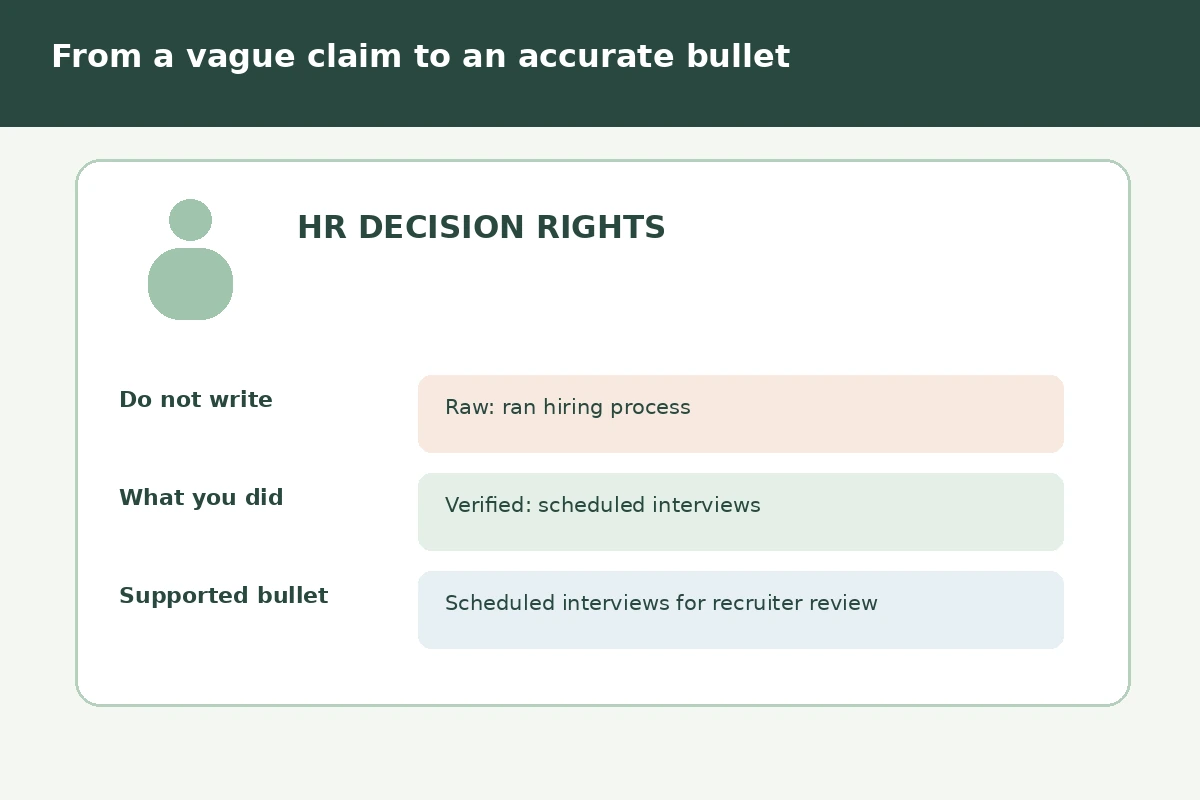
A resume should distinguish sending invitations, booking interviews and updating applicant-status fields from deciding who receives an offer. A candidate who organized recruiting calendars can legitimately write about schedule accuracy, candidate communication and escalations, but not claim to have hired employees if a manager made the decision. Recruiters with actual screening authority can describe the intake requirements and process they followed. Do not invent offer counts, fill rates or reduced hiring times without supporting records and a fair description of your contribution.
When referring to applicant tracking systems, identify whether you entered data, searched records, generated approved reports, or configured hiring workflows. These tasks require different permissions. You should not reveal protected interview comments, candidates’ identities or specific background-check information in public application materials. An accurate example is ‘Coordinated interview schedules and maintained approved candidate-status updates for recruiter review.’ That sentence identifies a real support function while leaving the final hiring decision with its actual owner. The specific approval line is often more informative than generic ‘full-cycle recruiting’ claims.

Describe personnel files without exposing employees
HR records can contain private employment details, so evidence should focus on safe process descriptions. Instead of naming an employee who filed a complaint or took leave, describe the record routing, checklist control or confidential handoff you performed. Only list actions you were authorized to take. A payroll assistant who verified timecard fields for supervisor review should not write that they independently approved wages, settlements or benefits. If you coordinated document collection, distinguish receipt verification from compliance determinations made by a qualified specialist.
Use language such as ‘maintained approved onboarding checklists,’ ‘referred exceptions to the HR generalist,’ or ‘updated authorized employee fields following documented approval,’ if those tasks actually occurred. Avoid claiming company-wide legal compliance or a zero-error personnel record unless independently supportable. If you have worked with sensitive data, your professional value includes knowing when to stop and escalate, not only speed. Do not use employee screenshots, identifiable case studies or downloaded HRIS datasets as portfolio proof. Systems and processes can be described without identifiable records.
| Experience type | What to show | Boundary to verify |
|---|---|---|
| Recruiting coordination | Schedules, candidate communications | Hiring decisions remain with owners |
| HR records support | Approved updates and checklists | Restricted employee information |
| HR specialist decisions | Specific authorized reviews or advice | Do not imply authority by job label |
Match systems and metrics to a defensible contribution
HR job ads may mention ATS, HRIS, spreadsheets, onboarding portals, payroll systems, learning management systems or reporting. Group only the tools you know and explain the function you used: scheduling, data entry, report checks, approved status changes or tracking training completion. A tool list without a work example can be misleading. If you created a report, say what information type was included and who reviewed it, without exposing restricted data. Explain the difference between preparing a hiring report and setting the hiring strategy.
Numbers are useful when they come from records you may discuss and when they measure your contribution. An application may truthfully state a weekly number of interviews coordinated or an onboarding packet volume, but avoid fake metrics about turnover or satisfaction. Even where a department improved retention, an assistant should not assume personal causal credit. A cautious bullet may describe a standardized checklist that reduced follow-up confusion, if supported by observed work; do not manufacture a percentage. Your resume must remain supportable without attaching private employee files or confidential system exports.
Make credentials and policy knowledge precise
List education and professional learning in their own section, with actual institution, program or credential title. Do not describe watching an HR webinar as earning a professional certification. If your role touches benefits, leave or investigations, state your involvement factually and avoid publishing legal interpretations or private decisions. The BLS notes that specialists may handle a broad range of responsibilities, but that description is not permission for any applicant to claim they were a generalist or adviser when their role was limited to administrative work.
If a vacancy requires knowledge of a particular jurisdiction’s employment rules, avoid blanket claims of universal expertise. Laws and employer policies vary. Express your demonstrated process, such as using an approved reference, preserving a record, and routing an issue to the authorized reviewer. A résumé is not the place to advise on specific employees’ benefit entitlements or disciplinary outcomes. Use a straightforward single-column layout with standard headings, consistent dates and generous readability. The subject matter is sensitive enough; the formatting should remove rather than add ambiguity.
Review the resume as a permission map
Before submitting, mark each bullet with a simple question: did I prepare, update, advise, decide or approve? If you prepared an offer packet but a hiring manager approved the offer, show that separation. If your recruiting role included screening, specify what you were authorized to review. If you supported onboarding, distinguish orientation logistics from legal verification or final employee classification. This exercise catches inflated verbs that a recruiter might otherwise read as claims of management-level authority. It also creates safer, more focused interview stories.
Compare dates, titles and tools with your own records and the exact job posting. Open the exported document and check that important text is selectable and the reading order remains logical. Remove private identifiers, expired training claims and acronyms unexplained outside your last employer. A valid summary might emphasize recruiting operations and records accuracy but should not erase the more precise work entries below. Leave protected information out, and ask a former supervisor about permissible references rather than attaching internal employee information to prove that you handled it.

How We Research and Verify This Resume Format
Sources reviewed on November 16, 2026: BLS distinguishes recruiting, records, orientation and broader specialist responsibilities.. CareerOneStop recommends consistent readable single-column layout and conventional section headings; file instructions take priority.. CareerOneStop recommends factual work entries that identify employers, dates, relevant responsibilities and accomplishments.. We also compared the article intent with the supplied JobAsk WordPress draft and published-post title exports, the preceding production batches, and public search results. This comparison cannot prove an unpublished WordPress URL is free. Resume samples and diagrams in this guide are explicitly hypothetical; adapt only the portions that match your real work and permissions. Employers may require different documentation or file formats, and no format guarantees an interview or ATS acceptance. We recommend no paid product or employer partnership here; see our affiliate disclosure.
More Resume and Cover Letter Guides
Yes if you used that system and can describe the actual authorized functions. Do not claim full configuration or administrative access based on limited use.
Yes, identify real scheduling, candidate communication or record work, and distinguish it from candidate selection.
Describe your approved workflow and controls, without exposing identifiable employee or applicant information.
List only a credential you actually hold, with truthful status. Courses, training certificates and professional credentials should not be mislabeled.
Use a clear chronology and a relevant summary or skills section while retaining dated evidence from administrative, records or people-support work.