
A human resources internship resume should make clear what you actually coordinated, checked, or documented while protecting employee and applicant privacy. Place your internship title, organization, and real dates in the experience section; follow with bullets about scheduling, applicant communications, training logistics, or authorized records work. Do not turn helping with an interview calendar into “hired employees,” and do not imply that viewing a personnel system means you owned HR policy decisions. Recruiters need to see reliable support work and sound escalation judgment.
The O*NET profile for human resources assistants includes maintaining personnel documents and supporting staffing and training processes. That occupational description is not a license for every intern to access files or make hiring decisions. Actual responsibilities vary by organization and permission level. The examples below are hypothetical drafting models; change every verb, tool, date, and outcome to match your verified internship or school experience.
Start With the Real Internship Title and Dates
Use the title your supervisor or program used, such as “Human Resources Intern” or “Recruiting Operations Intern.” Keep the organization name, location or remote arrangement if relevant, and month/year dates consistent with your other experience entries. If the internship is ongoing, use “Present” only while you are actually participating. If you received academic credit but were not employed, you may still put the position under a clearly named “Internship Experience” section, rather than implying full-time employment.
For a first internship, a one-page student resume can put education before experience if courses or student projects best establish your fit. For a second internship, lead with the most relevant actual responsibilities, not the most impressive-sounding team name. A campus recruiting committee role may belong in “Leadership,” while a paid or unpaid organization placement belongs in “Experience.” Both can be useful, but the category should help the reader understand what happened.
| Internship activity | Honest resume evidence | Claim to avoid |
|---|---|---|
| Interview scheduling | Organized approved invitations and flagged calendar conflicts | Claiming you selected or hired applicants |
| Onboarding records | Checked required fields and referred missing items | Publishing private employee details |
| Campus HR project | Created fictional tracker and labeled it a simulation | Presenting a class exercise as paid HR work |

Convert Recruiting Coordination Into Credible Evidence
Think about the workflow you supported: checking availability, sending approved scheduling notes, updating interview-calendar entries, or identifying missing applicant documents for an authorized recruiter. A usable bullet tells the reader which step you performed and what you checked. For example: “Coordinated candidate interview times with recruiting staff and flagged calendar conflicts before invitations were sent.” Include a number of interviews or time period only if you have a reliable record and sharing it is permitted.
Do not say you “selected talent” if you merely sent reminders or organized a spreadsheet. If you attended debriefs as an observer, you may describe a supervised exposure to the process but should not claim ownership of selection criteria. If you drafted candidate-facing messages, state whether they were reviewed before sending. Strong entry-level HR evidence often consists of accuracy, timely handoffs, and respect for an established approval chain—not a fabricated hiring conversion rate.
Explain Personnel Records Without Disclosing Them
A records assignment may include verifying that required fields were present, organizing approved forms, updating a status tracker, or sending an incomplete file back to an authorized staff member. Write what you handled without naming employees, exposing confidential dates or wages, or reproducing real applicant documents. A safe sample: “Reviewed approved onboarding checklist fields for completeness and flagged missing items for the HR coordinator.” The word “reviewed” is preferable to “audited compliance” if no compliance audit occurred.
Before describing a software system, check whether naming the product is accurate and appropriate. “Updated a restricted onboarding tracker under staff supervision” can be enough. Never include a screenshot of a personnel record in a portfolio without explicit permission and thorough de-identification review. Privacy judgment belongs in the description of your behavior: verified recipient, used authorized channels, and referred requests outside your role to designated HR staff.
Build Bullets From Task, Check, and Handoff
The strongest resume line answers three questions: what work did you do, how did you verify accuracy, and who received the result? Start with concrete verbs such as organized, scheduled, checked, drafted, updated, or escalated. Avoid verbs such as directed, approved, investigated, or adjudicated unless those actions were genuinely within your responsibility. For hypothetical campus-club experience, “Maintained volunteer sign-up records and confirmed shift changes with the coordinator” is stronger than “Managed human capital.”
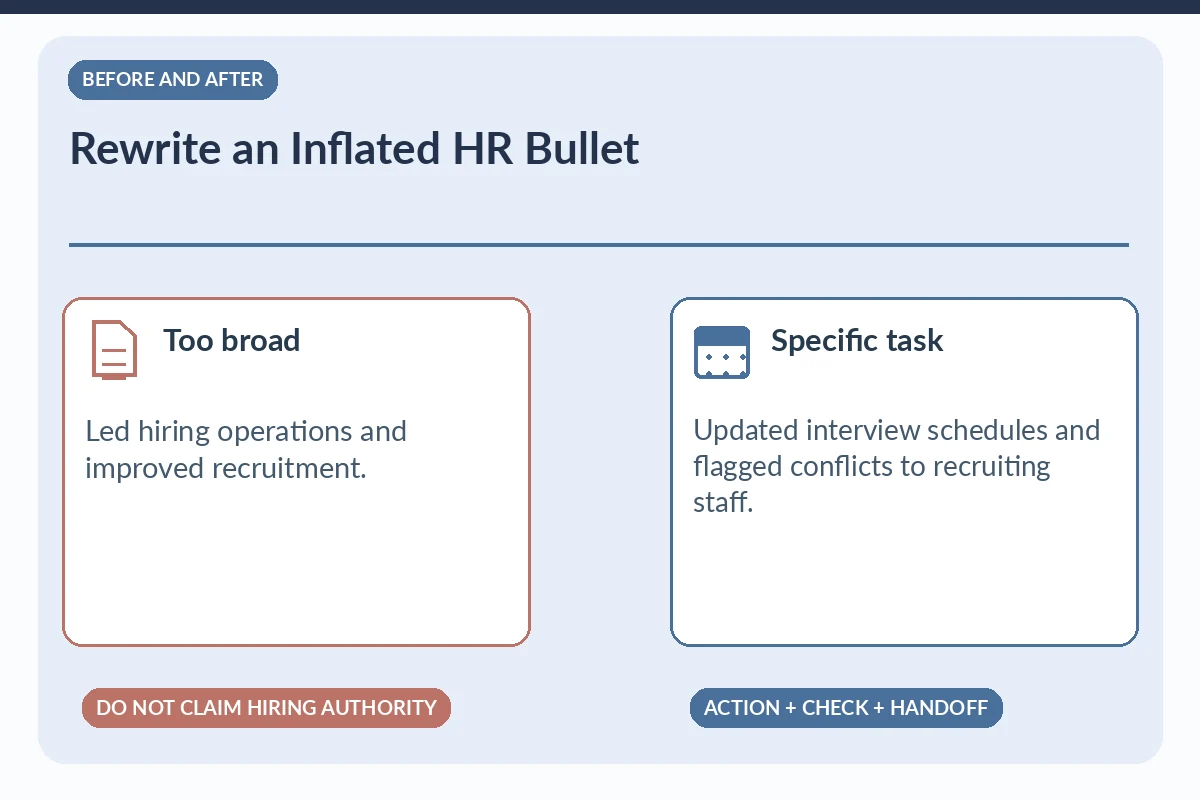
A good before-and-after edit removes inflated ownership. Before: “Led recruiting operations and improved hiring efficiency.” After, if truthful: “Updated interview schedules, confirmed candidate availability, and notified the recruiting lead of conflicting time slots.” The revised sentence gives enough detail to ask a follow-up question. Add a measured outcome only when you can explain how it was recorded and why the outcome was meaningfully attributable to your own action.
Use Projects to Fill Specific Skill Gaps
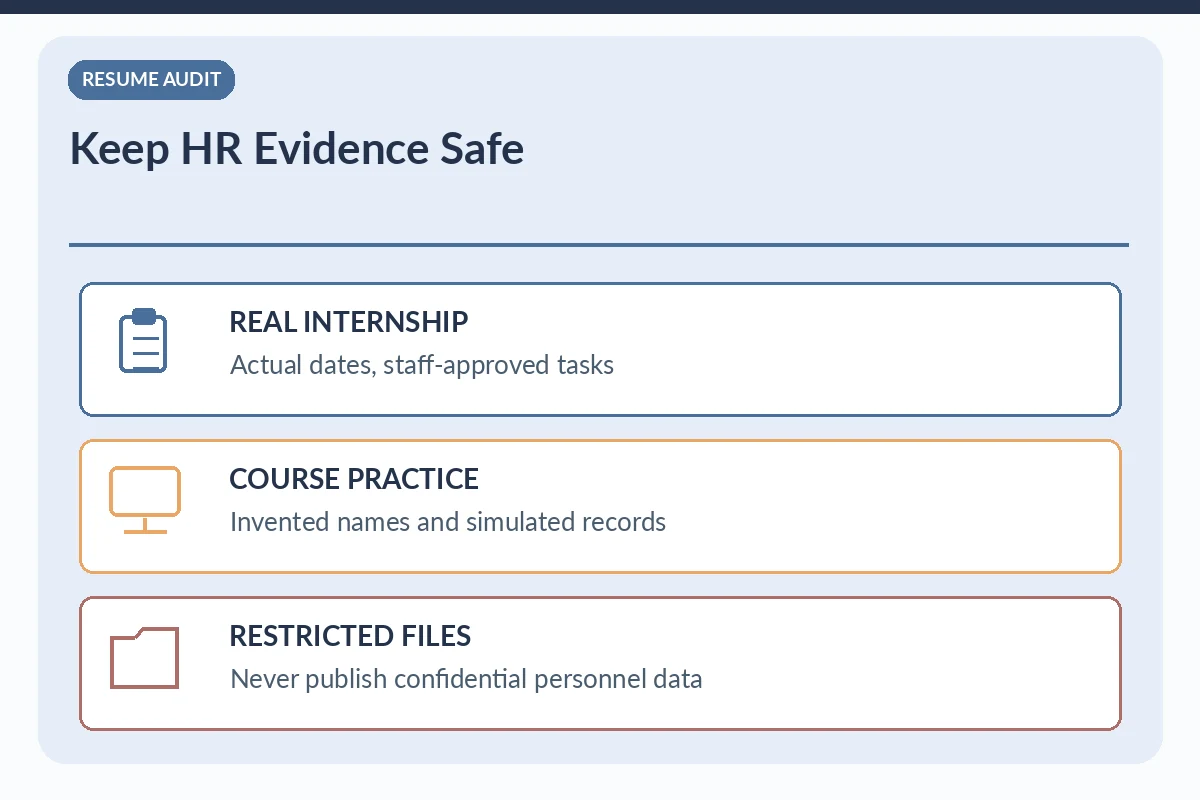
If you have not handled real personnel information, do not invent it. You can build a fictional interview calendar, create a sample orientation checklist, or map a simulated recruiting workflow using invented names and dates. Mark that entry as “Course Project” or “Independent Practice,” identify your contribution, and explain which checks you used. A reader should not have to guess whether the spreadsheet represents actual candidates or fabricated demonstration data.
Relevant coursework can support a claim of familiarity with workplace communication, research methods, records management, or organizational behavior. It does not establish expertise in employment law or approval authority. If a posting mentions a specific HR system, list it only if you truly used it. A simulation in a classroom can be described as a simulation; a brief demonstration video is not equivalent to maintaining production employee records.
Run an Accuracy and Privacy Audit Before Sending
Read every bullet as a potential interview question: “Which record did you check?” “Who authorized access?” “What happened when the information was missing?” Your answer should rely on work you can honestly describe without identifying a real employee or candidate. Confirm dates with your academic or organization records and ensure that confidentiality obligations from the internship still apply after you leave.
Finally, compare the top three internship bullets with the next role posting. If the opening emphasizes onboarding, move your verified checklist or training-coordination work upward; if it emphasizes recruiting, emphasize scheduling and communications. Keep a plain-text copy and check the exported PDF for consistent alignment, readable section labels, and no unintended personal information. The role-fit edit should change ordering and emphasis, never the underlying facts.
How We Research Internship Resume Examples
Sources checked on 2026-11-15: www.onetonline.org (Human resources assistants maintain, verify, and handle personnel-related documents and recruitment or training records.); career.ucsd.edu (Resume experience bullets should show the applicant’s own contribution, action, and relevant result.); careercenter.umich.edu (Concise, role-specific action bullets and consistent internship dates make student experience easier to evaluate.). We distinguish documented occupational tasks from work a particular intern was actually authorized to perform. All sample sentences above are invented examples; verify your own dates, duties, records, permissions, and outcomes. This informational guide has no verified paid recommendation. See the JobAsk affiliate disclosure for site-wide transparency.
More Resume and Cover Letter Guides
Yes. Label the role and dates truthfully; paid status is not necessary to describe relevant supervised experience.
Only when the figure was measured, sharing is authorized, and you can distinguish your own contribution from the team result.
Do not list it as hands-on proficiency. You may note supervised observation if it is genuinely relevant and accurately described.
State the category of task and your accuracy checks without revealing employee identities, sensitive fields, or restricted documents.
Put it under Projects or Coursework and label the fictional data and simulated workflow explicitly.