
Influencing without authority interview questions ask whether you can help another person consider a useful change when they do not report to you. A strong behavioral story identifies the shared problem, why someone hesitated, what evidence or alternative you offered, and who retained the final decision. You do not have to claim you “led the team” or forced a result. An honest example might end with a smaller compromise or a proposal not accepted. The hypothetical prompts and answers below emphasize persuasion by listening, testing, and checking the outcome.
Identify a decision you did not control
“Tell me about a time you persuaded someone who disagreed with you” is distinct from “Tell me about leading a project.” With influence, the other person has legitimate control over part of the outcome. Perhaps a teammate manages a handoff, an instructor approves a group-project change, or another department owns a shared document. Name the decision rights early in your answer so that persuasion does not masquerade as authority.
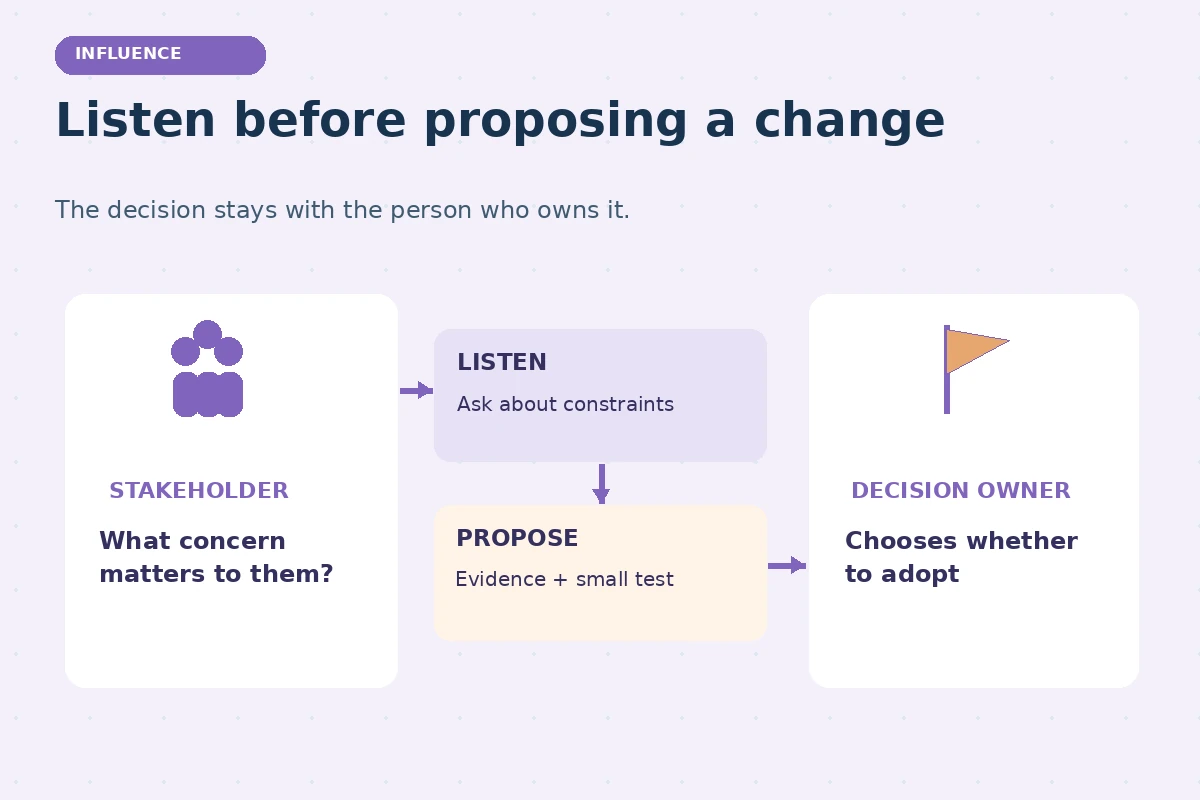
The story becomes credible when you explain the reason for resistance. The other person may have been protecting a deadline, worried about quality, following an established procedure, or missing information. A useful answer listens before it proposes. The point is not that your idea always wins; it is that you bring relevant evidence, offer workable choices, and respect the person who decides.
Map the stakeholder and the concern
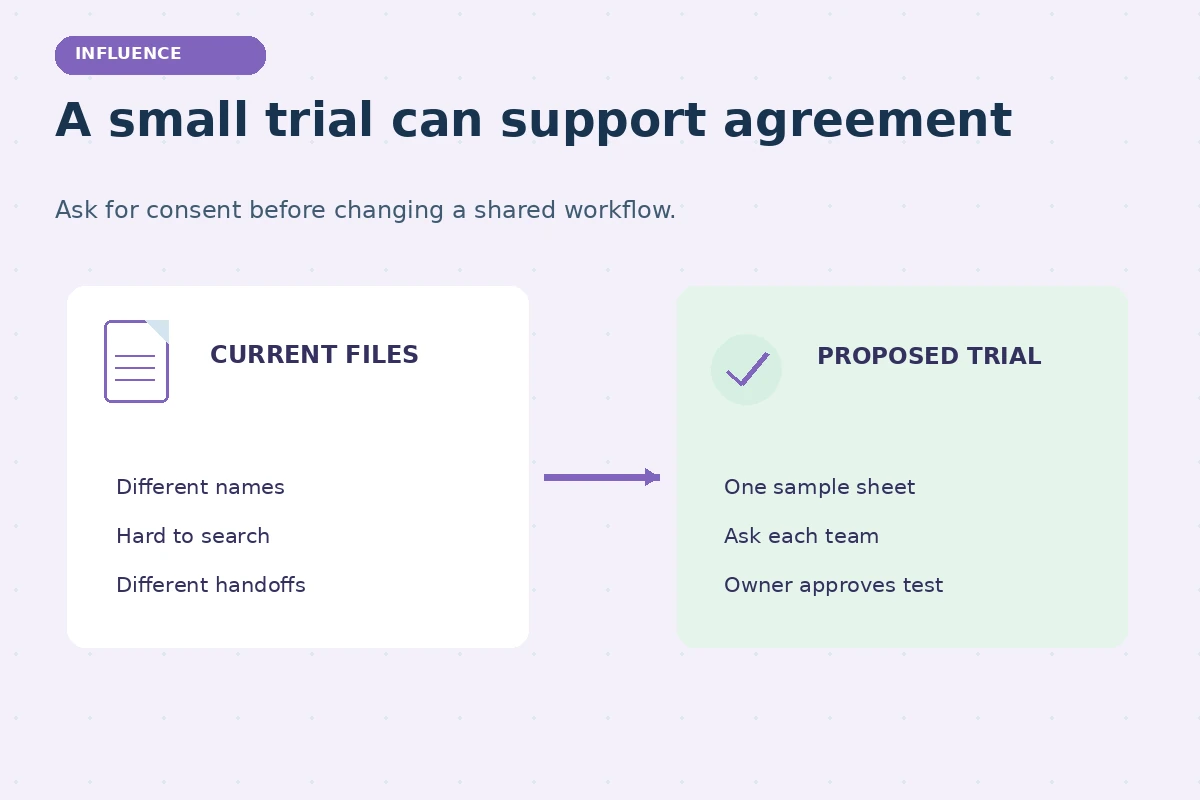
Build a simple table while preparing: stakeholder, their responsibility, concern, your proposed evidence, and final choice. Suppose a coworker was reluctant to change the order of shared files because the current system supported their existing workflow. Rather than labeling them “resistant,” you could show both naming conventions, request a short test, and ask which version is easier to retrieve. This is a hypothetical example, not an account of a real employer.
Notice that a trial is only appropriate where the person has permission to run it; never imply that a candidate may experiment with sensitive customer data, live financial systems, safety procedures, or regulated tasks without authorization. A successful influence story can involve recommending a safer review process rather than personally changing a system. Keep the manager or designated owner visible when their approval was necessary.
Practice questions about objections and compromise
Question one: “Describe a time you changed a peer’s mind.” Explain what they were worried about, the comparison you showed, and their eventual decision. Question two: “Tell me about a recommendation you made that was rejected.” Describe how you learned why, what you modified, and how you stayed collaborative. Question three: “How have you gained cooperation across teams?” Explain how you clarified who would perform each handoff and what you asked each person to confirm.
A harder prompt is “Tell me about persuading your supervisor.” Avoid an answer in which you went around the supervisor without context. Instead explain how you gathered a clear example, raised it respectfully, and accepted the decision or found an authorized next step. If your proposal was accepted, describe what was actually implemented; if it was only discussed, do not turn the discussion into an adoption claim.
Sample STAR answer: make a handoff easier
Hypothetical answer: “In a student group project, the research and presentation teams stored references in different formats [situation]. We needed a consistent source list, but neither group reported to me [task]. I asked each group which information they needed, showed a sample citation sheet, and proposed trying it for one shared draft [action]. The teams agreed to use the sheet for that draft and reviewed it together [result].” This is a modest influence example because it names the limited agreement.
Do not embellish it into “transformed the organization’s workflow” or invent hours saved. If the real teams did not adopt a change, a different result is still possible: they identified a constraint, agreed to a next discussion, or rejected the idea after seeing the evidence. Make the conclusion truthful and show what you would do differently. The interviewer should be able to identify your individual contribution apart from the group’s final decision.
Show evidence without making a sales pitch
Evidence might be a comparison of two versions, notes from a small user test, a documented recurring problem, or feedback volunteered by the affected people. Choose material you were allowed to share. Avoid overwhelming the listener with jargon or a spreadsheet you cannot explain. When the concern is relational, acknowledge it rather than announcing that data alone “proved” a coworker wrong. The specific communication step matters as much as the material itself.
Be clear about which methods you used: asking questions, reframing the goal, offering a reversible trial, recording decisions, or inviting the owner to review risks. Do not claim a consensus when only one person agreed. “I proposed a new naming convention; the document owner approved a test” is precise. It is different from “I mandated a new naming standard across the department,” which implies authority you may not have had.

Run the authority and outcome check
Underline the words “decided,” “approved,” “adopted,” and “implemented” in your practice answer. Who actually did those things? If you only suggested an option, describe a suggestion. If you tested a document format with permission, say exactly where. If another team changed its process later, distinguish what you observed from what you infer. OPM’s influencing competency refers to cooperation and agreement; it does not require pretending that one person controlled all participants.
Finally, say the story aloud using three questions: What was the other person protecting? What did I do to make cooperation easier? What decision did the proper owner make? These questions produce a more convincing answer than repeating “I am persuasive.” They also prevent this topic from becoming a duplicate of a generic leadership or conflict-resolution interview story.
How We Research Behavioral Interview Answers
We reviewed publicly available guidance from U.S. university career teams, university HR interviewing resources, and the U.S. Office of Personnel Management. We used those sources to check which types of questions assess this competency and how structured behavioral questions separate a situation, personal action, and consequences. Example narratives are explicitly hypothetical, not reports from an employer or a promise of selection. This article is informational guidance; the role, workplace rules, and individual experiences will differ.
Sources checked November 13, 2026: www.umass.edu — UMass Amherst HR includes prompts on persuading colleagues, supervisors, and customers and explaining complex ideas., www.opm.gov — OPM defines influencing and negotiating as persuading others toward cooperation and mutually acceptable solutions., economics.virginia.edu — University of Virginia provides behavioral interviewing prompts including explaining decisions, stakeholder concerns, and collaborative work..
This article offers general U.S. interview-preparation information, not individualized legal, workplace-investigation, medical, or professional advice. Read the JobAsk affiliate disclosure. The links to other JobAsk interview guides are informational; no paid partnership is claimed.
More Interview Preparation Guides
Yes, if it is real. Describe who made the decision, what evidence you contributed, and what the group actually agreed to do.
A rejected proposal can still demonstrate listening, respectful adaptation, and a good decision process. Be accurate about what was and was not adopted.
No. You can influence a decision through evidence and collaboration while someone else retains formal approval or ownership.
Use a number only if it is accurate, relevant, and attributable. A documented small test or agreed procedure can be a sufficient outcome.
An influence story centers on helping another decision-maker consider and act on a proposal. A conflict story may center on resolving a disagreement or repairing relationships.