
Resilience behavioral interview questions ask what you did after progress became difficult. Instead of claiming you “never give up,” describe a genuine setback, what you could and could not control, the practical change you made, and the support you sought. The best answer shows sustainable judgment, not endless overtime or ignoring safety limits. A recovery may be partial or ongoing. This guide offers hypothetical examples, prompts, and a timeline that helps you explain a real experience without inventing a dramatic comeback.
Choose a setback with a useful response
A setback is a meaningful obstacle, not simply an ordinary busy day. It could be a project delayed by missing information, a practice test you did poorly on, a volunteer event affected by a cancellation, or a work task returned for revision. UMass Amherst asks candidates to discuss particular setbacks and coping methods. The response should focus on what you did next, not on proving that the obstacle was unusually severe.
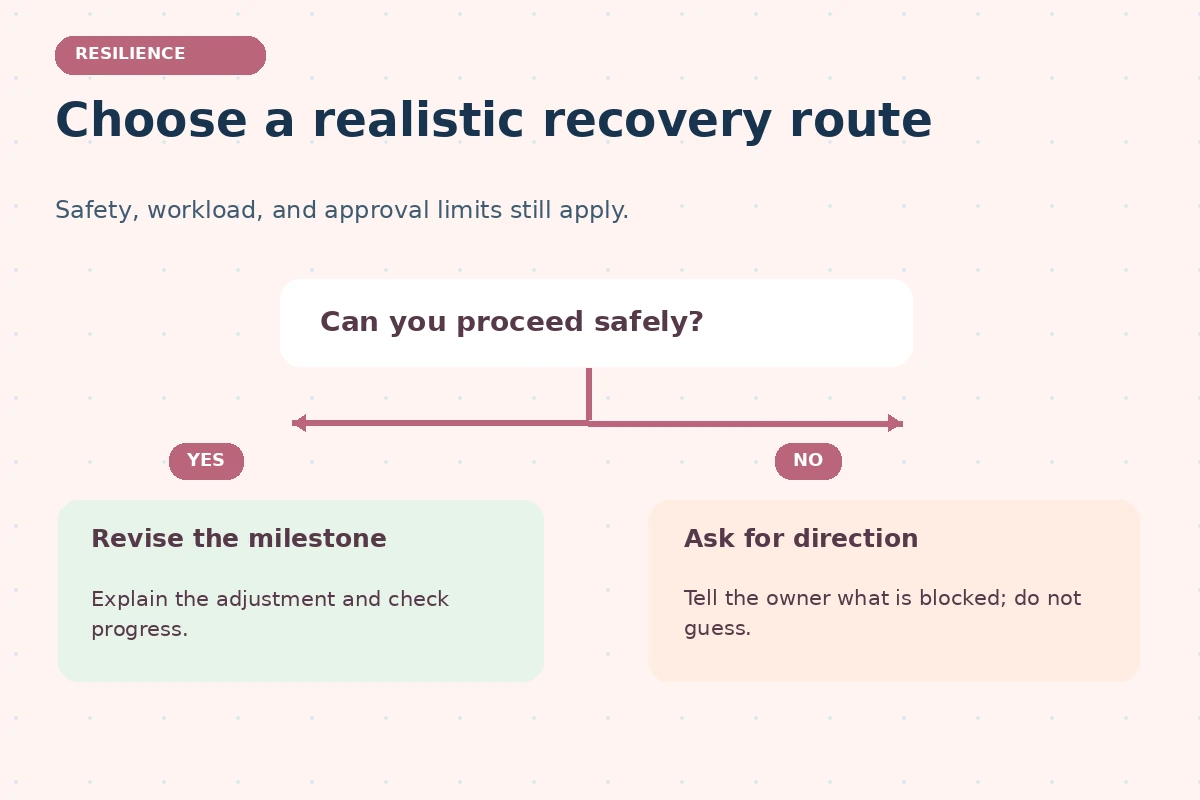
Identify the constraints that mattered: a fixed deadline, limited access, reduced staffing, a changed requirement, or the need to learn a difficult skill. Say which parts were outside your control. Then give your actual next step, such as breaking the task into smaller work, requesting clarification, renegotiating a feasible milestone, or asking someone qualified for help. Describing those choices is evidence of resilience; pretending no support was needed is not.

Build a recovery timeline instead of a hero story
Use four columns for preparation: initial plan, disruption, adjustment, and evidence of progress. Keep the sequence anchored in things that occurred. For instance, a hypothetical volunteer event loses access to a planned room. The organizer checks permitted alternatives, communicates the change to attendees, and uses an approved substitute location. The story does not need a claim that every participant loved the change or that no inconvenience occurred.
What is important is how you assessed the options and made the next step safe. If someone else approved the alternative, state that. If you could only notify the team, that notification may be your valuable contribution. Recovery is often collective, and an interview answer should neither take credit for everyone’s work nor shift blame for a problem you helped create.
Prepare several resilience prompts
Try “Tell me about a project that stalled and what you did next.” Show what blocked progress, how you detected it, and which part you could restart. Another prompt is “Tell me about receiving disappointing results.” Explain how you reviewed feedback, changed your study or work method, and tested whether that adjustment helped. A third asks when you had to persist through a difficult learning curve; show the practice schedule and the help you used.
A tougher version is “Describe a time resilience did not solve the problem.” A credible answer can acknowledge that a deadline changed, a proposal failed, or a project ended. Discuss the sound actions you took, how you communicated the limit, and what you learned. Avoid presenting burnout, unsafe shortcuts, or ignoring qualified advice as admirable persistence. Resilience includes recognizing when escalation or rest is necessary.

Sample answer: revise a difficult assignment
Hypothetical STAR answer: “I was preparing a research presentation, and my first outline did not answer the assigned question [situation]. The presentation date was unchanged, so I needed to correct the scope [task]. I asked the instructor to clarify the research objective, divided the remaining work into source review and slide revision, and shared an updated outline for feedback [action]. The revised outline was accepted for the final presentation [observed result].” The student did not claim an award or invent a score.
A real applicant may have a stronger or weaker outcome. If the revised work was still incomplete, say which part you completed and what was handed off. Explain what changed about your method: perhaps you asked for feedback earlier rather than guessing about the brief. The skill is not “I suffered more than others.” It is “I recognized the obstacle, selected a workable adjustment, and checked the result.”
Talk about support and health responsibly
Interviewers may ask how you manage stress as a related topic, but resilience is not a license to reveal private health information. You can discuss task-management methods, seeking procedural guidance, or using available team resources without sharing a diagnosis or family circumstance. You can also choose a different example if the original setback is too personal or confidential. There is no need to prove that you can work indefinitely without assistance.
When discussing workload, emphasize communication before the problem grows. For example: “I told the coordinator which deliverables were at risk and proposed a revised order for approval.” That is more professional than “I stayed until everything was done regardless of the rules.” It shows that you respected time, safety, and the other people affected by the delay. If your role required someone else to approve a deadline change, name the approval rather than implying you set it yourself.
Test whether the outcome matches the evidence
Look for words like “recovered,” “saved,” “completed,” and “improved.” Do you have a concrete basis for each claim? The final stage may be a submitted revision, a restored schedule, a supervisor-reviewed plan, or a carefully documented handoff. You do not need a numerical performance score to show progress. If you have a reliable measure, explain how it was obtained and what you controlled.
Practice the answer with an interviewer who asks, “What would you do sooner next time?” An effective reply might be to seek clarification earlier, document a dependency, or identify a backup route before a deadline. This makes the learning specific and keeps a resilience answer distinct from generic failure, adaptability, or working-under-pressure pages.
How We Research Behavioral Interview Answers
We reviewed publicly available guidance from U.S. university career teams, university HR interviewing resources, and the U.S. Office of Personnel Management. We used those sources to check which types of questions assess this competency and how structured behavioral questions separate a situation, personal action, and consequences. Example narratives are explicitly hypothetical, not reports from an employer or a promise of selection. This article is informational guidance; the role, workplace rules, and individual experiences will differ.
Sources checked November 13, 2026: www.umass.edu — UMass Amherst HR provides prompts about work setbacks, coping strategies, learning from failure, and persistence., www.umass.edu — UMass Amherst HR also distinguishes stress responses and managing simultaneous deadlines., www.opm.gov — OPM describes structured behavioral questions as requesting context, actions, and consequences rather than unsupported personality claims..
This article offers general U.S. interview-preparation information, not individualized legal, workplace-investigation, medical, or professional advice. Read the JobAsk affiliate disclosure. The links to other JobAsk interview guides are informational; no paid partnership is claimed.
More Interview Preparation Guides
Yes. Choose a real challenge, explain your response, and be clear about the context rather than pretending that the experience was paid employment.
No. Demonstrate sound adjustment, honest communication, and learning. A partial result can be more credible than an invented complete recovery.
You generally can select a job-relevant example that does not require disclosing sensitive personal details. Focus on observable work or learning steps.
Not by itself. Good judgment can include asking for help, adjusting scope, protecting quality, and recognizing safety or workload limits.
Adaptability focuses on responding to changed conditions; resilience emphasizes recovering or continuing constructively after a setback. Some examples show both, but use the angle the question asks.