
A career conversation is for learning, not a formal hiring decision. Use a brief thank-you that acknowledges specific advice, states one next step, and respects the contact. This guide provides a situation-specific decision process, an original hypothetical message, and checks to avoid false claims. An interview thank-you is a courtesy, not a guarantee of a job, referral, or response. Adapt every example to the conversation that actually took place.
Remember the conversation was about learning
An informational interview is a conversation with someone who can explain a profession, not a selection interview for an open job. Your thank-you should recognize the person’s time and the professional perspective they shared, rather than urge them to hire you. Tufts University explicitly frames career conversations as opportunities to learn and warns that a conversation is not the moment to ask for an internship or job. That distinction should carry into the email. Thank the contact for concrete information about their field, work environment, skills, or recommended research steps.
The most valuable detail is often a question you can now answer more clearly. Perhaps your contact explained the difference between a program coordinator and a program analyst, or described how a museum collections assistant begins with inventory records rather than curatorial decisions. Mention one point accurately. Do not restate private workplace stories, disclose names of colleagues without permission, or make the person responsible for finding you a role. A short, thoughtful note makes it easier to maintain a professional connection without placing an obligation on the recipient.
Make a specific advice-to-action connection
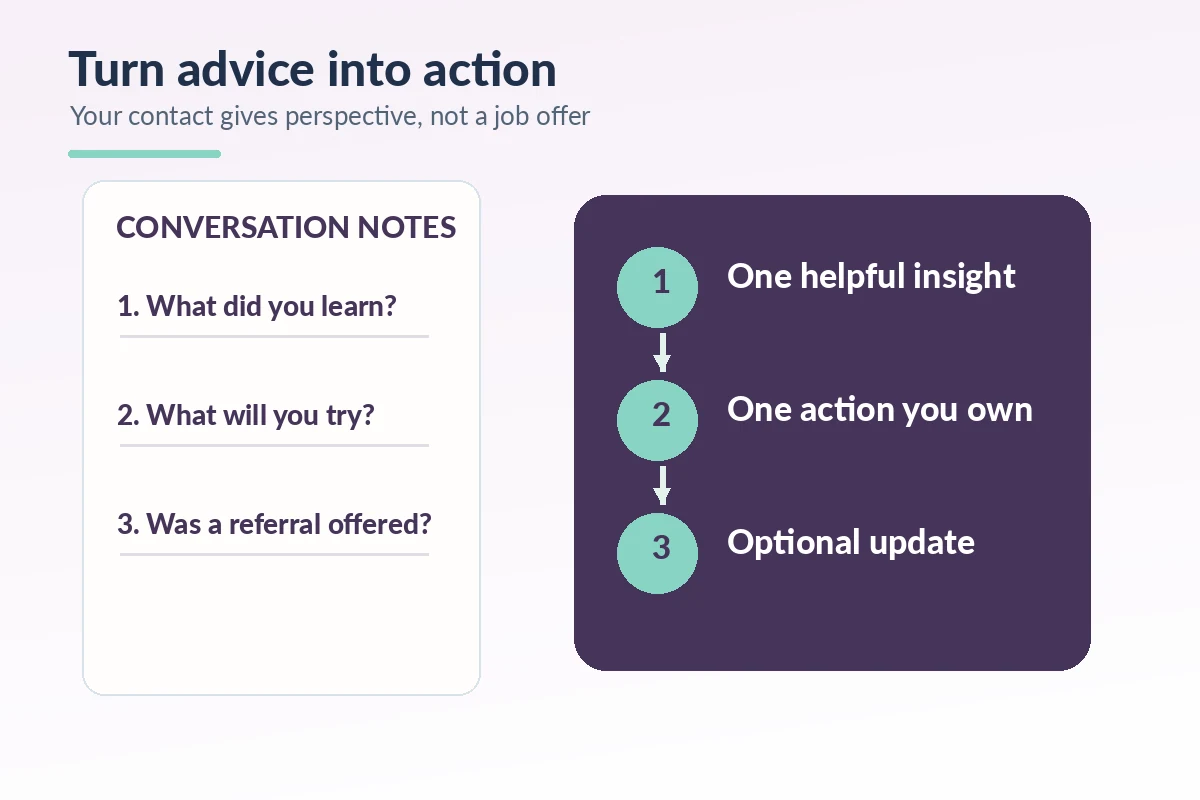
A useful email follows a small sequence: advice heard, why it mattered, and one realistic action you will take. For example: ‘Your suggestion to compare entry-level program support descriptions helped me see where my scheduling work fits. I will review three current postings and adjust the examples on my resume.’ The action should be yours to complete. Avoid grand claims such as ‘Your advice changed my life’ when the conversation was brief, and avoid promising a course, certification, or introduction that you do not intend to pursue.
Sometimes the contact recommended a professional association, a public webinar, or an informational resource. You can thank them for the exact suggestion without implying that it guarantees employment. If you already acted on it, one factual sentence is enough: ‘I reviewed the association’s public career page and found the entry-level job descriptions useful.’ If you have not done so, write ‘I plan to review’ instead. This simple distinction prevents a polished thank-you from becoming a false update about progress you have not made.
Handle introductions and referrals with permission
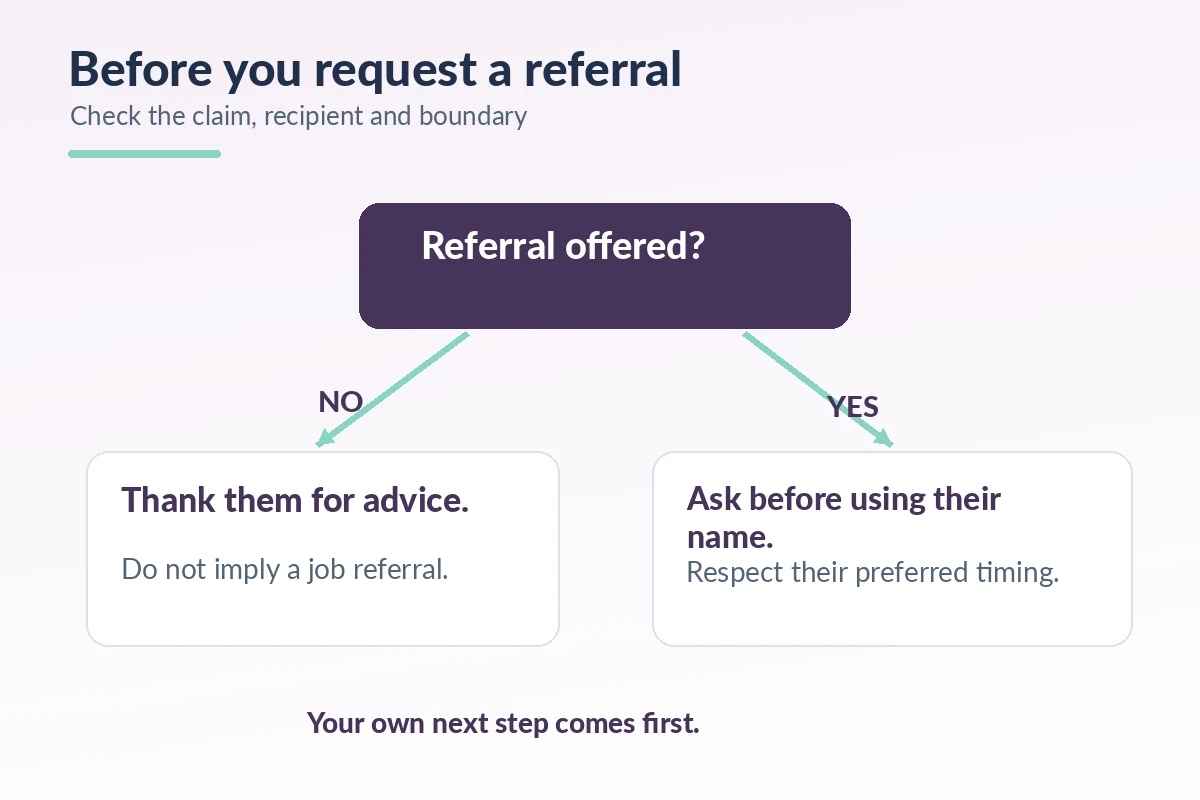
A career conversation may end with ‘You should speak with someone in operations.’ That is a recommendation, not automatically permission to use a person’s name as a referral. Ask before forwarding contact details or claiming they referred you. If the contact offered to introduce you, your thank-you might say, ‘I would appreciate the introduction if it is convenient, and I understand if the timing does not work.’ If they simply named a professional community, investigate its public resources yourself. Avoid attaching the person’s comments to applications or quoting their opinions as employer endorsements.
Do not send a stack of questions in the thank-you note. A follow-up question can be reasonable if it is narrow and easy to answer, but a second interview request should be made separately and with respect for the person’s schedule. If the contact cannot reply, that silence is not necessarily a rejection of you as a person; your next step is to act on what you learned. The exchange should remain useful even if the person never offers a referral, a recommendation, or another meeting.
| Situation or detail | Practical approach |
|---|---|
| Advice received | Mention one accurate insight, not a transcript. |
| Next action | State your own practical step, not a demand. |
| Referral suggested | Ask permission before citing a personal introduction. |
| Future contact | Send occasional relevant updates; respect silence. |
Use an accurate hypothetical appreciation note
Illustrative subject: ‘Thank you for our career conversation.’ Illustrative message: ‘Hello Avery, Thank you for taking time to discuss program operations with me today. I especially appreciated your explanation of the difference between tracking program activities and evaluating outcomes. That distinction helped me identify skills I should build, and I plan to review entry-level coordinator postings before choosing my next course. I appreciated your perspective and hope to keep in touch occasionally. Best, Jordan.’ The contact and conversation are fictional; do not paste this as if it happened to you.
If you received a link or introduction, add a separate factual line only if warranted: ‘Thank you for sharing the public association resource; I will review it this week.’ Do not send a resume unless it was requested. A thank-you to someone outside your organization needs no salary request, employment availability date, or candidate ranking language. The message is about a professional favor and useful knowledge, not a vote in a hiring committee. If the conversation was via video or phone, the same principles apply.

Keep future contact light and reciprocal
Career relationships grow through occasional, relevant updates rather than repeated asks. A later message may be appropriate if you actually completed a step discussed, such as attending a public session or finishing an introductory project. Identify the earlier conversation, give one short update, and avoid requesting a response unless you have a specific reason. If your contact said they could introduce you to someone, wait for that introduction rather than pressuring them daily. Respect a request not to be contacted or a preference for a professional platform instead of email.
Before sending, check that you spelled the person’s name and role correctly, named advice they truly gave, and are not revealing sensitive information from their workplace. In the subject, ‘Thank you for the conversation about supply chain careers’ is clearer than ‘URGENT: Opportunity.’ A thoughtful note says you listened. It does not promise hiring outcomes, count as an application, or create a personal obligation for future advice. If you decide to apply to the person’s employer later, use the published recruiting process.
Final review before you send your note
Read your draft once as the intended recipient would. Check that the name, position, and conversation detail are accurate; remove invented numbers, private information, unrequested attachments, and claims that anyone promised a hiring outcome. Confirm the communication channel is appropriate, and keep the note easy to read on a mobile screen. If the situation is not a formal hiring interview, identify it honestly. A timely, sincere note is useful, but hiring processes vary and a reply is never guaranteed.
How We Research Interview Follow-Up Advice
We compared published university career-center guidance on timing, specificity and message tone with the distinct context covered in this article. UC Davis Career Center. USC Career Center. Tufts Career Center. UVA Career Center. These resources support general communication practices; the fictional examples, decision tools, and role-specific wording are editorial illustrations, not a record of an actual employer discussion. Follow the hiring organization’s instructions when provided. Visit our affiliate disclosure to understand site relationships.
More Interview Preparation Guides
No. Its purpose is to learn about a field or career path, so the thank-you should not ask for a hiring decision.
Only if a referral was specifically offered or you seek permission gently; do not assume their support.
Only if the person asked for it or invited a review; otherwise focus on appreciation and a next step.
A prompt note, often the same day or the following day, is a considerate practice, not a guarantee of future contact.
Thank the person for one specific insight and say you will reflect on it rather than invent a project or commitment.