
Thank an interviewer after a career-change conversation by matching one proven skill to the new job and naming an honest learning need when relevant. This guide provides a situation-specific decision process, an original hypothetical message, and checks to avoid false claims. An interview thank-you is a courtesy, not a guarantee of a job, referral, or response. Adapt every example to the conversation that actually took place.
Name the transferable skill without inventing a past title
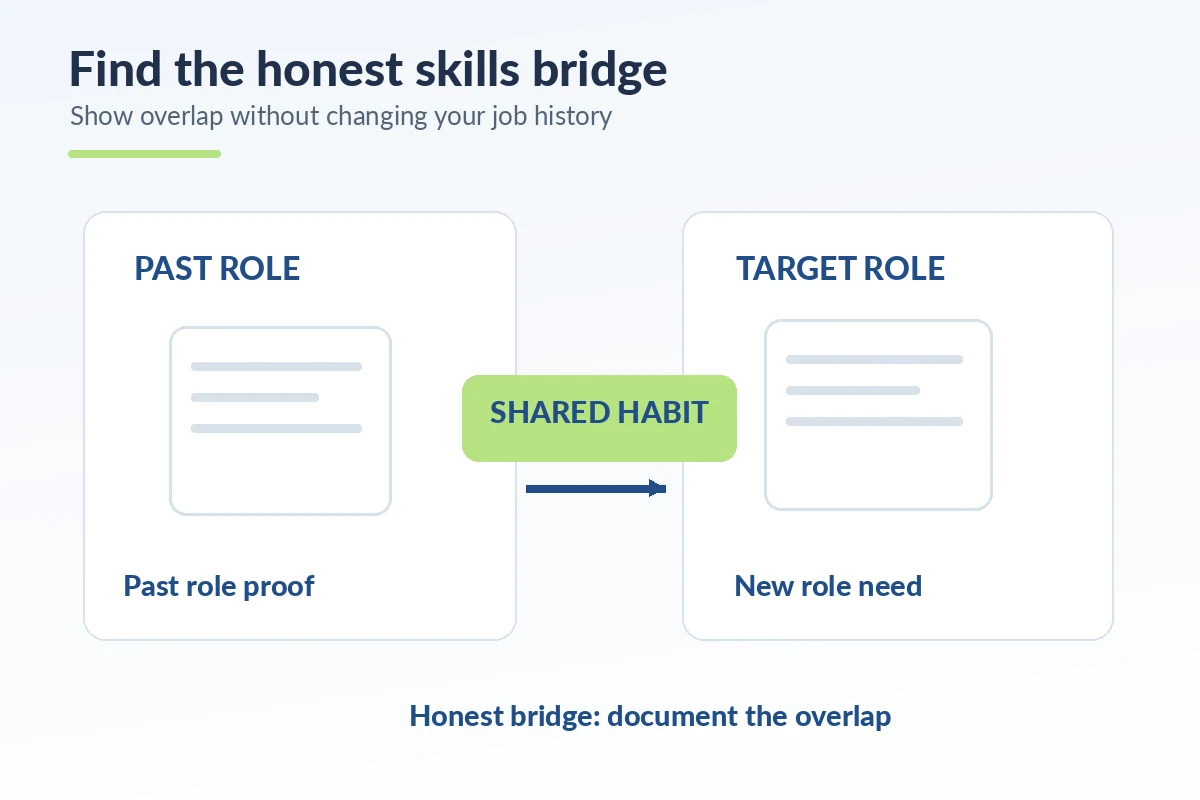
A career-change interview often includes a question about how experience from a different field applies to the new role. Your thank-you email is an opportunity to reinforce one answer with evidence, not to rewrite your entire professional history. Start with the job’s task, then select the closest responsibility you actually performed. A retail supervisor applying to purchasing support might discuss comparing inventory discrepancies, not negotiating supplier contracts if that was outside their role. A hospitality employee applying to office administration might discuss schedules and record handoffs, not claim years of formal office management.
A clear bridge has three parts: the new role’s requirement, the earlier behavior that supports it, and the boundary between the two. For example, ‘Our conversation about accurate ticket routing reminded me of how I categorized guest issues and handed unresolved requests to the responsible team.’ That statement may help with an entry-level help-desk application, but it should not claim you administered networks or resolved complex access problems. Specific overlap is more credible than the idea that every skill transfers directly.
Choose the interview detail worth reinforcing
Review your notes and locate the point at which the interviewer clarified the team’s work. It could be a need for well-documented handoffs, a requirement to learn a new system, or a quality-control process. Mention one accurate detail and say what it taught you about the role. Do not pretend an interview was a career-coaching session if the person simply reviewed job requirements. Your note should demonstrate that you understood those requirements and can assess your readiness. Even if the interviewer asked difficult questions, a short respectful response is better than rearguing every answer.
If a requirement surprised you, distinguish interest from competence. ‘I appreciated learning that the role uses a case-management platform and would welcome the employer’s formal training’ is appropriate if training is available. It would be misleading to say ‘I am already proficient’ when you only saw a screenshot during the interview. If you completed a real project in a similar tool, name the task you performed rather than announcing mastery. The thank-you is a focused follow-up, not an opportunity to add new credentials you have not earned.
Show one concrete example and a truthful learning plan
Use a single short example, ideally one that was discussed in the interview, so the note remains readable. Suppose a former restaurant shift lead is applying for logistics coordinator work. They might mention preparing handoff notes and tracking delivery exceptions, while acknowledging that specialized inventory software would be new. That pairing conveys a relevant habit and an honest learning need. Do not guarantee you can manage a system you have never used, supervise a regulated process, or make licensed decisions without preparation. Focus on procedures, communication, and learning behaviors you can explain.
If the employer requires an external credential before starting, a generic statement about being willing to learn does not satisfy that requirement. Verify the posting and only confirm eligibility you actually have. Similarly, a personal project can be evidence of basic familiarity without counting as paid professional experience. Keep the exact labels: a course is a course, a volunteer task is volunteer work, and an observed workplace procedure is observation. Careful phrasing shows the interviewer that you can represent your experience accurately even when transitioning into a new industry.
| Situation or detail | Practical approach |
|---|---|
| Old-role action | Describe what you truly performed. |
| New-role need | Use the employer’s wording for the job task. |
| Real overlap | Give one concrete comparable behavior. |
| Training gap | Acknowledge what you still need to learn. |
Adapt this illustrative career-change example
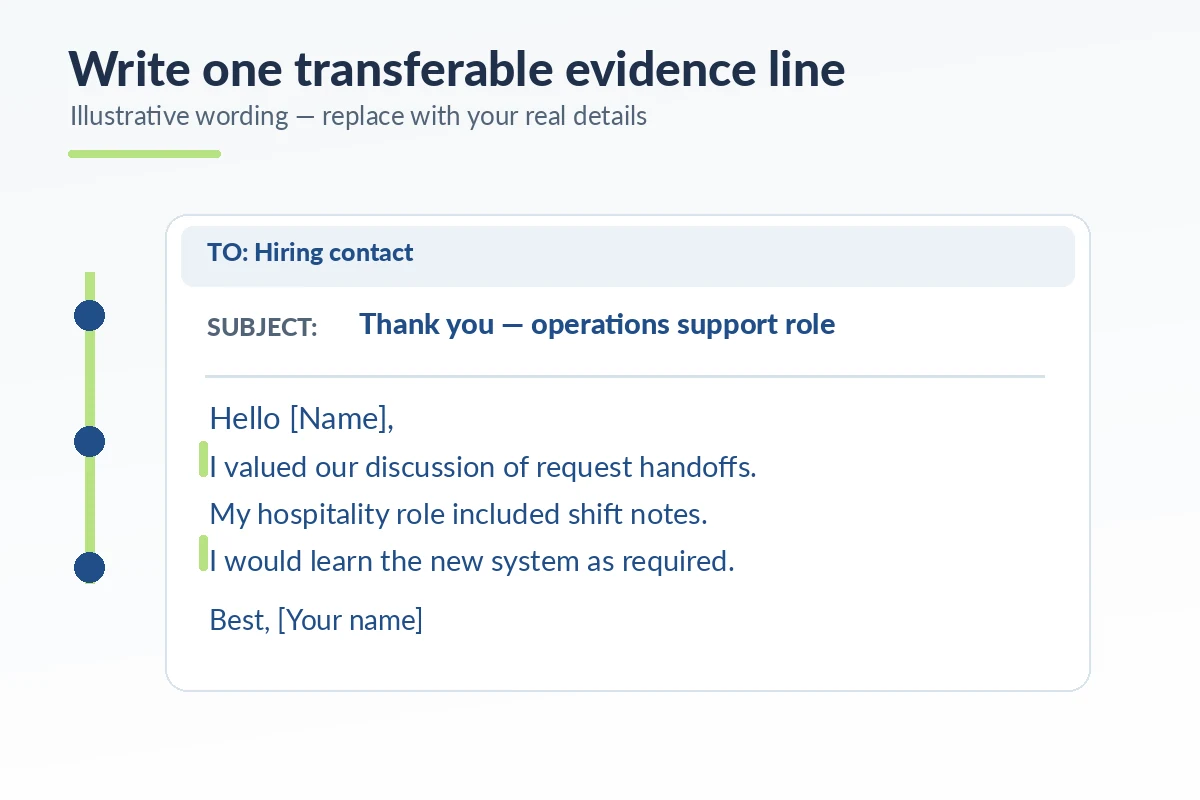
Illustrative subject: ‘Thank you — Operations Support interview.’ Illustrative message: ‘Hello Casey, Thank you for discussing the operations support role with me today. I appreciated learning how your team records requests and escalates exceptions. In my hospitality role, I maintained shift handoff notes and directed unresolved guest issues to the appropriate supervisor, which gave me relevant practice in accurate communication. I would be eager to learn your specific tracking system through the training process you described. Thank you for your time and consideration. Best, Riley.’ The note is fictional and must reflect your real background.
The example avoids presenting hospitality experience as identical to enterprise operations work. It also avoids an unsupported promise that training will be provided unless that was actually discussed. If the interviewer did not mention training, remove that phrase and simply express interest in learning more about required tools. If you had a specific skills gap brought up in the conversation, you might briefly refer to a verified course already underway, including its actual status. Do not send screenshots of personal training records or proprietary projects unless the employer specifically requested them through a trusted channel.
Follow up after the thank-you without overexplaining
A short note within the next day is a useful convention. Keep the subject recognizable: ‘Thank you — Operations Support interview.’ Use a professional greeting, two to four substantive sentences, and a closing. Do not add a lengthy defense of why you are switching careers or apologize repeatedly for missing a preferred qualification. The interview already provided context; the email should clarify rather than restart the assessment. A concise, confident note can acknowledge an authentic gap without promising instant expertise or implying that your previous field was unimportant.
After the thank-you, respect the employer’s stated decision window. If a next-step assignment was requested, complete it through the correct channel as a separate task; do not bury it in your note. If you decide the requirements are incompatible with your current qualifications, you can still send a brief courteous thank-you without stating unconditional interest. Retain your own notes about role expectations for later decisions. Career change is a process of evidence and learning, not a single persuasive email, and no wording guarantees an invitation or an offer.

Final review before you send your note
Read your draft once as the intended recipient would. Check that the name, position, and conversation detail are accurate; remove invented numbers, private information, unrequested attachments, and claims that anyone promised a hiring outcome. Confirm the communication channel is appropriate, and keep the note easy to read on a mobile screen. If the situation is not a formal hiring interview, identify it honestly. A timely, sincere note is useful, but hiring processes vary and a reply is never guaranteed.
How We Research Interview Follow-Up Advice
We compared published university career-center guidance on timing, specificity and message tone with the distinct context covered in this article. UC Davis Career Center. USC Career Center. UCSF Career Development. These resources support general communication practices; the fictional examples, decision tools, and role-specific wording are editorial illustrations, not a record of an actual employer discussion. Follow the hiring organization’s instructions when provided. Visit our affiliate disclosure to understand site relationships.
More Interview Preparation Guides
No. Explain the specific transferable value you bring and represent any training gaps accurately.
Only if the tasks truly correspond. Similar work is not automatically the same credential or formal job experience.
Acknowledge it briefly and name a real learning step, but do not claim proficiency before you have it.
Only when requested or clearly relevant and permitted; do not share proprietary or confidential material.
Keep it short and tailored, usually a few meaningful sentences instead of a second cover letter.