
An internal informational interview is a short conversation with a colleague from another department to learn about the work, not a request to transfer or a replacement for your employer’s application process. Before you message anyone, define the decision you are researching: the pace of the team, its tools, its customer handoffs, or the skills that distinguish an entry-level role. Ask for a brief discussion and make it easy to decline. Do not assume a friendly colleague can promise you a vacancy.
Internal conversations can be more sensitive than external networking because both people are employed by the same organization. You may know the company’s language but not the other team’s approval chain, workload or rules for requesting transfers. Read internal careers and mobility guidance if available, and ask HR where the official requirements live. An informal conversation should produce better questions and a realistic learning plan; it should not be treated as an endorsed job offer or permission to access another team’s files.
Decide What You Actually Need to Learn
Start by distinguishing an appealing title from the actual activities. If you work in customer support and are curious about business operations, perhaps you want to learn how requests become reports, who resolves missing data, and what deadlines drive each week. Write down two examples of work you already do and two skills you lack. That lets you ask about the gap instead of using the meeting to recite your resume. Do not invent internal accomplishments to make the case stronger.
Choose a person whose responsibilities match your question, rather than the most senior leader you can reach. A colleague who handles a workflow every day may explain handoffs more accurately than someone who oversees several teams. You can begin with an employee network or team introduction; verify that contacting the person is appropriate under local policy. If your employer expects manager notification before shadowing, distinguish a conversation from shadowing and follow those rules.
| Conversation topic | Useful question | Appropriate takeaway |
|---|---|---|
| Team workflow | What enters and leaves the team? | Generic handoff, not private records |
| Skill gap | Which tools and judgments matter? | One safe practice task |
| Mobility policy | Who explains formal transfer rules? | Official HR policy or posting |
| Boundaries | What cannot be shared? | No confidential files or hiring details |

Ask Questions About the Team’s Normal Work
Ask: “What work usually arrives at the start of your day, and how do you know it is complete?” Then follow with “Which decisions can someone in this role make, and which go to a lead?” If the team uses dashboards, ask what types of questions the metrics answer, not for private customer numbers. The aim is to see an actual decision process: intake, review, action and handoff. Avoid asking for performance rankings of current employees.
A useful question about cross-team work is: “Which request from my department helps your team, and which kind usually causes a rework?” Listen for a specific, actionable lesson such as clearer ticket notes or confirmed definitions. Also ask what training was useful before the colleague entered the team. One person’s story is not an official credential checklist, so check any formal eligibility, education or experience requirements with HR before making a career plan.
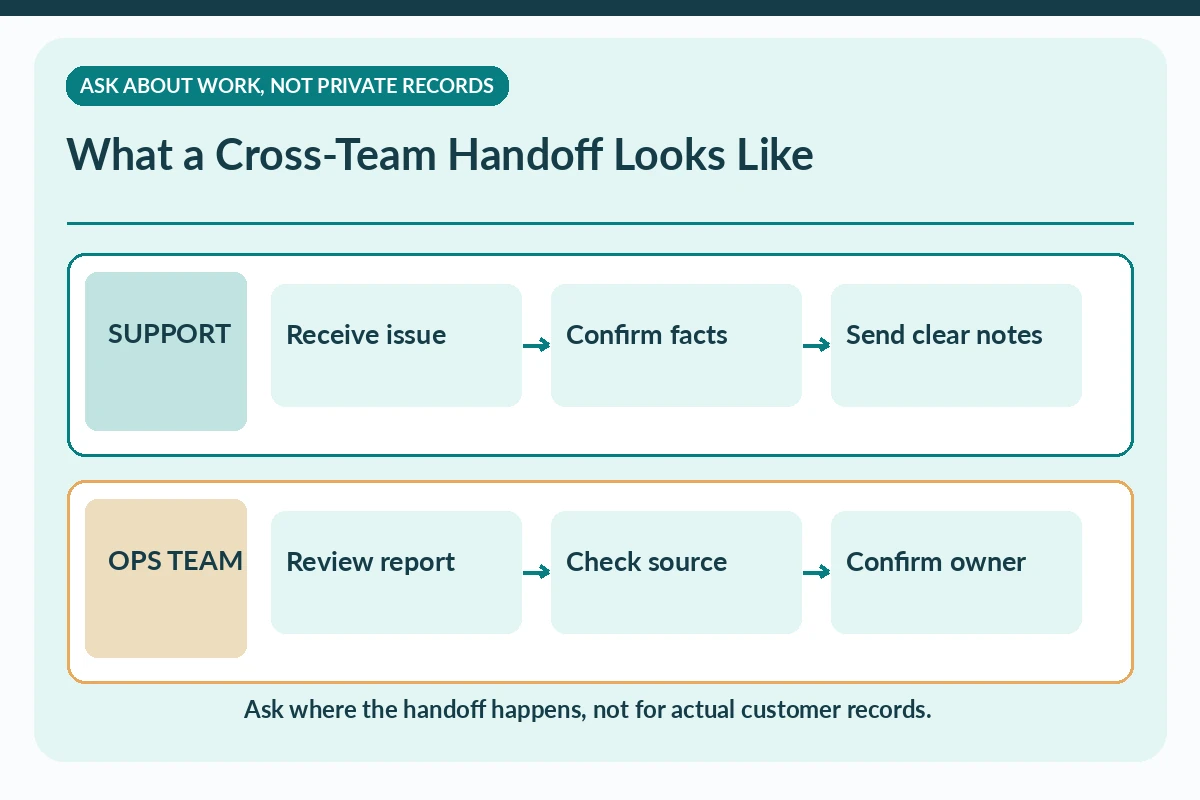
Respect Internal Confidentiality and Hiring Rules
Do not ask a colleague for confidential roadmaps, customer lists, employee evaluations, selection-panel discussions, or preannounced openings. They may be willing to describe the generic workflow while being unable to share examples from live accounts. If a sample would help, request an approved or hypothetical example. Avoid recording the meeting or circulating notes that identify customers or coworkers without permission. Respecting this line makes the conversation safer for both people.
Ask about the transfer procedure rather than inviting the contact to bypass it: “Where can I read the formal internal application requirements, and who can explain any manager-notification rule?” The colleague may not know, and it is fine to leave that question for HR. Do not imply that the informational interview creates priority, waives tenure requirements or guarantees that your supervisor will approve a move. A conversation and a personnel decision have different owners.
Use a Clear Request and a Short Meeting
Illustrative message, not an actual correspondence: Illustrative message: “Hi [Name], I’m exploring how [team] handles [specific work]. I noticed your role involves that process and would appreciate 15–20 minutes to learn what a typical week looks like. I am looking for career information, not asking for a transfer or confidential materials. If your schedule does not allow it, I completely understand. Thank you, [Name].” Use a real connection only if it exists; do not pretend someone referred you.
Open the meeting with one sentence of context, one question about work, and a time check. If the person has 15 minutes, make the final few minutes about skills and next steps. Take short notes about public or shareable concepts. For example, record “monthly reporting requires careful source reconciliation,” not a screenshot of someone else’s dashboard. Thank the colleague afterward without asking them to sponsor an internal application unless they themselves offer a formal appropriate route.
Translate the Conversation Into a Small Skill Test
Turn advice into a small, permission-safe task. If the colleague says clear problem statements matter, practice summarizing a fictional ticket into issue, evidence, decision and owner. If they mention spreadsheet quality, work with a made-up dataset rather than copying real company information into a personal portfolio. One learning project can tell you more about your fit than a pile of new job titles. Be candid about what you practiced and where feedback came from.
Compare your notes with the official internal posting, not with an imagined fast promotion path. A conversation may suggest useful courses, but it cannot certify that training will qualify you for a job. Check whether the employer posts openings, requires an application through its HR portal, or has restrictions on team transfers. If you later decide to apply, follow that process openly and distinguish your exploratory meeting from an official referral.

Make a Decision Without Assuming Approval
Afterward, summarize three facts you learned, two uncertainties and one action you can complete without special access. For example: “The target role prepares exception summaries; I need more practice with spreadsheet validation; I will review publicly available exercises.” Mark statements that reflect one employee’s perspective, not confirmed company rules. Ask a second person when different teams use the same job title for substantially different duties.
If the role seems attractive, do not rush into an implied commitment. Clarify schedule, reporting relationships, mobility policy and application criteria through official channels. If the work does not fit, you still gained insight into better handoffs with a neighboring team. The best outcome of an internal informational interview is a clearer, defensible career choice—not a whispered promise that the position is yours.
How We Research Informational Interview Guidance
Sources checked on 2026-11-15: career.utdallas.edu (Career networking and informational-interview questions, listening, and follow-up.); www.shrm.org (Informational conversations are career exploration rather than promises of roles or referrals.); careers.usc.edu (Brief, specific outreach explaining how a contact was found and what the seeker hopes to learn.). These sources support general career-conversation practices or occupational facts, not promises about any individual employer, recruiter, legal practice or business. Every proposed conversation and example is hypothetical. No relationship with an interviewer or service provider is claimed. Review Affiliate Disclosure.
Related Job Search Guides
Follow your company’s policy. A short conversation may be treated differently from job shadowing or a transfer application. If the rules are unclear, ask HR rather than guessing.
They should follow their employer’s information rules. Ask about role requirements and published internal opportunities instead of requesting confidential staffing plans.
You can keep a short summary of your background ready, but this meeting is for learning. Offer a resume only if the context and company process make that appropriate.
No. It does not grant transfer eligibility, hiring priority, manager approval, or a formal referral.
Identify a safe skill-building task, read the posted qualifications, and check the formal mobility process before applying.