
Use the job title you genuinely held on your resume, then explain the work in plain language when the internal title is unfamiliar. You can add an accurate functional descriptor in parentheses without presenting yourself as promoted into a different job. An official “Customer Operations Associate” who handled scheduling, for example, might write “Customer Operations Associate (appointment scheduling)” if the description is true. The descriptor aids interpretation; it is not an invented title.
Separate formal job titles from useful descriptions
An HR record, offer letter, position description, or supervisor confirmation may establish the official title of a role. The public job market may use other language for similar tasks. “Client Experience Partner,” “Operations Specialist,” and “Office Services Associate” can cover different work at different employers. You should not assume that a familiar market title is equivalent to your actual job or authorization level. Start with the formal title, then identify the most relevant function through your bullets.
Suppose a fictional person was a “Service Enablement Associate” whose day involved responding to support tickets, drafting help articles, and routing technical problems. For a help desk application, an honest entry could be “Service Enablement Associate — user support and ticket routing.” It should not become “IT Support Engineer” if the person did not troubleshoot systems at that level. Specific duties and tools are more useful than a title upgrade.
Choose one of three transparent title formats
The simplest is “Official Title — Employer | Dates” with clear bullet points. If the title is opaque, add a short truthful functional note: “Operations Associate (inventory reporting)”. If you had a formally recognized dual role, use both titles with appropriate dates or a combined title that the employer actually used. These approaches preserve a traceable record without assuming how a particular applicant tracking system handles parentheses or slashes.
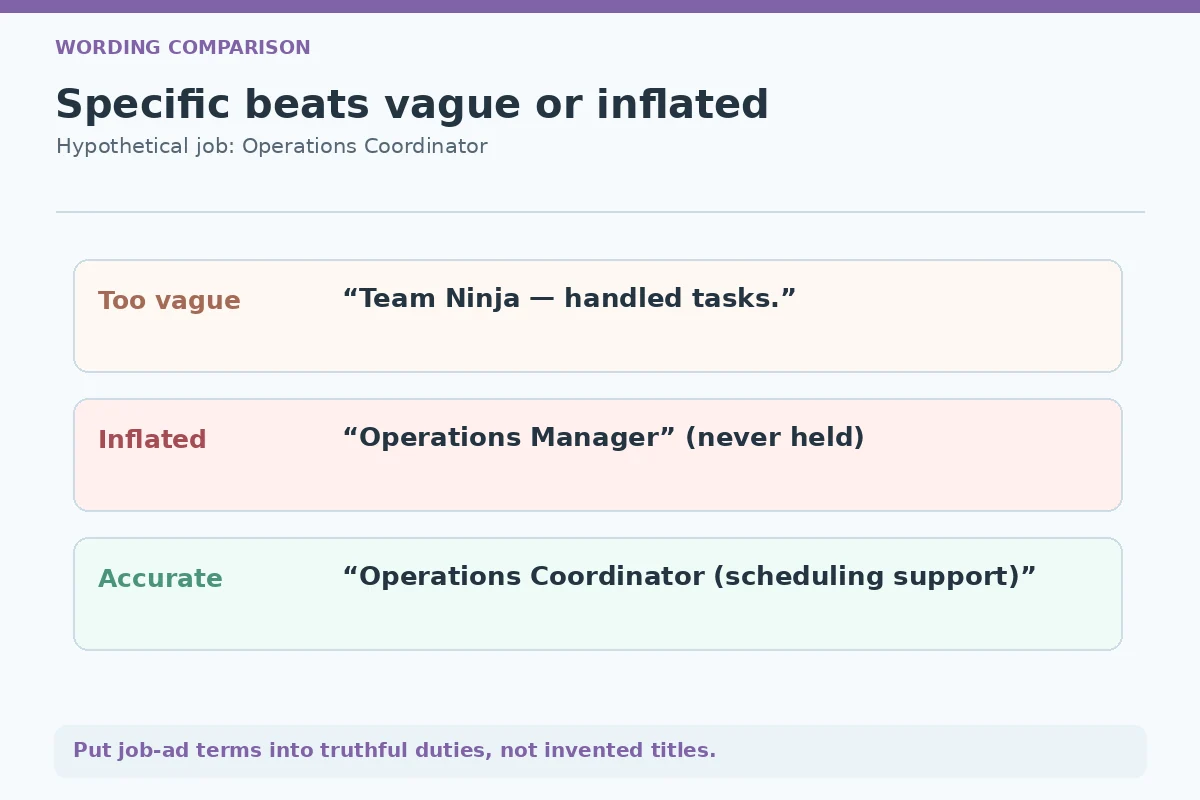
A before-and-after pair illustrates the distinction. Too vague: “Team Ninja — handled tasks.” Misleading: “Operations Manager” when the company classified you as a coordinator. More defensible: “Operations Coordinator (schedule and vendor follow-up) — maintained appointment records and escalated conflicting assignments.” All employer names and roles in these examples are hypothetical. A hiring manager can assess the work without a fabricated rank or grandiose phrase.

Match job-ad language through facts, not title replacement
Read the target job advertisement for tasks and required skills. If a requirement matches your genuine work, use the same ordinary term in a bullet or skills section. A posting may say “customer case tracking” where your company called it “queue coordination”. You can explain both if your work involved tracking customer requests. Do not copy a title or claim a license, certification, direct report, budget, or approval authority that you never had.
For instance, “Tracked inbound cases in a shared queue and prepared an exception handoff” may be a useful line for a service operations application. It tells the reader what the person did. “Owned the entire service desk” would be inaccurate if the applicant only staffed one queue. Harvard recommends specific, fact-based resume language. CareerOneStop likewise emphasizes the context of actual duties and outcomes over empty generalities.
Show title changes without rewriting past years
If the company renamed your job classification but responsibilities remained largely similar, you may state the official title at the time and annotate the later name where helpful. If your responsibility changed materially as well, separate the jobs by their true dates. A role that was “Office Clerk” until May and “Administrative Coordinator” from June should not appear under the latter title for the entire period unless that is how the employer formally documented it.
Temporary acting appointments require an especially careful boundary. Use “Acting” only where it was a real designation, and do not imply that a short period supervising scheduling gave you permanent personnel-management authority. Likewise, an employee might have served as a subject-matter contact without being the department lead. Show the work in bullets, not an unearned title.
Adapt to applications that request exact titles
A resume is a targeted summary, but some forms request complete work histories and formally recorded titles. Fill in those fields with accurate details. USAJOBS guidance currently asks applicants to list job title, employer, dates, and, for relevant experience, hours per week; federal applicants should read the particular announcement as well. Never place only a marketing-style title in a field that explicitly asks for your official designation. Use a separate duty-description field to explain equivalent functions.
If a title was genuinely ambiguous, ask a former supervisor or review the original documentation. You can still describe the job in plain language even if the internal name was confusing. Do not assert that adding market keywords guarantees passing an ATS; software and employer review practices vary. Write for the person assessing competence and preserve a reliable record for later verification.
Test whether the entry conveys scope accurately
Read the entry aloud as though a stranger were checking your qualifications. Could they identify the employer? Do they see the actual title and dates? Are the responsibility level, tools, systems, and approval boundaries clear? Could a former colleague agree that the description is fair? If one answer is no, revise the examples or add a functional phrase. Another helpful review is to compare the resume against your own HR records and application form before submitting.
Do not include confidential department names or customer information solely to prove your title was specialist-level. Your skills can be explained through ordinary workflow nouns, such as “appointment scheduling,” “invoice coding support,” or “ticket triage under supervision.” If a descriptive title still sounds misleading, drop it and use a direct duty sentence. A plain, accurate title is stronger than a flashy synonym that cannot be defended.

How We Research Accurate Resume Titles
Our method compares CareerOneStop’s work-experience and formatting guides with Harvard’s evidence-based resume tips and current USAJOBS instructions for titles and employer records. These sources support truthful, readable descriptions and clear matching to job requirements, but do not prescribe a single universal label for every company’s internal roles. Read CareerOneStop, Harvard, and USAJOBS. Fictional examples demonstrate formatting only. For site relationships, see affiliate disclosure.
More Resume and Cover Letter Guides
Be careful. Keep the formal title as the reliable anchor, then add a truthful functional descriptor or use bullets to explain what you did.
Not unless manager was genuinely your role. Training or supporting coworkers can be useful evidence without a managerial title.
Use accurate words from the posting in task and skill descriptions where they reflect what you actually did. Do not copy seniority, credentials, or approval authority you lacked.
Show the real titles and dates, or use a short note explaining a verified classification change. Avoid applying the later title retroactively.
Follow the exact announcement and give accurate job title and employer details. Explain equivalent functions in the description rather than using a promotional label in a formal field.