
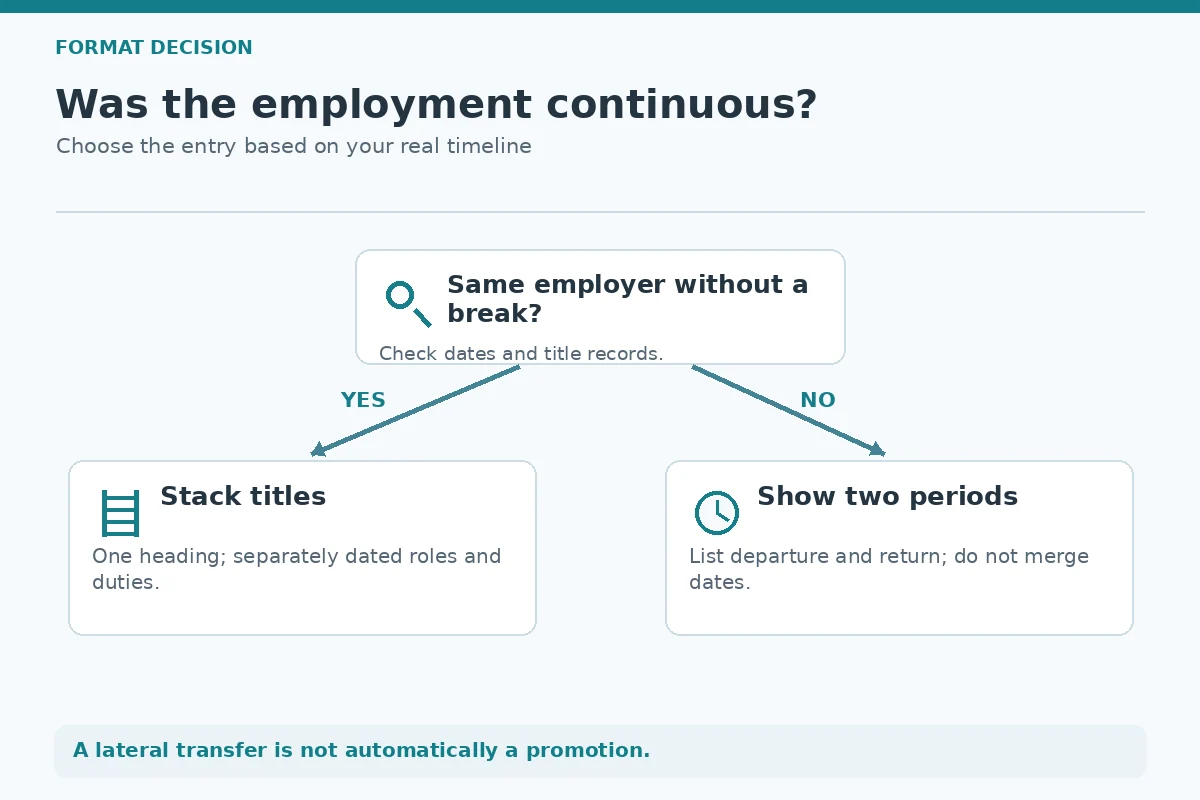
If you held two or more jobs at the same employer, use one employer heading with separate, dated role lines when the employment was continuous. Give each position its accurate title and its own relevant evidence; a promotion is a change in scope, not simply an extra adjective in a summary. Split the employer into separate entries only when a break in employment or a substantially different role makes that clearer. These are editorial formatting choices, not rules imposed by every employer or tracking system.
Decide whether the roles belong under one employer
Start with the employment record rather than the page layout. Write the exact employer name, the date you first joined, the dates of each role, and whether the move was a promotion, lateral transfer, temporary assignment, or return after leaving. Those distinctions affect the wording. If you have remained employed continuously, a single employer heading can reduce repetition while keeping the role history visible. When a former colleague sees the resume, the sequence should match what actually happened.
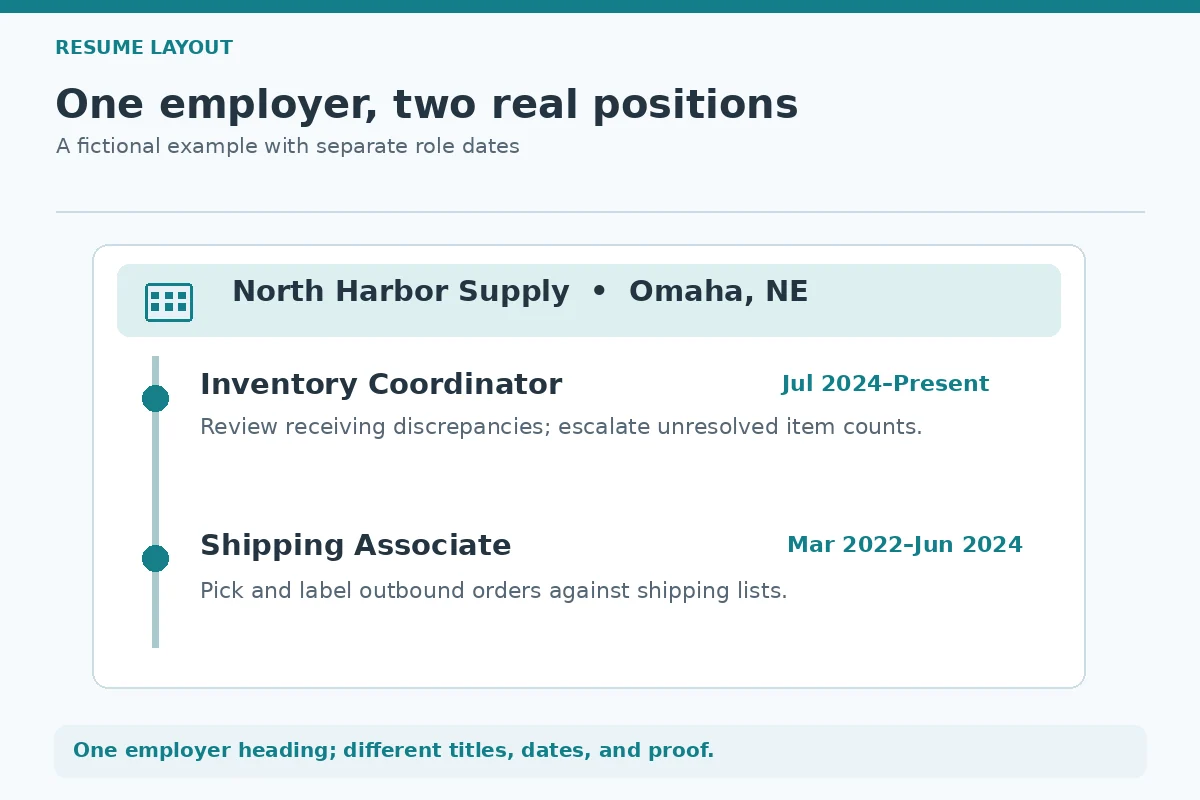
Suppose an invented applicant worked at a small distribution company as a Shipping Associate from March 2022 through June 2024, then as Inventory Coordinator from July 2024 to the present. Under one employer heading, place Inventory Coordinator first and Shipping Associate second. Give the recent role more detail if that role is closer to the vacancy. Do not write “Manager” merely because you sometimes showed a new coworker how to scan packages; training is useful evidence but not proof of a management title.
Use stacked role lines to keep the timeline visible
A practical stacked layout begins with the real employer and location, followed by the latest title and dates, then its bullet points, followed by earlier titles and their dates. Another acceptable layout repeats the employer for each role when an online form requires separate job records. Both can be truthful. CareerOneStop recommends clear work history with title, organization, dates, duties, and accomplishments, and Harvard recommends reverse chronological ordering within sections. A reader should be able to see the change without decoding a decorative timeline.
Hypothetical resume entry: “North Harbor Supply — Omaha, NE | Inventory Coordinator, July 2024–Present; Shipping Associate, March 2022–June 2024.” Under the coordinator role, a relevant bullet might read, “Reviewed receiving discrepancies and escalated unresolved item counts to the inventory lead.” Under the earlier associate role: “Picked and labeled outbound orders against approved shipping lists.” Each sentence identifies a task and boundary, not an invented percentage. If you have verifiable volumes or improvements, add them only after checking records and permission.
Distinguish a promotion from a change in assignment
A true promotion may expand decision rights, complexity, supervision, or accountability. A lateral transfer may develop valuable skills but is not automatically a promotion. An acting title requires a time boundary and language such as “Acting Team Lead” only if that was an actual assignment; it should not silently become “Team Lead” for an entire year. A department move can be displayed as “Customer Support Specialist — Billing Team” if that was the genuine job and team, with no suggestion that you were appointed a supervisor.
Before claiming advancement, gather the role-change email, HR record, job description, supervisor feedback, or a reliable personal timeline. These are for your private fact-checking, not documents to attach to a public resume. If the date of a transfer is uncertain, check a record or use an honest month/year range rather than making up a precise day. External application forms may require a different level of detail than the resume; complete the form as directed.
Write different bullets for each stage of the work
One common failure is copying the same three bullets under every role. That suggests the title changed but the work did not, even when the applicant really did take on different responsibilities. For the earlier role, show foundation skills: systems used, service interactions, documentation, handoffs, or problem recognition. For the later role, show the newer level: independent decisions you actually made, new audiences, quality checks, coaching, or project responsibility. Do not ascribe team-wide outcomes to yourself without knowing your specific contribution.
Here is another hypothetical contrast. Before: “Promoted twice for excellent work.” After: “Service Coordinator, May 2025–Present: scheduled technician visits and flagged conflicting appointments for supervisor approval; Service Assistant, August 2023–April 2025: logged customer requests and maintained appointment records.” The second version allows a recruiter to infer development from evidence. If you want to mention formal promotion, put a simple “Promoted to Service Coordinator in May 2025” line only when it is accurate.

Handle return employment and overlapping dates correctly
If you left the employer for another company and later returned, show two distinct periods even when the employer name is identical. Do not merge the gap into one continuous range. A short second stint, a part-time role overlapping a full-time job, and a seasonal return may all be legitimate, but a recruiter should not have to guess whether two dates mean concurrent work or a typographical error. Where the application asks for hours per week, report each period truthfully.
When a move occurred mid-month, some months may appear at the boundary of both roles, depending on the date format. That does not by itself mean you held two jobs for a full month. Keep your private detail sheet with actual dates so you can explain any transition. Do not add unrelated precise figures simply to make the resume look more technical.
Choose the relevance level for older positions
If the vacancy closely matches the newest role, use more space for its strongest work and summarize prior positions in one or two bullets. If an older role demonstrates a required skill that the newer role does not, retain a specific bullet for it. If you have three or four historical titles at one employer, compress the oldest without hiding the titles or falsifying dates. Avoid an arbitrary bullet count; clarity and useful evidence matter more than symmetry.
A review pass should answer three questions: Can the reader identify the employer once? Can the reader tell exactly when each role happened? Can the reader distinguish what you did at each level? If any answer is no, reformat the entry. Check that the title and dates agree with your application form and professional profile. Do not change the history merely to match a target job’s title.
How We Research Multiple Roles on a Resume
We compared the U.S. Department of Labor’s CareerOneStop work-history and formatting guidance with Harvard’s resume guidance and a practical promotion-format explanation from Indeed. They support clear employer/title/date information, reverse chronology, and truthful experience descriptions; they do not mandate one universally accepted stacked layout. Read CareerOneStop work experience, Harvard resume guide, and promotion layouts. Examples are invented for instruction, not a real applicant’s record. For site relationships, see our affiliate disclosure.
More Resume and Cover Letter Guides
Not necessarily. For continuous employment, one employer heading with separately dated titles can work well; separate entries can also be clearer for substantially different duties or required application fields.
No. Give each title the dates when you actually held it. A title that started in 2025 should not imply you were doing that role in 2022.
List the correct new title and duties, but do not label a lateral move a promotion. Show the additional skills or responsibilities you genuinely developed.
Use the formal acting title and the actual period only if you were genuinely assigned that designation. Otherwise explain coaching or scheduling tasks under your real title.
Use separate employment periods so the absence is not disguised as continuous service. Keep the dates consistent with the official application form.