
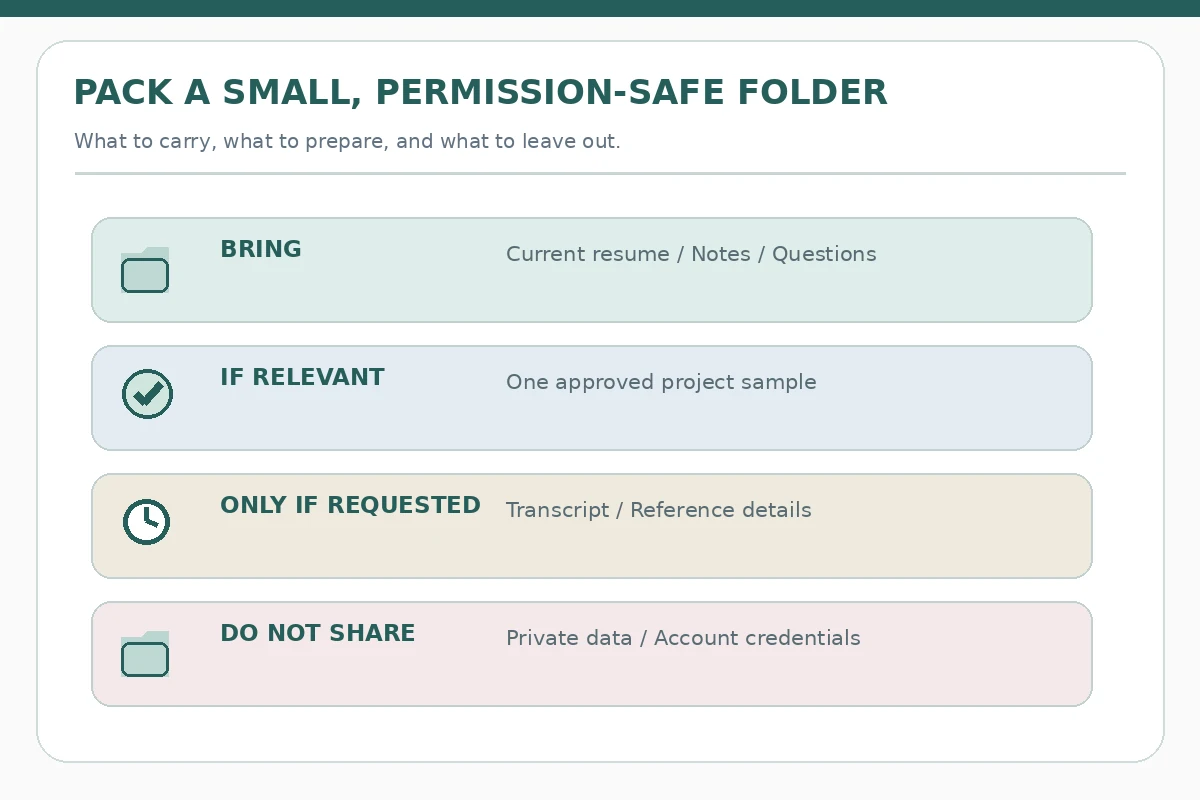
For an internship interview, bring what helps you explain your actual readiness: a current resume, the invitation details, a short list of questions, and one or two relevant projects or work samples you are permitted to share. For an in-person meeting, paper resume copies and a notebook are practical; for a virtual one, keep the same information in an organized local folder. Only bring transcripts, references, identification or other supporting documents if the employer asks through a verified process.
Internships are learning roles, and proof may come from coursework, a club, volunteering or a personal project. University of Minnesota career guidance recommends updated resumes and work samples when relevant. Your task is to show what you personally contributed, not to turn a group assignment into paid client work or expose student, customer, or employer data. A small evidence kit is easier to use well than an oversized portfolio.
Pack the Essentials Before Choosing Extras
Start with the interview confirmation, location or joining link, coordinator’s contact method, and a copy of the job posting. Keep your resume current and consistent with the submitted application. In person, bring a few clean copies, a pen, and a slim notebook or folder; a device can be a backup but should not become a distraction. For video, place these items within easy reach and silence unrelated notifications.
Prepare three thoughtful questions about actual internship duties, supervision, feedback and schedule. If the interview email requests a writing sample or transcript, check the exact requested format and deadline. Do not assume every internship requires academic records or letters from referees. When an organization needs an official transcript or sensitive identity document, follow its authorized instructions rather than forwarding the file casually to an unfamiliar email address.
Select One Project That Answers the Posted Role
Read the posting for the main tasks and skills. For a marketing internship, a publicly shareable content plan might illustrate audience research; for a data internship, a small project using public or synthetic data could show methods and limitations; for design, one clear mock-up may work better than a folder of unfinished images. Choose the project you can explain in a minute, including the question, your contribution, tools, checks, and outcome.
A class project must be labeled as class work. A personal experiment is not client delivery. A group assignment can be included if you clearly identify which section, code, analysis or design you performed. If you cannot explain a detail because another teammate handled it, say so. Internship interviewers may be evaluating learning potential; a clear account of what you tried and learned is more credible than a polished-looking project with false ownership.

Get Permission Before Showing Any Restricted Material
Exclude classmates’ personal records, unpublished employer work, confidential customer information, student data, private research interviews and account credentials. Merely removing names may not make a dataset safe to share; combinations of details may still identify people. If you are unsure whether a sample may leave an organization or course system, ask the owner or supervisor and use a recreated example with synthetic information instead.
Do not screen-share an entire desktop containing private files. For a virtual interview, pre-open only approved documents, check that links work in a signed-out browser if public access is intended, and close unrelated windows. For a printed portfolio, use copies rather than original documents. The University of Minnesota portfolio guide suggests using relevant pieces selectively rather than trying to display everything in one interview.
| Material | Use it when | Privacy or approval check |
|---|---|---|
| Resume and questions | Nearly any interview | No unnecessary personal data |
| Project or portfolio | Relevant and requested or welcomed | Own work; permission granted |
| Transcript or ID | Explicit verified request | Use official secure process |
Use Samples as Evidence, Not as the Interview Script
When an interviewer asks about a challenge, explain the situation, your specific task, what you did, and what the output taught you. Then ask, “Would a brief example be useful?” before opening a file or handing over a portfolio page. That gives the interviewer a choice and keeps the discussion on the role. An illustration with one annotated line is often more effective than turning the conversation into an unrequested slideshow.
Keep a backup: a short verbal explanation should still make sense if the Wi-Fi fails, the laptop cannot connect, or the interviewer has no time to see the sample. Do not leave behind original documents or expensive prototypes. Offer an authorized public link or a copy only when it is genuinely appropriate. The point is to add evidence to an answer, not to overwhelm or pressure the reviewer.

Check the Interview Type and Requested Credentials
An on-campus internship conversation may need little more than a resume, a class schedule and two relevant questions. A lab, clinical, public sector or other regulated internship may have separate documented eligibility requirements and a formal verification stage. Do not guess which forms are required or hand over sensitive documents before a legitimate request. Review the official vacancy and ask the recruiting contact what to bring.
If you are attending a career fair rather than a scheduled interview, a concise resume and a short introduction may be more useful than a full portfolio. If the recruiter arranges an assessment, confirm whether calculators, software, internet access or materials are allowed. This avoids giving yourself an unfair advantage or accidentally breaking test rules. The packing checklist should change with the actual interview format.
One Safe Portfolio Page for a Student Analyst
Imagine a hypothetical student interviewing for a data internship. They bring their current resume, the job posting, and one page explaining a course project completed with a publicly available dataset. The page shows a question, a simple data-cleaning step, a chart and a brief note about limitations. It states the student’s own tasks and credits the group for the shared report. No private participant records or employer data are included.
The interviewer asks about a missing value. The student answers from their actual project notes and offers to show the page; the interviewer agrees. When the meeting ends, the student keeps the original project materials and provides a public link only if asked. The example demonstrates why a small permission-safe portfolio helps an honest discussion. It is fictional and is not a claim that every internship interviewer wants printed work or that this approach guarantees an offer.
How We Research and Verify Interview Advice
We reviewed these publicly available guidance sources on 2026-11-14: University of Minnesota career services (University of Minnesota advises bringing resumes, requested documents, and appropriate examples of work.) Virginia Tech Career and Professional Development (Virginia Tech recommends extra resume copies and relevant portfolios.) University of Minnesota portfolio guide (University of Minnesota explains how to present portfolios during an interview and protect originals.) The practical scenes and sample wording in this guide are hypothetical illustrations, not real employer instructions, job offers, or claims about how a hiring decision will be made. Employers differ in dress expectations, procedures and assessments; use the verified invitation and direct contact as the controlling instructions. No approved affiliate partnership or guaranteed outcome is implied. Read our affiliate disclosure.
More Interview Preparation Guides
For an in-person interview, a few copies are useful even if your application is on file. Keep a digital version ready for virtual meetings.
Yes, if it is relevant and you describe your work honestly. Exclude restricted classmate, participant or employer information.
Only when requested or clearly relevant to the employer’s verified process. Never assume an unofficial copy replaces an official requirement.
Bring or prepare a selective, permission-safe portfolio if it fits the role. One strong example can be better than many unrelated samples.
Use an authentic assignment, volunteer task or learning exercise and explain its limits; do not invent paid experience or confidential samples.