
After an internship interview, send a brief thank-you message first, then wait until the employer’s announced decision date before asking for a status update. Include the program or position title, interview date and one clear question about next steps. Unlike an ordinary full-time role, an internship may involve a fixed term, registration deadlines, credit approval or school-specific hiring arrangements. Mention a real deadline only when it affects whether you can take the placement, and never describe school approval as already granted if it is pending.
Record the employer and school timelines separately
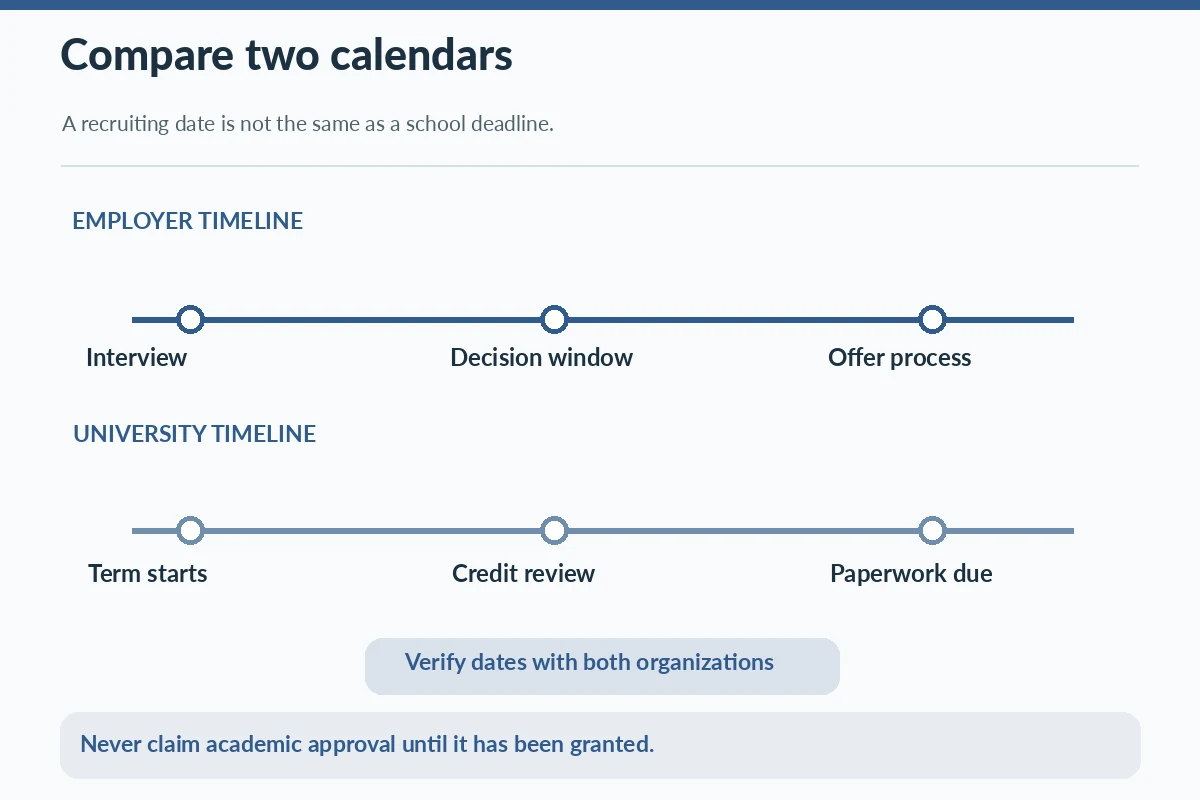
Write down the hiring schedule the interviewer actually gave: whether more interviews are planned, a projected decision date and who will contact candidates. In a second column, record your own program milestones such as course registration, academic-credit forms, housing, travel or eligibility checks. The dates do not automatically match. Boston University’s internship guidance notes that recruiting windows vary substantially by organization and field, which is why a candidate should track individual applications rather than assume a single universal deadline.
If you do not know the employer’s timeline, ask the recruiting coordinator for it once, politely. Avoid fabricating an urgent school requirement to obtain a faster answer. Some programs have flexible approval windows, while others need paperwork completed before the placement starts. Verify requirements with your academic advisor, career office or the actual program handbook. For work authorization, consult the designated university official or qualified authority instead of treating an email suggestion as legal approval.
Identify whether to contact the recruiter or program coordinator
Internship recruiting may involve a department supervisor, a university career office, a centralized early-talent recruiting team or a third-party program partner. Use the channel named in the invitation or follow-up email. If the interview was part of an on-campus schedule, the university career office may have rules for communicating with employers. Do not copy every person who interviewed you just to increase the chance of a response; this can create duplicate work and mixed information.
The recruiting contact is best placed to answer hiring-stage questions. The academic advisor is best placed to verify credit requirements. A prospective supervisor can often discuss the work itself, but may not control institutional paperwork. If the employer asks you to commit before you understand academic eligibility, respond with accurate conditions rather than an unqualified yes. Separating these channels prevents a hiring inquiry from becoming an unauthorized request for special admission or program treatment.
Use a student-specific follow-up email example
Subject: Internship interview follow-up — [program name]. Hello [Recruiter Name], thank you for speaking with me about the [Internship Title] opportunity on [date]. I appreciated learning about the team’s [specific genuine task or project area]. I’m still interested and wanted to ask whether the anticipated decision schedule or next step has changed. If useful, I can provide the program documents you request through your application process. Best, [Your Name]. This is a model, not a real correspondence record.
The note is short because it is a status request, not a second cover letter. Replace the project detail with something truly discussed. If you have a legitimate deadline, add one factual sentence: ‘My university requires the placement agreement by [date] for credit review; please let me know whether that affects your schedule.’ Do not imply the employer must change its hiring timetable, and do not supply student identifiers, transcripts or immigration documents to an unverified address.
Decide when academic deadlines should appear in the message
If the course-credit deadline is weeks away, it is usually enough to wait for the employer’s advertised schedule. When the deadline is closer and relevant, contact your university first to confirm the requirement and any alternatives. Ask the employer whether it can provide the necessary decision or documentation within that window, but frame this as an information request. A deadline does not create a hiring obligation, and an internship offer may involve further review before it is final.
For a hypothetical illustration, an applicant might have an internship interview in February and a university agreement due in March. The specific dates are not general rules. Ask about the likely hiring decision and whether the agreement may be signed later, rather than telling the employer that academic credit is guaranteed. If travel or relocation is involved, avoid nonrefundable arrangements until terms and approvals are known. Keep personal, school and employer schedules visibly separate.
Handle a waitlist or a delayed internship decision
An employer may say it is still interviewing, funding is being finalized or a start date is uncertain. Reply by acknowledging the update and asking when a further update is likely. If no schedule is given, use the restrained follow-up approach recommended by university career guidance. Do not ask whether another student has accepted, request applicant rankings or promise to decline all other offers unless that is genuinely your plan and you understand the consequences.
Continue exploring other credible internships while waiting, especially if your academic term has a firm deadline. Maintain a simple tracker for the program name, contact person, interview date, expected response, next reminder and your own commitments. If the employer ultimately declines, you can ask for feedback, but it may not be available. A courteous response preserves a future connection without making a false claim that you had previously secured the placement.

Confirm program details before saying yes to the placement
If invited to the next stage, clarify whether the opportunity is paid or unpaid, the scheduled hours, location, expected start and end dates, supervisor, required paperwork and any conditions for school credit. Do not treat a friendly interview discussion as a written offer. For research, clinical, youth-facing or regulated environments, check onboarding, privacy training and supervision needs before claiming readiness to start independently.
Ask the organization which secure system it uses for required records. A recruiter may request a resume or project summary, but that is not the same as permission to email sensitive identification or banking information. The same principle applies to school documents. Keep copies of correspondence and avoid forwarding classmate data, employer work samples or confidential project details without authorization. Confirm instructions with verified official contacts.
Audit the message for substance rather than enthusiasm
Before sending, confirm the internship name, year or term, date of the interview and whether your question already has an answer in the posting. Avoid ‘just checking again’ messages every few days. Replace generic praise with one relevant observation and a plain question about timing. Keep any additional document request separate if the employer specifically directed you to use an application portal. Email is a coordination tool, not a substitute for completing required steps.
Your best follow-up can be read in less than a minute and leaves the recruiter free to reply with a date, next step or statement that no information is available. If you learn that the company calendar conflicts with a university requirement, ask both organizations about their actual policies before making commitments. A well-managed internship search is about verified timing and appropriate approvals, not pressure to receive an immediate answer.

| Question or stage | Best first route | Important boundary |
|---|---|---|
| Hiring update | Recruiting team | Ask about next steps |
| Academic credit | University program office | Verify forms and deadlines |
| Start commitment | Employer and student | Wait for terms and approvals |
How We Research and Check Follow-Up Advice
This guide compares documented interview-follow-up recommendations with primary institutional guidance for this specific situation. Examples are hypothetical; they do not describe a real applicant, actual selection, guaranteed response date, or employer policy. We reviewed the cited sources on 2026-11-05 and compared this article with the site topic inventory for distinct intent. Employer and school instructions override generic timing suggestions. For relationship and funding disclosures, see the JobAsk affiliate disclosure.
Sources reviewed: Boston University — Boston University advises tracking internship application and interview follow-up and notes recruiting calendars differ across organizations.; Boston University — Boston University advises a brief status inquiry after the stated decision window and discourages repeated follow-up messages.; University of Pennsylvania — Penn career services explains that a professional status inquiry can follow a missed employer decision date after allowing additional time.. Use the vacancy instructions and the documented recruiting channel for your own case.
More Interview Preparation Guides
Yes when it is genuine, verified and relevant. Explain the date as a constraint, not a demand for special hiring treatment.
Follow the university recruiting program instructions and use the employer coordinator or named hiring contact.
Only if the verified application process requests it. Do not send sensitive records unnecessarily.
No. The school and employer may have separate approval processes, both of which need confirmation.
Ask your program office about genuine alternatives, and then tell the employer accurately what schedule you can accept.