
When an online job application asks for references, list people who know your work or relevant activities, can speak honestly about your contribution, and have agreed to be contacted. Confirm their preferred email or phone number and describe the relationship truthfully. A former supervisor, project lead, volunteer coordinator or instructor may be appropriate depending on the role; a recognizable title is not a substitute for first-hand knowledge.
CareerOneStop recommends obtaining permission and learning how each person wants to be contacted. MIT Sloan’s career office likewise advises asking first and sharing the job details. This article focuses on the application form itself—relationship fields, contact permissions, current-manager concerns and safe submission—not on putting references into the resume document.
Choose a Person Who Has Seen Your Work
If the role emphasizes accuracy and coordination, consider someone who actually observed how you handled those tasks. If you have limited paid work, a teacher who supervised a substantial project or an organizer who directed your volunteering may provide more honest detail than a distant acquaintance with a prestigious title. An applicant with several jobs can choose contacts with direct knowledge of recent relevant responsibilities.
Do not label a coworker as your supervisor, invent a reporting relationship or list a friend as a professional manager. Review each employer’s stated reference requirements, because it may request certain types of contacts. If you lack a requested category, ask the recruiting team whether a real alternative is acceptable rather than filling the field with fictional information. Any sample relationship in this guide is hypothetical, not an actual person.

Ask Permission Before Entering Any Contact Details
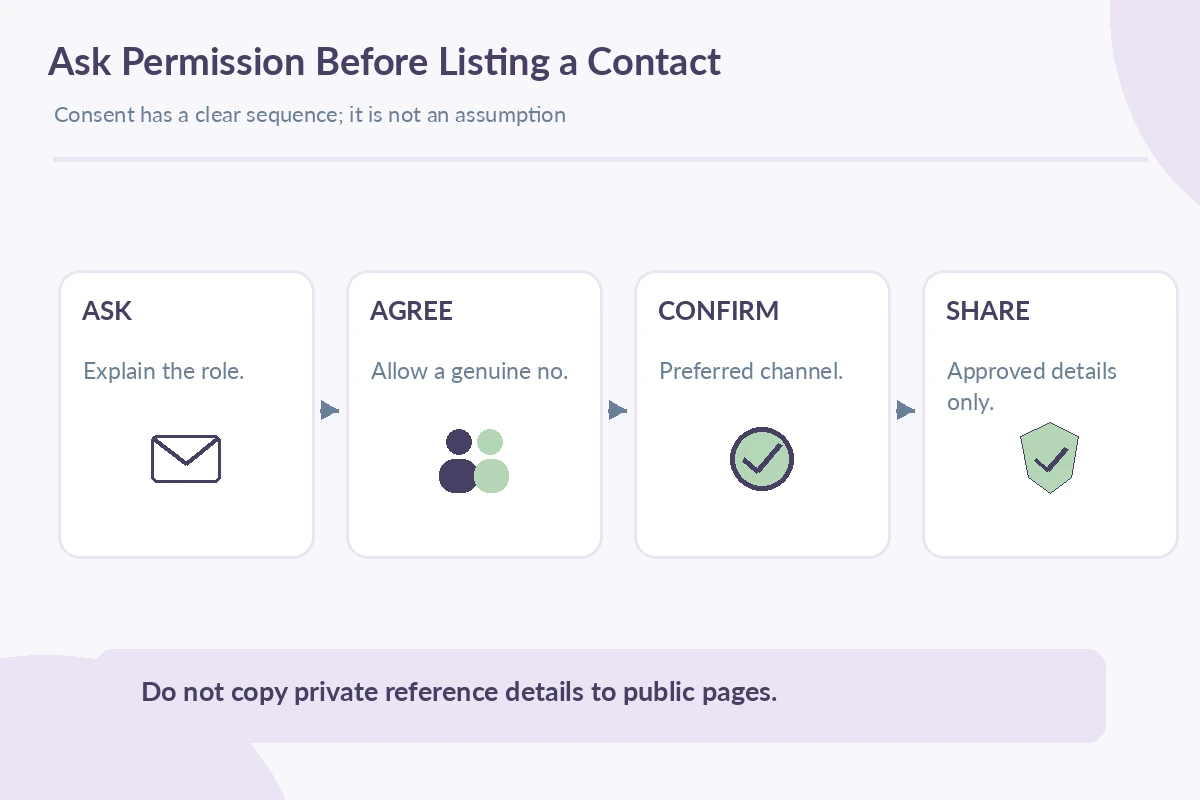
Ask the person whether they are comfortable being a reference for this type of job, explain what you worked on together and confirm what contact information they authorize you to share. Send the job description when useful and let them decline without pressure. Permission is more than assuming that because a phone number is public you can hand it to recruiters.
Hypothetical request: “I’m applying for an operations coordinator role. Would you be comfortable serving as a reference for the inventory project we completed together? I can share the description and confirm which contact method you prefer.” This example is invented, not a message from a real applicant. MIT’s guide supports preparing references with context rather than surprising them with a call.
Map Each Reference to the Correct Form Fields
Common fields include name, current title or role, organization, relationship to you, email, telephone and sometimes how long you have known the person. Enter only information requested and approved, and double-check the spelling and digits. A form asking for “relationship” usually needs something like “project supervisor” or “former coworker,” not a glowing review of character.
Be careful with dates: “worked with during a college project” does not mean “supervised my employment for three years.” When a dropdown lacks your exact relationship, choose the closest truthful option only if it is not misleading; otherwise use any provided comment field or official support channel. Do not use a reference’s personal address if the employer did not request it and the reference has not approved that disclosure.

Handle the Current Employer Question Carefully
If your current manager does not know you are job hunting, do not casually list their number just because a form has a supervisor row. Read whether the employer asks for references now, at a later stage or only for verification. When you can, provide former supervisors or other qualified people who have agreed to speak. If a required field explicitly demands current-manager contact, seek clarification about timing and alternatives.
Distinguish a reference who evaluates your work from an HR contact who verifies employment dates. The employer may use different processes for these tasks. Never promise that a hiring company will delay contact, and do not mark a permission checkbox dishonestly to hide a concern. Use the employer’s official contact to explain a legitimate constraint instead of disclosing someone else’s details without their agreement.
Keep Reference Records Private and Updated
A small private record can list each person’s approved name, relationship, preferred channel, date permission was obtained and jobs they agreed to support. Review it before each application. Someone who agreed last year may have changed jobs or phone numbers, or may no longer have time. Permission for one reference request is not a license to publish their details on a public portfolio or in every unsolicited application.
If an unfamiliar recruiter requests an entire contact list before explaining the role or organization, verify the recruiter first. FTC scam guidance warns that supposed employers may try to collect personal information early. Reference contact details belong to other people; respect their privacy as well as your own. A trusted employer process should be identifiable before you transmit them.
Review the Completed Reference Section
Before submission, confirm that each contact agreed, details match their preference and the relationship is accurate. Read the job posting again: does it request two names, an employment reference or a professional contact? Follow the actual requirement rather than assuming a universal number. If the reference later withdraws permission, use the employer’s legitimate correction channel where available.
After someone provides a recommendation, send a thank-you message. If you advance in a hiring process, you may also let the reference know what types of duties could be discussed without scripting a false endorsement. The value of a reference is independent testimony based on true experience, not a fabricated performance claim. The form is simply a way to connect the right person with the employer.
How We Research and Check Application Guidance
The practices here are based on a first-party or professional source and additional documented guidance, reviewed on October 26, 2026; other linked sources clarify the platform, candidate or safety constraints. The checklists and sample scripts are original editorial teaching tools, not employer procedures or measured hiring outcomes. When a form or employer policy conflicts with an illustrative workflow, read the actual official instructions.
Any named candidate or employer scenario here is expressly hypothetical; no real outcome, hiring advantage, test score or guaranteed application success is claimed. Recruitment platforms, company rules, accessibility procedures and forms can change. No affiliate partnership is claimed. Read our affiliate disclosure.
Related Guides
- Job Application Referral Email: Mention a Real Contact With Permission
- Job References: How to Ask, Prepare and Share a Reliable List
- Filling Out a Job Application With No Experience: Honest Field-by-Field Examples
- Found a Typo in a Job Application? Decide What to Fix
- How to Complete a Job Application PDF and Check It Before Sending
Only if the employer requests them at that point; follow the specific form instructions.
An instructor who knows your relevant work can be appropriate, especially early in your career, if the employer accepts academic references.
Ask permission first and contact the recruiter if you need to discuss a current-manager constraint.
Thank them, do not share their details, and ask a different person who can speak honestly about your work.
Follow the number and types actually requested by the employer; there is no one form requirement for every job.