
List a language on your resume when you can use it for a task that matters to the job. Name the language, describe your current functional level in plain words, and distinguish speaking from reading or writing when those abilities differ. Do not present an untested impression as an official proficiency score. For a customer-facing role, conversational speaking may matter; for a document-review role, reading accuracy may matter more. The examples below are hypothetical, and the right wording depends on work you can genuinely perform without assistance.
Decide Whether the Language Helps This Application
Read the posting and underline actual language tasks before editing your skills list. A front-desk employer might need to greet visitors and transfer calls; a research support employer might need to read source documents; a bilingual service position may expect difficult conversations with customers. Those are different competencies. A language you studied long ago but cannot currently use could distract from stronger qualifications, especially when there is limited space. Only list it if you could answer a reasonable task-based question about it today.
Create a quick evidence note for each language: when you last used it, with whom, for what task, and how much help you needed. For example, a hypothetical applicant who speaks Spanish with neighbors but has never prepared a formal letter in Spanish should not describe all four abilities as equally fluent. Another who reads scientific material in French may have strong reading skills but modest spontaneous conversation. These distinctions make the resume more credible and help you prepare for an interview demonstration.
Describe Listening, Speaking, Reading, and Writing Separately
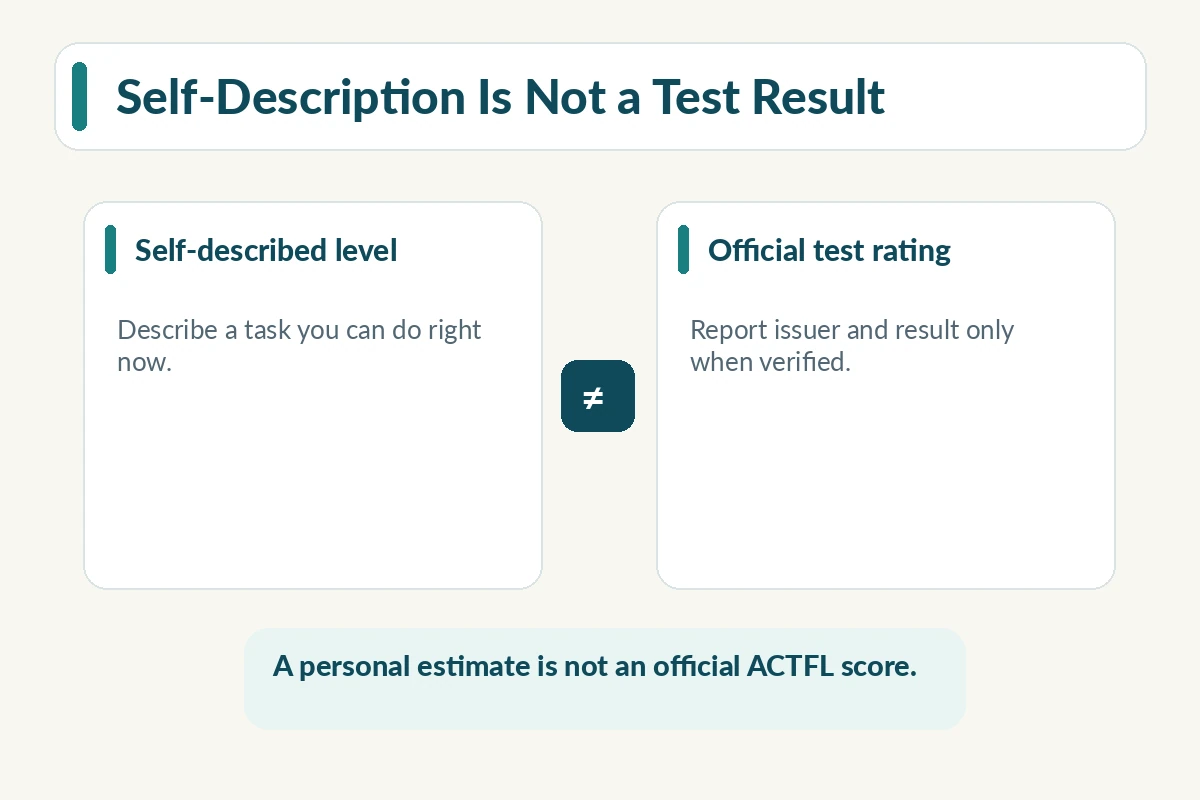
The ACTFL proficiency framework treats listening, speaking, reading, and writing as separate domains. You do not have to use its official rating labels to create a useful resume. In fact, a self-rating is not an official ACTFL score. Use language the employer can understand, such as ‘Spanish — conversational speaking; comfortable reading routine messages,’ provided both claims are true. If a test is specifically required, report the credential, issuing body, score, and date exactly as documented.
Watch for mismatched functions. Understanding a coworker’s everyday instructions does not necessarily mean handling a distressed caller; being able to read a menu does not prove professional editing ability. A helpful self-check is to imagine a common task from the job description and ask: Could I complete it accurately without a translator or coworker stepping in? If the answer changes by task, describe that narrower skill rather than using an umbrella label like ‘fluent.’

Choose a Short Wording and a Defensible Level
Plain-language words such as basic, conversational, proficient, and fluent are widely seen on resumes, but they are not uniform test scores. Anchor them to functions, not just confidence. ‘Basic spoken German; reads routine instructions’ communicates more than a colored bar showing 70 percent. ‘Fluent in Arabic’ is reasonable only if you can sustain the broad communications a hiring manager would likely associate with that word. Avoid invented percentages or CEFR/ACTFL levels if you have not earned or reliably assessed them.
For a fictional bilingual receptionist, an honest entry might read, ‘Languages: English; Spanish (professional customer conversations and routine email replies).’ For a fictional student applying to a lab, ‘Japanese (reads technical abstracts with reference tools)’ is more precise than ‘advanced Japanese.’ You may put a relevant language in Skills, or mention a specific work task in Experience if it actually happened. The task statement adds evidence; it does not substitute for an employer-required certification.
| Job task | Accurate wording | Do not imply |
|---|---|---|
| Greet visitors | Spanish: routine spoken greetings | Certified medical interpreter |
| Review source notes | French: reads academic abstracts | Fluent professional writing |
| Email customers | Arabic: drafts routine replies | Legal translation authority |
Write Examples That Distinguish the Four Abilities
A compact matrix can prevent accidental overclaiming. In a practice draft, write one sentence for the strongest skill, one for the weakest, and decide whether both matter to the employer. You might be able to read Portuguese correspondence with confidence but need support drafting a formal response. If reading is the useful qualification, list reading rather than implying equal fluency in writing. This is not a formal assessment method; it is a transparent editing check before you publish a claim.
Do not make the resume an autobiography of how you learned the language. Courses, family exposure, travel, and daily use can inform your confidence, but the hiring decision concerns present work ability. If a current certificate is requested, keep its name and results separate from self-described skills. When language proficiency is central to safety-sensitive, regulated, or legal interpretation duties, check the employer’s testing and credential requirements instead of assuming a resume label proves readiness.
Decide Where Languages Belong in Your Resume
A single relevant entry often fits in Skills near software and other measurable abilities. If language is one of the job’s major requirements, move it toward the top, but keep work history and degree information discoverable. If you have actual job evidence, a separate work-history bullet can add context: ‘Answered routine bilingual scheduling questions and referred clinical questions to authorized staff.’ That example makes the boundary of the work clear without claiming medical interpretation or clinical authority.
For less relevant languages, use one short line or omit them. Do not repeat the same phrase in your summary, skills, and every experience bullet just to satisfy keywords. An applicant with a verified proficiency test may include the test in Credentials and the functional language skill in Skills, but the descriptions should agree. Remove old scores, overstated workplace claims, or languages you cannot now use to the level stated.
Audit the Final Wording Before You Send It
Read every proficiency label as if the interviewer asked you to perform a realistic task on the spot. Check spelling of each language name and use consistent punctuation. If you are unsure of a label, narrow it to an observable task, such as ‘can read standard customer emails’ or ‘conversational in routine service settings.’ Never turn a self-check into an invented certified level. If the role has explicit legal or professional qualification rules, verify those independently with the employer or the applicable authority.
A final proofread also catches presentation problems: language bars with no defined scale, mismatched ratings in different resume versions, and icons that conceal meaning. Export the file as requested, reopen it, and confirm text remains legible. A trustworthy language entry may be modest, but it is more useful than a grand claim that fails the next practical question. Keep examples as examples and tailor the final line to the specific posting.

How We Research and Check This Guide
This U.S.-focused article was researched on 2026-11-13 using primary or university career guidance: www.actfl.org, www.actfl.org, cla.umn.edu. Each source is used only for the claims it supports. All sample people, employers, dates, association names, publication titles, credentials, and illustrative outcomes in this guide are hypothetical; they do not describe real applicants or imply any guaranteed hiring result. Review the job posting, issuer records, and any confidentiality requirements that apply to your own case. See the JobAsk affiliate disclosure; none of the examples represents an employer endorsement or paid partnership.
More Resume and Cover Letter Guides
Only if the current skill matters to the posting and you can accurately describe what you can do. Otherwise stronger experience may deserve the space.
You can describe your functional skills in your own words, but do not claim an official ACTFL rating or official test result without valid documentation.
Yes when the difference is material. A concise separate description helps prevent an employer from assuming that conversational fluency includes professional writing.
Not always. If the job requires specialized writing or reading, explain the relevant capability instead of assuming that a background label proves every skill.
Usually a Skills line is enough. Give them more prominence when the posting makes the ability central, and support important claims with real work examples.