
A career highlights section should give a hiring reader two or three reasons to continue reading your resume. Choose statements that match the job posting and that your work history can actually support. Keep the heading simple—’Career Highlights’ or ‘Summary of Qualifications’—and place the section near the top only when it adds something beyond your job title. A highlight is not a slogan, a rating of your own talent, or permission to invent a savings figure. It is a short preview of verifiable work that appears in more detail below.
Start With Job Requirements, Not a Self-Praise List
Take the position description and identify three important job tasks: perhaps reconciling records, coordinating a shift, and communicating exceptions. Then search your actual history for evidence that connects to each one. You do not need to write ‘excellent communicator,’ ‘highly motivated,’ or ‘results-driven leader’ to show fit. A practical bullet can describe the work performed and its scope: ‘Coordinated evening service handoffs across front desk and housekeeping,’ if that is true and is shown in the candidate’s Experience section.
The University of Minnesota describes a short optional qualifications summary of three to five bullet points that preview the resume. For this guide, use three strong claims as a helpful editing target, not a universal rule. A new graduate without enough distinct evidence may prefer no highlights section; a deeply experienced applicant may need a concise summary sentence instead. The important test is whether the reader learns something meaningful that is easy to verify elsewhere.
Build an Evidence Ledger Before Writing
Write a private three-column note: target requirement, proof in your experience, and proposed highlight. This prevents a polished opening from drifting away from the facts. A fictional office candidate might pair ‘record accuracy’ with ‘checked invoice fields against approved purchase records’ and propose ‘Documented invoice discrepancies for supervisor review.’ The latter is supported by a real type of task and does not claim they authorized payments or eliminated every error.
If you cannot point to the employer, project, training, or documented work that backs a statement, narrow or remove it. Evidence can be a procedure you performed, a work product, a task frequency you know, or a result you can attribute honestly. Not every role offers a percentage or money figure. Inventing ‘improved efficiency 35%’ just to sound impressive weakens a resume and may create an uncomfortable interview exchange.

Distinguish Your Scope From the Team Result
Start with the strongest accurate verb: supported, prepared, reviewed, coordinated, documented, or led, depending on what you personally did. A team outcome can be mentioned with appropriate attribution, but don’t turn a shared project into solo ownership. ‘Supported rollout of revised dispatch records by testing weekly sample entries’ is not the same as ‘implemented a companywide dispatch system.’ The first is concrete and defensible; the second requires broader authority and impact.
UT Dallas’s career center emphasizes actions, methods, and outcomes as useful ingredients in accomplishment statements. Apply that approach to highlights, but only when you can support each component. For a customer service applicant, ‘Handled product questions and routed policy exceptions according to team procedures’ may be a better summary than a made-up service score. For a warehouse candidate, ‘Recorded inventory discrepancies and escalated counts for authorized review’ may accurately show attention to controls.
| Target need | Possible proof | Honest highlight |
|---|---|---|
| Record accuracy | Reviewed fields, flagged errors | Documented exceptions for review |
| Shift coordination | Maintained actual handoff log | Coordinated shift handoffs |
| Training support | Prepared approved onboarding notes | Supported new-hire onboarding |
Choose a Three-Line Layout Readers Can Scan
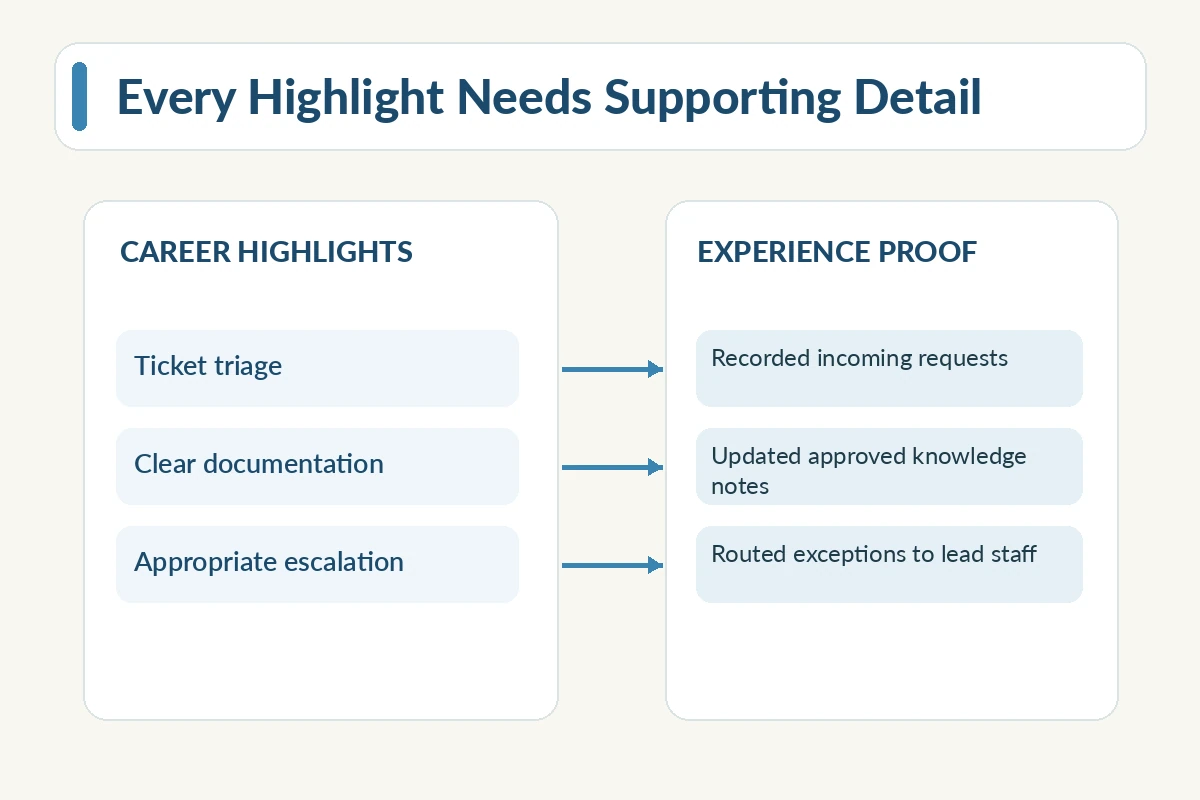
Use one compact bullet per genuinely different qualification. A good set mixes skills instead of restating ‘organization’ three ways. For a fictional support specialist, the first line might establish ticket triage, the second describe documentation, and the third show escalation communication. This creates a useful map for the reader who will then look for the supporting employment entry. Keep each bullet brief enough that it does not overwhelm the header, and avoid columns or decorative skill meters that interrupt reading order.
If you use a ‘Career Highlights’ header, do not add a second ‘Professional Summary’ paragraph repeating the same content. Each claim must connect to the actual target role. When applying for a different job, update the three-line selection, not necessarily the facts about your history. That way, the resume remains accurate across applications while still being tailored. Avoid copying keywords into the highlights without a truthful example supporting them.

Edit Weak Statements Into Evidence-Based Claims
A before-and-after exercise can help. Weak: ‘Exceptional leader and problem solver.’ Better, only when true: ‘Coordinated weekly volunteer coverage and escalated schedule gaps to the program manager.’ Weak: ‘Data expert with perfect accuracy.’ Better: ‘Checked survey records for missing fields and documented issues for review.’ Both revised sentences describe activity rather than personality or impossible guarantees. They may be used as highlights if those activities appear elsewhere in the resume.
Use numbers only when you know what they count. If you supervised five people, list five; if you merely participated in a team of five, write ‘worked with a five-person team’ rather than ‘managed five employees.’ If a performance measure belongs to the entire department, do not imply it resulted from your own isolated action. The goal is not to avoid achievements, but to keep action, scope, and result aligned with the evidence.
Audit the Three Claims Against the Rest of the Resume
Before exporting, draw a line from each highlight to a related experience bullet, project, or credential entry. The reader should find that support without guessing. If a highlight says you ‘trained employees,’ the Experience entry should show what training or onboarding you actually supported and whether you were authorized to evaluate others. If a claim says you ‘managed budget,’ the underlying work should clarify whether you approved spending or simply tracked expenses. This cross-check catches inflated verbs and conflicting scope.
Do a final pass for duplicate phrases, unexplained acronyms, and claims that cannot be discussed in an interview. Skip the highlights section if it consumes space better used for directly relevant achievements. If included, a concise evidence-backed section can help readers orient themselves quickly, but it does not promise ATS performance or a hiring outcome. The surrounding experience still has to carry the proof.
How We Research and Check This Guide
This U.S.-focused article was researched on 2026-11-13 using primary or university career guidance: cla.umn.edu, career.utdallas.edu, career.ucla.edu. Each source is used only for the claims it supports. All sample people, employers, dates, association names, publication titles, credentials, and illustrative outcomes in this guide are hypothetical; they do not describe real applicants or imply any guaranteed hiring result. Review the job posting, issuer records, and any confidentiality requirements that apply to your own case. See the JobAsk affiliate disclosure; none of the examples represents an employer endorsement or paid partnership.
More Resume and Cover Letter Guides
No. They are optional. Use them when they help a reader quickly see relevant qualifications that are backed by detailed experience below.
Three concise and distinct claims can be an effective editing target, although some career centers allow roughly three to five summary points.
Yes with accurate attribution. Explain your contribution rather than claiming you personally produced the entire team outcome.
No. Highlights should preview the strongest relevant evidence; the Experience section should provide the detail and context.
No. Include only metrics you can verify. Concrete actions, scope and work products are useful even without a numeric outcome.