
You can explain that you left work for personal health reasons without turning an interview into a medical history. Keep the reason truthful, describe the employment dates accurately and focus on the work requirements you can currently meet. You do not have to invent a different reason or volunteer a diagnosis, treatment history or prognosis to make your experience understandable. U.S. federal EEOC guidance places important limits on disability-related questions before a job offer, but individual circumstances and applicable laws vary; this guide is practical interview preparation, not personal legal or medical advice.
Choose the most accurate level of personal detail
Decide what happened in work terms: you resigned to address a personal health matter, you took an approved leave and later returned, or the employer ended your employment for another reason. Those are different histories. If you resigned, a simple explanation may be ‘I stepped away from that role for a personal health matter and am now focusing on opportunities that fit my qualifications.’ You can be truthful without describing symptoms or diagnosis. If there was an involuntary separation, do not rewrite it as a voluntary decision. Keep the language aligned with your application and any records you may later be asked to verify.
Understand the difference between privacy and deception
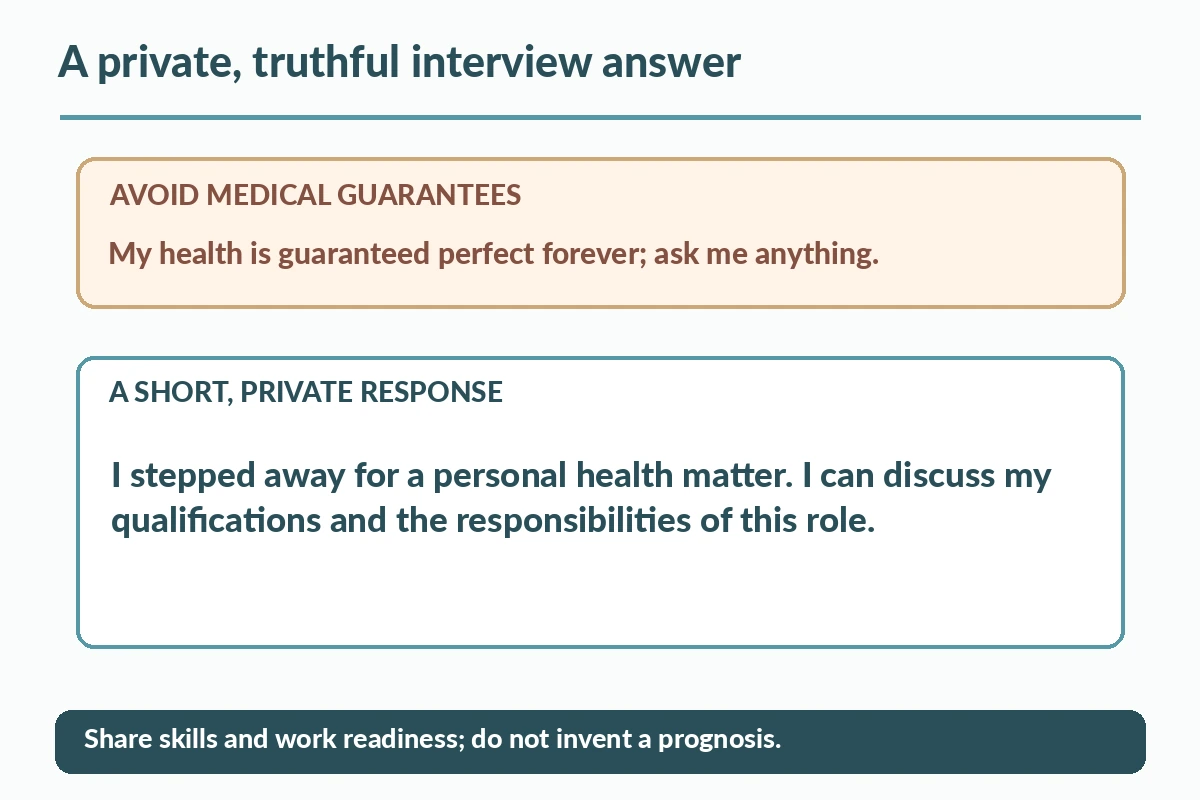
Privacy means choosing not to volunteer unrelated medical information; it does not mean making up a fictional employer, training program or family event. A statement such as ‘I took time away for a personal health matter’ may be sufficient when accurate. Do not say the issue is ‘completely cured’ or claim you can perform every imaginable physical task simply to reassure the interviewer. Job qualifications depend on essential functions, schedules and lawful accommodation arrangements in the specific context. The strongest answer is concise, calm and centered on what you can reasonably discuss about the position you are applying for.
Use a two-sentence interview answer
Illustrative wording: ‘I left my prior role to address a personal health matter. I am now looking at positions whose stated responsibilities I can meet, and I would be glad to discuss my relevant operations and records experience.’ Adapt the second sentence to real skills and actual readiness. If you remain uncertain whether you can meet key requirements, do not promise that you can. The explanation can name a broad personal reason while leaving room for a later work-specific discussion. It should not contain invented diagnoses, a made-up recovery timeline or claims about what future health circumstances must be.

Review the job functions before describing readiness
Read the posting for actual duties, physical tasks if relevant, working hours, required travel, licenses and supervision. Be prepared to explain your qualifications and how you would approach the tasks you have actually performed. If the posting is vague, ask the interviewer to describe a typical shift or key responsibilities. The EEOC explains that employers may ask job applicants whether they can perform particular job functions, while different rules apply to disability-related inquiries before a conditional offer. This guidance does not resolve every individual’s legal situation; if a sensitive issue arises, consider obtaining advice from an appropriate qualified professional.
Know what EEOC guidance says about pre-offer questions
Under the federal Americans with Disabilities Act framework described by the EEOC, employers generally cannot ask pre-offer questions designed to reveal a disability or require medical examinations before a conditional offer. They can ordinarily ask about job qualifications, performance of job functions and legitimate schedule requirements. Exceptions and more specific rules exist, particularly where a disability is obvious or voluntarily disclosed and relevant to a particular function. Do not turn these principles into a blanket promise that no employer can ever request any health information. This article is for U.S. job seekers; state law, employer type, process stage and individual facts may matter.
| Your situation | What to explain | What to verify |
|---|---|---|
| Voluntary health-related break | State a private, truthful personal reason | Accurate departure dates |
| Job requirements unclear | Ask about essential tasks and schedule | Official role description |
| Interview accommodation needed | Use an appropriate request process | Employer instructions and EEOC guidance |
Separate job-readiness questions from accommodation discussions
An applicant may need an accommodation for an interview or for performing the role. The EEOC explains that employers can ask candidates whether they require an accommodation for the hiring process; rules for job-related accommodation questions at the pre-offer stage are more limited. You can request an interview accommodation through the employer’s process without presenting a detailed medical history to every interviewer. If you have questions about an accommodation or legal protections in your own case, consult the employer’s accessible process, an appropriate agency or a qualified adviser. Do not presume that a former condition prevents work or that an accommodation is automatically approved in every situation.
Handle an employment gap without a medical story
Your resume can show correct dates and relevant work without a paragraph describing the health issue. CareerOneStop notes that applicants with gaps may decide to explain them in a cover letter or interview rather than in the resume itself. If asked about the interval, give one accurate sentence and redirect to current qualifications. Do not insert fictitious freelance contracts or pretend that leave time was paid employment if it was not. If you completed real training or volunteer work during the interval, list only what you actually did and clarify its context. A truthful timeline is more useful than a perfectly continuous but invented one.
Practice boundaries for intrusive follow-up questions
A respectful boundary might be: ‘I prefer to keep medical details private, but I can discuss the responsibilities and schedule of this position.’ This does not guarantee how an interviewer will react, but it gives a concise way to redirect. Avoid debating hypothetical diagnoses, taking a confrontational tone or answering medical questions you do not understand. The EEOC resources provide detailed distinctions among pre-offer inquiries, job-function questions and later stages of hiring. If you believe a question or decision violates applicable law, seek specific guidance rather than relying on a short article as definitive legal advice.

Do not promise a medical outcome to secure an offer
An interviewer needs accurate information about whether you can meet the job’s genuine requirements, not predictions about the future course of a condition. Refrain from unsupported phrases such as ‘I will never miss work again’ or ‘All health concerns are permanently over.’ If you can meet the stated hours, say so; if you need clarification about travel, shift rotation or another responsibility, ask directly. You can express enthusiasm and confidence in your professional skills without guaranteeing your future health. This approach respects the employer’s legitimate job information needs and the candidate’s privacy at the same time.
End with a work-centered example and a question
After giving the short departure explanation, move to a real accomplishment or task: maintaining accurate intake records, preparing project summaries or coordinating a team handoff. Use a hypothetical model only as a writing aid, not as a personal achievement. Ask which responsibilities matter most early in the role and how employees are trained to complete them. If health or accommodation issues need individualized discussion, that belongs in an appropriate process with informed support, not in an improvised public disclosure. The goal is a truthful reason for leaving, accurate employment history and a fair discussion of your qualifications for the job.
How We Research These Interview Explanations
JobAsk checked the following primary or professional sources on November 16, 2026: The EEOC explains limits on disability-related questions before job offers and the ability to ask about performance of job functions. EEOC guidance distinguishes pre-offer disability inquiries from permissible questions about job functions, qualifications and attendance requirements. CareerOneStop recommends accurate employment dates and notes that a health issue may explain an employment gap without being detailed on a resume. All sample responses are hypothetical and must be adapted to the applicant’s actual employment status, dates and qualifications. We do not promise any interview outcome, diagnose health conditions or provide individualized employment-law advice. Read the affiliate disclosure.
More Interview Preparation Guides
You can ordinarily discuss work qualifications without volunteering a diagnosis. Federal EEOC guidance restricts many disability-related inquiries before a conditional offer; individual circumstances may need professional advice.
Yes, if it remains truthful and does not misstate an involuntary separation. A concise private explanation is usually preferable to invented details.
Discuss the actual functions and qualifications accurately. If you need clarification, ask for the relevant task or schedule requirements.
Not necessarily. Show accurate employment dates and relevant experience. You can choose to give brief context when asked rather than listing medical details on your resume.
Avoid unsupported medical guarantees. Focus on the job requirements you can meet and seek individual guidance where accommodations or legal questions matter.