
Personal assistant jobs with no experience should start with a clear, verifiable task list—not an open-ended promise to handle anything. Many beginner assignments involve scheduling, organizing documents, monitoring messages or coordinating routine errands. A role supporting a private individual can differ sharply from an administrative position at a business. Before applying, identify the employer, work site, hours, reimbursement rules and which personal or financial accounts you would be allowed to use. Show organizational proof from real projects without exaggerating your level of authority.
The Bureau of Labor Statistics describes administrative staff handling calendars, documents, communications and filing systems; entry-level workers often learn procedures on the job. A private personal assistant job may include errands or household coordination beyond those office duties, so do not assume that every task is standard administration. Titles such as executive assistant, virtual assistant, personal assistant and household manager often signal different experience and judgment requirements. Look for responsibilities and reporting lines, not just a familiar job title.
Compare Real Entry Routes Before Applying
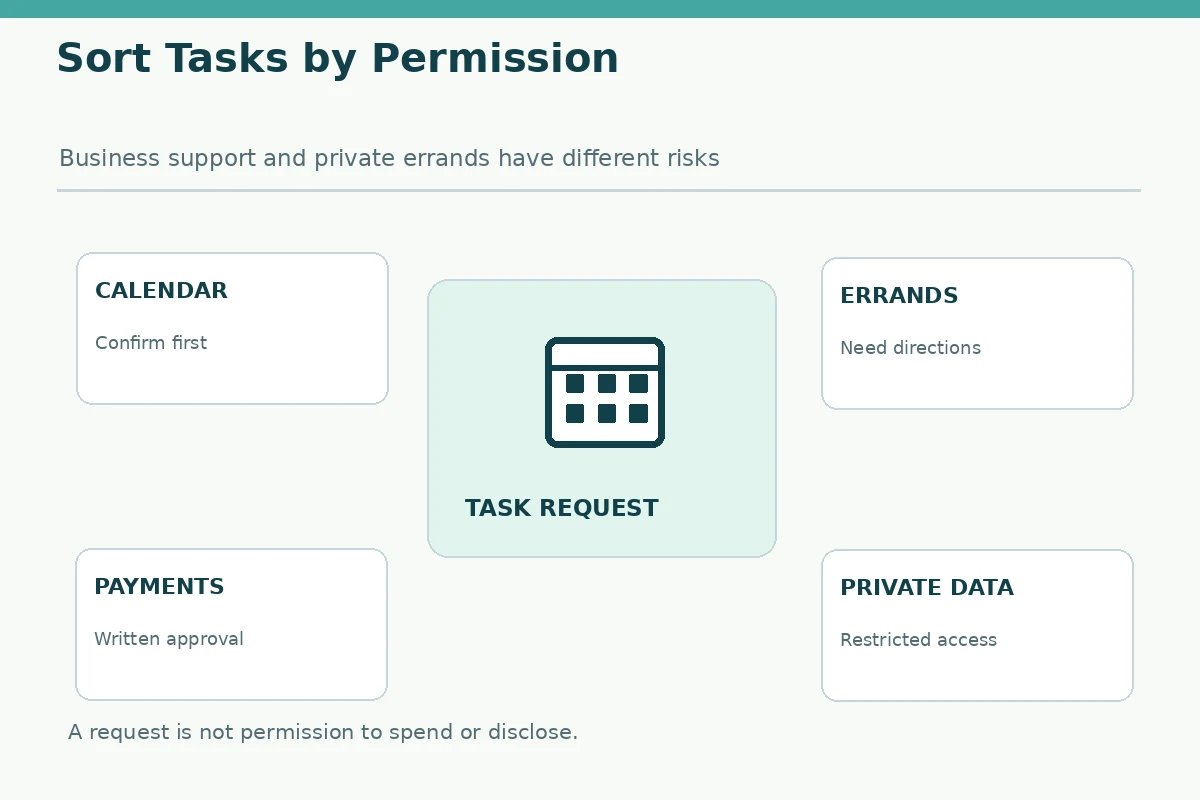
Three names often appear near this search. They do not describe identical duties, hiring standards or authority. Read the actual posting and separate possible beginner tasks from roles that call for previous experience or specialized credentials. Here is a practical comparison for personal assistant jobs no experience:
| Route | Work or boundary |
|---|---|
| ADMIN SUPPORT | Schedule calls, prepare documents and keep approved task records. |
| PERSONAL ERRANDS | Coordinate pickups and appointments only under clear directions. |
| HIGH-TRUST SUPPORT | Payments, private accounts and sensitive matters require explicit authority and safeguards. |
Build Proof Without Inventing Experience
Create a fictional, privacy-safe example week: color-coded appointments, one change request, travel time, a task owner and a confirmation state. Demonstrate a meeting reminder or a short handoff note without using any real household addresses or clients. You might cite actual school events or volunteer projects where you kept schedules accurate. Label hypothetical schedules as demonstrations rather than professional client work. Explain how you check details before sending messages; reliability matters more than pretending that you already managed an executive’s confidential calendar.
A Four-Step Search and Application Workflow
Step 1: Separate household from business support
Read each role for who is being supported, which location you would work from and what a typical day includes. A personal assistant might organize a household calendar, while an office assistant may maintain team documents and schedule meetings. The same employer might expect both. Ask which tasks require travel, which are remote, whether hours vary and who approves decisions. If the post says simply “handle all needs” with no specifics, request a real duty list before sharing personal information.
Limit to remember: Do not assume the right to enter a home, access private devices or act on behalf of a person.
Step 2: Show simple scheduling and follow-through skills
Use a small demonstration: receive a request for an appointment, record options, confirm availability, obtain approval, send a final calendar invite and note changes. Keep the distinction between a request and a confirmed commitment visible. Include an actual example of organizing school, volunteer or club logistics if you did so. Explain how you handle conflicting times and missing contact details rather than inventing a high-profile employer or numerical achievement.
Limit to remember: A sample calendar must not contain real private schedules or contact details.

Step 3: Set account and expense permissions in writing
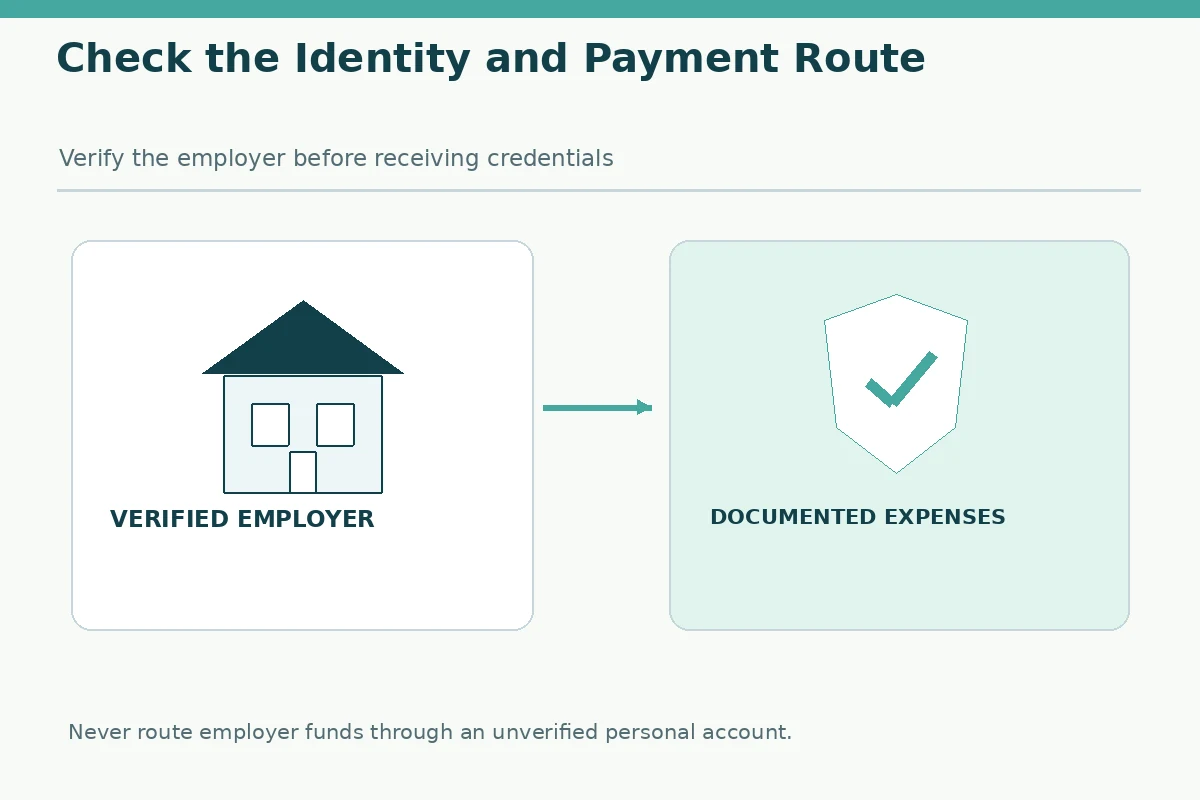
Ask who authorizes purchases, how receipts are handled and whether reimbursement is written into the engagement. Confirm whose account is used, what tools are approved and what happens if a request arrives outside working hours. Never forward one-time verification codes or take payments through your personal bank account to “prove trust.” The FTC warns that fake employers may ask applicants to accept checks or release sensitive information before hiring.
Limit to remember: Do not use personal identity or bank accounts for an unverified employer’s transactions.
Step 4: Apply through a verified channel
Send a concise resume with dependable tasks: scheduling, document accuracy, follow-up and courteous communication. Use the employer’s official contact, reputable agency or other verified route. Ask about supervision during onboarding and confidentiality before accepting access. If a private employer is hiring directly, request a written role description and an appropriate interview process rather than relying solely on a text-message offer.
Limit to remember: Do not disclose an applicant’s home address, SSN or bank details before a legitimate process requires them.
Which Route Fits? A Decision Table
| What you see | Safer next step | Verify with |
|---|---|---|
| Calendar update needs approval | Propose options and confirm before booking | Named decision maker |
| Errand requires reimbursement | Obtain documented expense rules before purchasing | Written payment process |
| Recruiter sends unexpected transfer check | Do not deposit; verify employer independently | Official organization contact |
An Application or Work Sample You Can Adapt
Illustrative application message: “Hello, I am applying for the Personal Assistant role. I have organized volunteer event schedules and maintained a shared checklist with confirmed owners and due dates. I can show a fictional calendar demonstration that keeps changes separate from approved appointments. I would like to learn your preferred scheduling tools and process for expense authorization. Could you clarify whether this is household coordination, business administration or both?” Use only tasks you have really handled. Never claim to have managed private family accounts when you have only prepared a sample.
Mistakes That Make a Beginner Application Less Credible
A broad job title can hide unreasonable access requests. Avoid describing yourself as available around the clock unless you have agreed to specific hours. Do not treat a messaging-app chat as authorization to move money, book travel or distribute someone else’s records. Conversely, do not assume that a legitimate role is unsafe merely because it includes errands: ask for written boundaries and normal employment verification. Explain what you will do when a contact cannot be reached: record the request, flag the urgency and wait for the authorized decision rather than inventing a solution.
A Simple Follow-Up and Verification Plan
Track employer verification, role location, assigned supervisor, schedule, account permissions, reimbursement policy and training. Prepare a one-page demonstration of an appointment request moving through “pending,” “confirmed” and “changed.” Keep this outside any actual private account. If the employer requests more than calendar and coordination work, ask whether the task is covered by the written role. Build trust by being consistent about limits, not by volunteering unrestricted access.
Review This Role Before You Say Yes
Before you give an employer sensitive information, confirm that it is the correct organization and that the role exists. Read the description for where the job happens, how the work is supervised, whether the training is paid, and which shifts are required. If the employer uses an agency, verify the agency through a trusted source. Do not assume that a recruiter message, a course certificate or a public participation badge guarantees employment. Keep copies of the actual posting, the dates of your communications and the tasks you were asked to complete. If a condition is unclear, request a written explanation rather than filling in the missing facts yourself.
How We Research Entry-Level Job Routes
We reviewed occupational and public-interest guidance on 2026-11-14. www.bls.gov explains bLS identifies scheduling, files, correspondence and entry-level administrative training. consumer.ftc.gov explains fTC explains how fake recruiters seek money and personal information before actual hiring. consumer.ftc.gov explains fTC explains risks of remote work advertisements and advance fees. We also compared the intended query against the supplied JobAsk inventory. The example people, application notes and practice scenarios here are fictional; they are not active job advertisements, employer endorsements or guaranteed hiring paths. Local eligibility rules, workplace policies and position details can differ. See our affiliate disclosure.
Related Job Search Guides
Some beginner assignments accept evidence from school, volunteering or organizing events. Roles handling executive strategy or complex private finances may require substantial prior experience.
Not necessarily. Executive assistants often support complex organizational work and may require extensive experience; a personal assistant job can mix household and administrative duties.
Do not agree to route an employer’s funds through your personal account without trusted, documented arrangements; unexpected checks and transfers are well-known scam indicators.
A clearly fictional schedule with request owner, date, time zone, decision maker, confirmation status and a change log. Avoid private or actual client information.
Ask for examples, hours, supervision and written boundaries. A legitimate employer should be able to explain the core work and approval process.