
A legal internship cover letter should tell the reader which legal-support tasks you can already approach carefully, where your evidence comes from, and what you hope to learn under attorney supervision. Lead with a real course, clinic assignment, student journal, or administrative project rather than describing yourself as a future attorney who can already represent clients. The strongest opening names the specific internship and one relevant work product you can explain without disclosing a client matter.
The U.S. Bureau of Labor Statistics describes legal assistants and paralegals as organizing case files, researching laws, and drafting documents to support lawyers. That is a useful map of possible internship exposure, not a promise that any particular intern may perform every duty. A student applicant can show precise note-taking, source comparison, deadline tracking, and willingness to ask for review. The letter should never imply independent legal advice, privileged access, court filing authority, or verified experience that did not occur.
Read the Internship Notice as a Legal Work Assignment
Underline the verbs in the posting: organize, research, cite-check, schedule, draft, or support. Notice whether the employer is a legal aid office, courthouse unit, corporate legal department, policy organization, or private law firm. The same degree program may be relevant to all of them, but the letter should not pretend they handle identical tasks. If the notice emphasizes intake records, prioritize accurate files and client-facing professionalism; if it emphasizes research, describe your method of locating and comparing authority.
Inspect requirements for year of study, eligibility, writing sample length, office hours, and application route. Some internships are for law students, while others welcome undergraduates or paralegal-program students. Do not call an undergraduate exercise a case memo prepared for a client. If you lack experience with a named database, describe the research tools you actually used and explain how you learn new systems with guidance rather than claiming access to restricted resources.
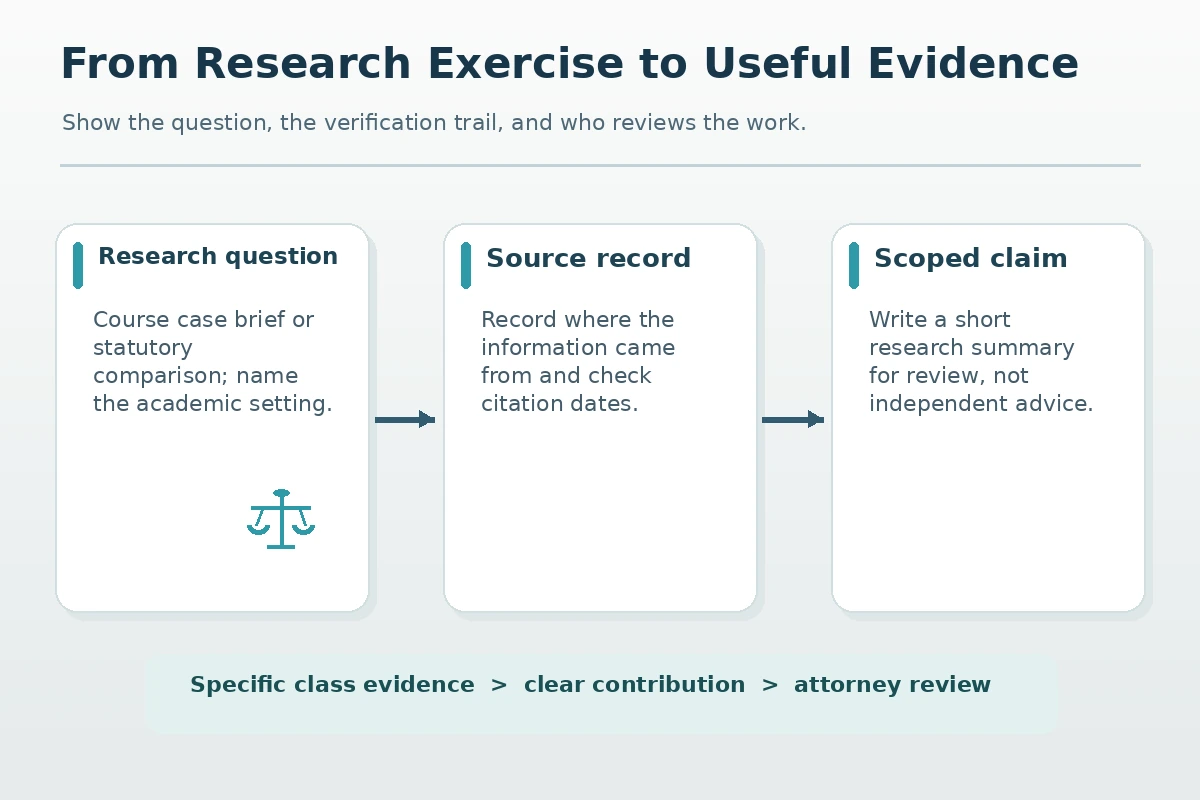
Turn Class Research Into Verifiable Writing Evidence
Choose one assignment whose process you remember: a statutory interpretation exercise, source annotation, mock case brief, or policy comparison. Explain the question, how you checked dates and authority, and which part was yours. A statement such as “I compared primary and secondary sources and produced a clearly cited class memorandum” is far stronger than “I have excellent legal research skills” if you can discuss the research process. Avoid naming confidential parties or reproducing restricted materials.
If you worked with a team, distinguish tasks: did you collect citations, draft a section, maintain the document index, or edit for consistency? Mention the actual deliverable and whether it was reviewed by a professor, teaching assistant, or supervising professional. Do not claim a favorable case outcome or legal conclusion merely because you completed an academic exercise. Demonstrate careful reasoning by acknowledging what you checked and what needed someone else’s judgment.
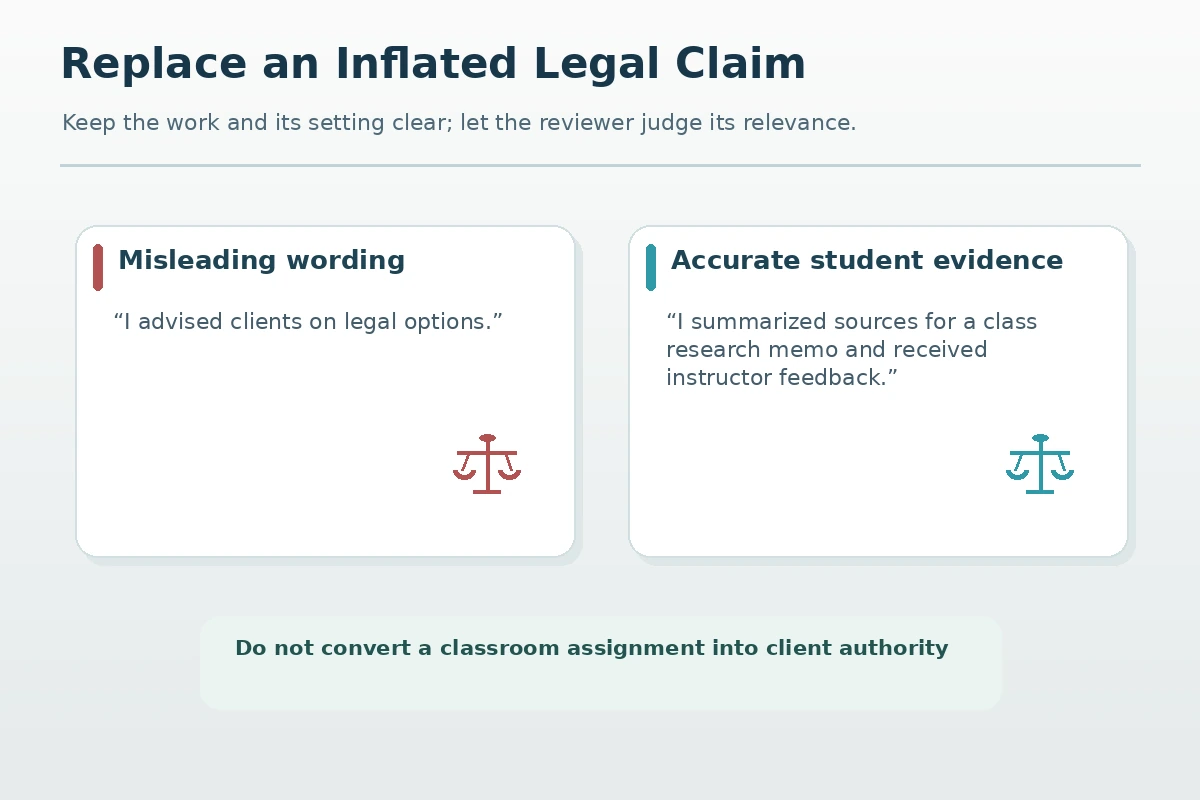
Write a Letter That Respects Attorney Authority
A hiring manager needs to know you can take instructions, identify uncertain claims, and handle sensitive records appropriately. Say that you welcome feedback on research summaries and drafts. When describing communications with members of the public, use “routed questions to the responsible staff member” rather than “advised clients,” unless the latter accurately describes authorized work. Never attach client documents to an application without written permission from the person who controls them.
Keep the message readable: opening with the position, middle paragraphs demonstrating one research and one organization skill, and closing with availability plus an invitation to discuss. Avoid sweeping statements about justice or litigation if the internship is primarily transactional or administrative. Name a real organizational reason only after checking the employer’s own site, current practice areas, or project description. Accuracy is more persuasive than grand claims.
| Experience to cite | Useful proof | Scope to keep clear |
|---|---|---|
| Source research | Class case brief with cited authorities | Do not claim legal advice |
| Document support | Index and version tracking | Do not imply court filing authority |
| Writing sample | Permission-cleared course memo | Exclude privileged materials |
Adapt the Draft to the Office and Work Sample Rules
For legal aid, use evidence of respectful information handling and recognizing when a question requires an attorney. For a court administration team, focus on public records, calendars, and procedural accuracy without suggesting that court staff represent litigants. For an in-house team, emphasize document version control and clear escalation. Each setting has its own confidentiality rules. Select only one or two relevant themes instead of listing every field of law you have studied.
A request for a writing sample is separate from permission to share one. Submit a course paper if it is your work and you are permitted to provide it; remove identifiable case details from clinic work only with the supervisor’s approval. Check page limits and whether the employer prefers a neutral or persuasive sample. A letter can refer to an attached writing sample without claiming that it was accepted for publication or used by an actual court.
Check Claims and Send the Final Application
Before sending, read each sentence as a factual claim. Can you name the course, describe the document, explain the citation check, and identify your own contribution? Ensure the letter matches the year of study, employer name, and internship title on the application. Proofread legal terms and citations if you include them; an unnecessary citation that is wrong is worse than a clear description of the work. Use a neutral file name and follow the employer’s submission method.
Preserve the final letter and the exact advertisement privately so you can prepare for an interview. If an application portal asks for different materials, follow its instructions instead of emailing additional confidential files. Do not send legal opinions to demonstrate expertise. Your closing should present a teachable, careful applicant with a research habit and respect for professional review—not an already qualified practitioner.
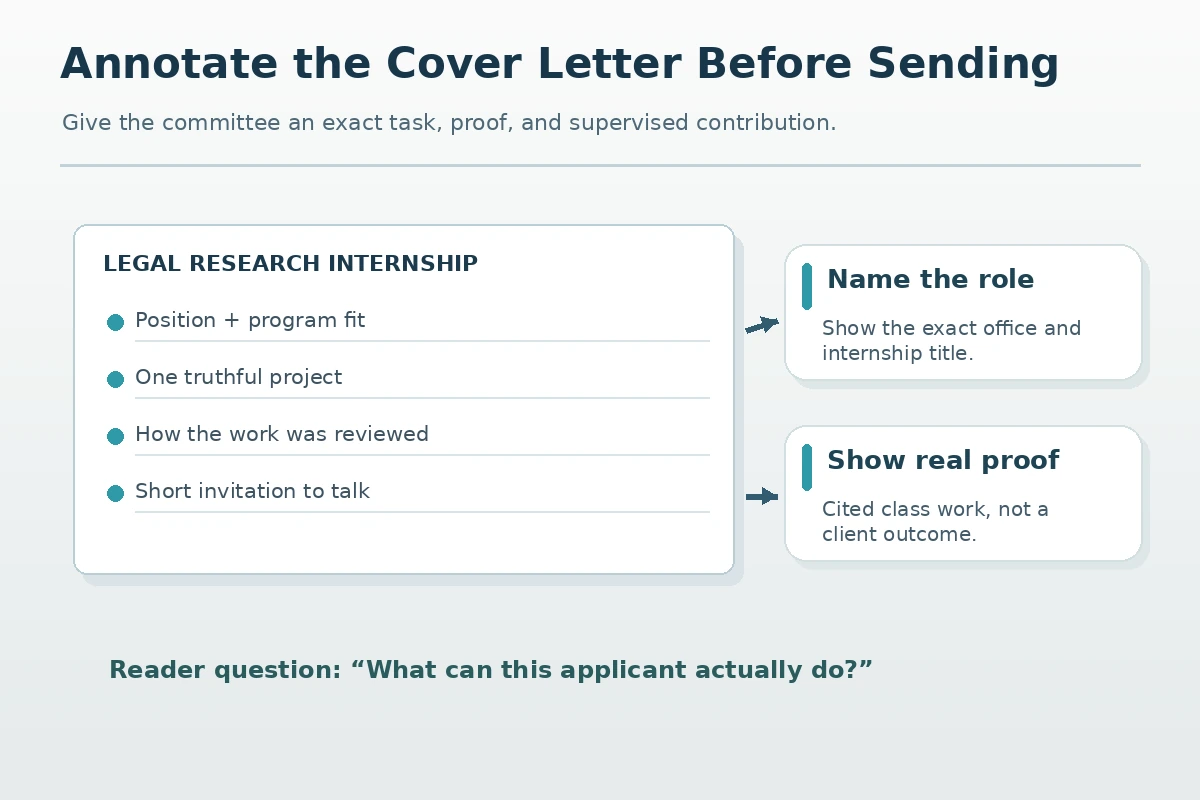
A Complete Example Letter With Truthful Project Details
Illustrative example only: The application below is fictional and must be rewritten using the applicant’s real work, program, employer, and availability. Do not copy any hypothetical experience as a factual achievement.
Dear Hiring Committee,
I am applying for the Legal Research Intern position with your organization. In a university research seminar, I compared statutory and secondary sources, maintained a citation log, and prepared a concise class memorandum explaining where the sources agreed and where further research was required. That project taught me to distinguish a supported statement from an assumption and to make my research trail easy to review.
I also maintained shared records for a student organization, which required consistent file names, deadline checks, and clear handoffs. I would bring that attention to detail to research summaries, document indexing, and other support assignments within the supervision structure you describe. I understand that a student intern does not independently provide legal advice or make attorney decisions.
I would welcome an opportunity to discuss how my writing and organizational experience fit your team’s internship projects. Thank you for your consideration.
What a Realistic Revision Looks Like in Practice
Consider a hypothetical applicant who finished a mock case brief in class and managed minutes for a campus policy club. The applicant should not turn the mock case into “assisted with litigation,” nor call the club’s rules a legal compliance program. Instead, the letter can state the question researched, the accurate citation record produced, and the dates or file versions tracked for the club. The hiring committee can evaluate those specific skills without being misled about a client or court.
The applicant reviews the internship posting and notices that the office wants research summaries and accurate scanned-document labels. They revise the first evidence sentence to emphasize citation checks and file naming, remove a claim about advising clients, and attach a class writing sample only after confirming that it contains no restricted information. This fictional sequence demonstrates editorial decisions, not a measured hiring result. A genuine application should use the person’s own evidence and the employer’s exact request.
How We Research and Verify Internship Letters
We checked primary occupational guidance and career-center writing advice on 2026-11-14. The UC Berkeley Career Engagement cover letter guide recommends relating an applicant’s concrete experience to the exact organization and role. The BLS legal support occupational profile supports this article’s treatment of legal research, document organization, and attorney support work. Descriptions of class projects and model letters here are hypothetical teaching examples, not reports of applicants or actual hiring outcomes. Sources describe general work and eligibility; the employer notice and authorized supervisors determine internship duties. For commercial relationships and editorial transparency, see our affiliate disclosure.
More Resume and Cover Letter Guides
Yes, when the program accepts undergraduates. Specify your actual degree stage, academic research and support skills; do not describe yourself as an attorney or law student if that is untrue.
Yes, label it as a class exercise or simulation. Explain the research, organization or communication you personally performed rather than presenting it as live client work.
Not without clear authorization from the responsible supervisor and compliance with applicable confidentiality rules. A permitted class sample may be safer.
Follow the employer’s instructions first. Otherwise use a concise, readable letter with one or two concrete examples and a direct closing.
Describe research tools and citation methods you have actually used, then state that you are ready to learn employer tools with supervision.