
A journalism internship cover letter should demonstrate that you can find a story, verify what people tell you, write with clarity, and accept an editor’s corrections. Choose one real reporting exercise, student-media piece, interview assignment, or carefully documented writing sample. State where it appeared and who edited it. A draft in a class folder is valuable evidence, but it is not a published article, and a student blog is not automatically a newsroom job.
BLS describes reporters and journalists as researching topics, interviewing sources, checking accuracy, and reviewing stories with editors. An intern may assist with reporting, fact-checking, transcription, or publishing steps, but should not imply that unapproved work was independently assigned by a newsroom. The cover letter is itself a writing sample: it should be concise, exact in names and dates, and alert to confidentiality or consent when discussing sources.
Match the Newsroom Beat and Internship Duties
Read the posting and identify the kind of work on offer: local news, audience engagement, visuals, audio, newsletters, data reporting, or copy editing. A local reporting internship may prioritize interviews and public-record verification; a digital audience position may emphasize headlines, accessibility, and accurate social descriptions. Use examples that match the job instead of claiming to be equally experienced in every newsroom task. A published clip is useful when it relates to the outlet’s coverage.
Check whether the organization requests a clip packet, a single sample, a portfolio URL, or a pitch. Follow the specified link count and format. If the internship has an ethical or legal requirement, do not invent compliance training. A student who has practiced quote confirmation and citation in coursework can explain that process without suggesting formal investigative authority. The opening should reflect the outlet you actually researched, not a generic admiration for journalism.

Prove Your Reporting Process With One Story
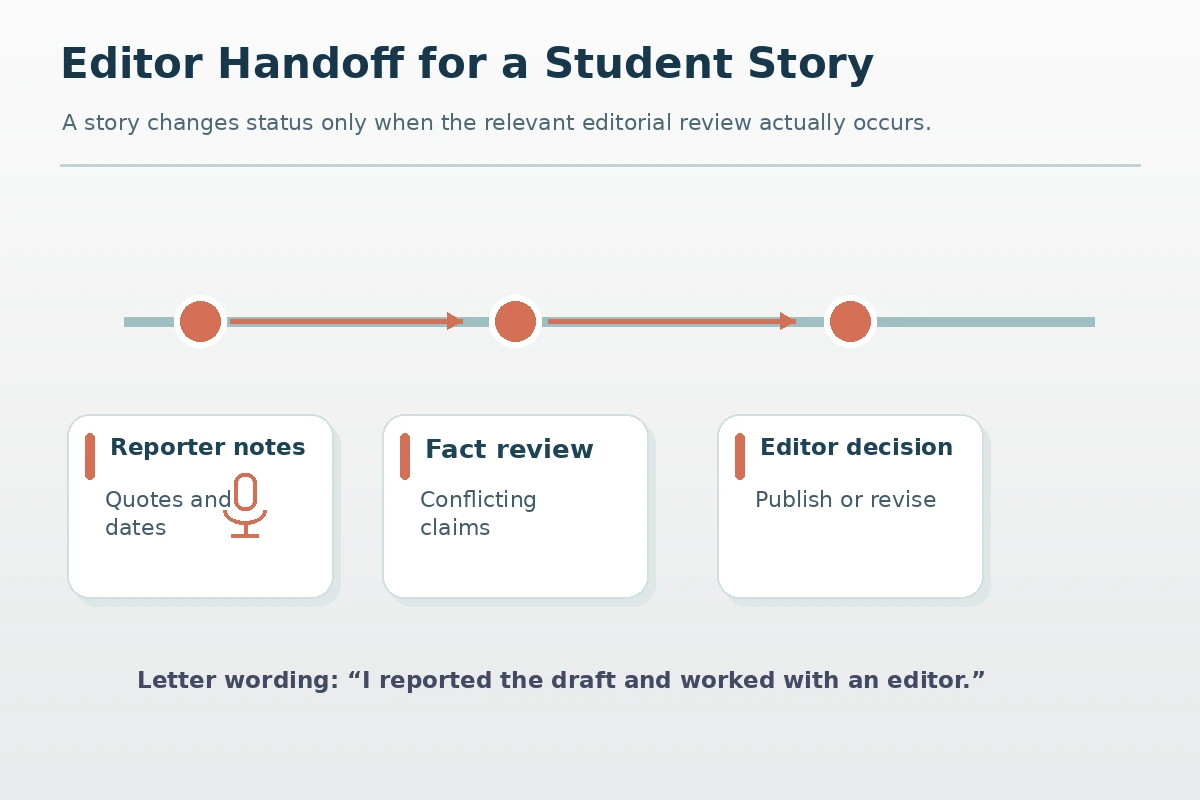
Describe the story’s question, the sources consulted, and the editing step. For example, “I interviewed club organizers, checked dates against the campus calendar, and revised the piece after an editor flagged an unsupported sentence” provides a traceable reporting workflow. Explain whether the story was published, submitted for class, or held as a draft. Do not transform a class story into investigative reporting or describe a peer-reviewed publication when none exists.
If your work was collaborative, distinguish reporting, photography, copy editing, and publishing contributions. An accurate clip description might read “reported and wrote the draft; student editor revised the headline.” Discuss how you checked conflicting information or handled a source who did not want to be named. Do not promise anonymity as a general practice; newsroom policies and source protections require editorial judgment, and the letter should show respect for that process.
Put Verification and Corrections Ahead of Hype
A newsroom intern can demonstrate value by flagging missing confirmation rather than rushing a claim into print. State that you cross-checked a time, title, number, or quote with a primary source and corrected a draft when evidence differed. Never claim that a story changed policy or reached a large audience unless there is sound evidence. Avoid invented traffic metrics, awards, or investigative outcomes, even when a job posting asks for impact.
If you have an unsuccessful reporting attempt, describe its learning value: a source did not reply, a claim needed another independent confirmation, or a headline implied certainty the reporting did not support. Show the editor’s role in reviewing the next version. Editorial collaboration is not a weakness; it is part of reliable reporting. An application should make clear that you can work to deadlines without treating accuracy as optional.
| Experience to cite | Useful proof | Scope to keep clear |
|---|---|---|
| Published clip | Byline and fact-check note | Credit the editor |
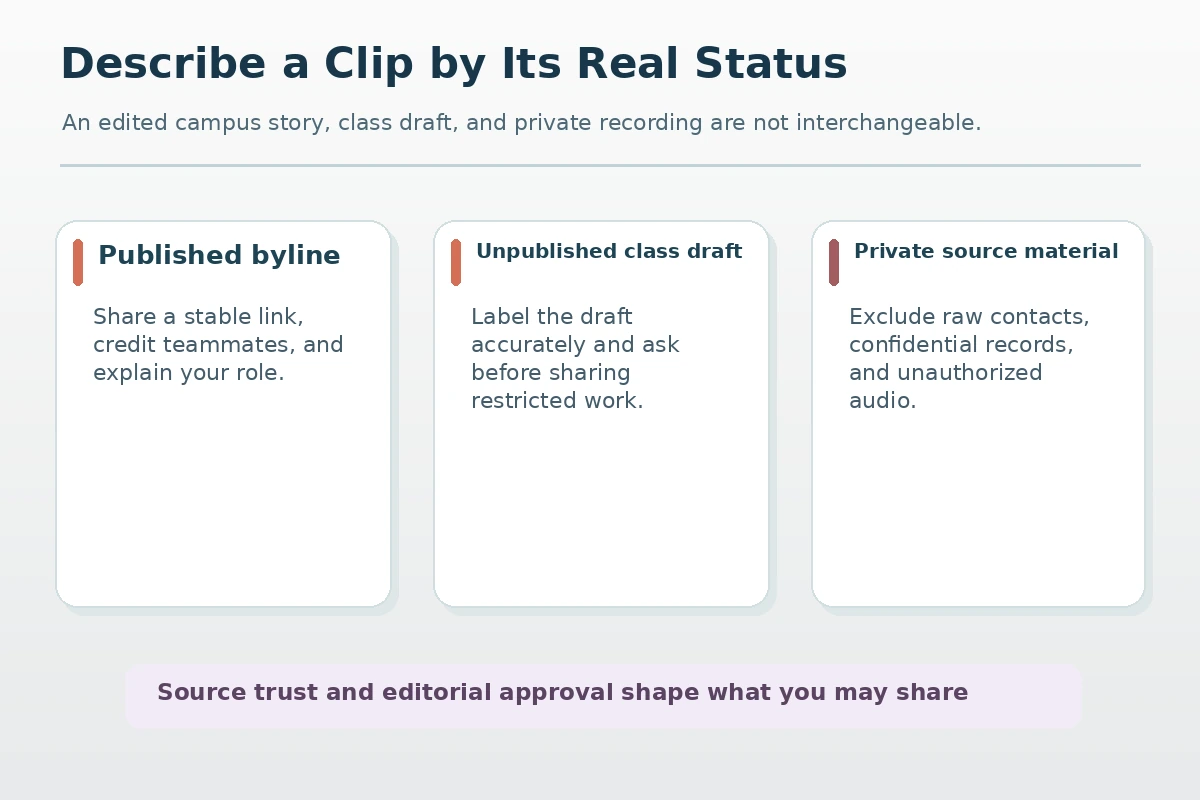
| Class assignment | Clearly labeled draft | Never invent publication |
| Interview material | Approved excerpt or summary | Protect source details |
Choose Clips and Protect Source Information
For clips, provide stable links with bylines or a clearly identified draft PDF if the employer accepts unpublished samples. If a paywall prevents access, follow the outlet’s rules before providing a file. Do not post unpublished newsroom documents, a source’s private contact information, or raw interview recordings in an open portfolio. Consent to an interview does not automatically mean consent to release everything recorded or collected.
If you have no published clips, use a labeled class assignment, student-radio script, or edited newsletter story and explain the status plainly. A short excerpt can sometimes demonstrate an angle, verified facts, and clear prose more effectively than a large folder. Check permissions for images and graphics; a photo from the internet is not yours simply because you used it in a campus presentation.
Send a Letter That Can Survive a Copy Edit
Proofread names, pronouns, outlet titles, dates, beat descriptions, and URLs. Replace “I am passionate about storytelling” with a concrete account of your reporting method. Use active sentences that show what you did and identify where an editor or instructor checked the work. End with a brief availability line and a respectful request to discuss how you could contribute to the specified beat or production workflow.
Before submitting, test your portfolio on a device that is not logged into your school accounts. Make sure the link leads to the promised sample and not a private dashboard, and that captions credit collaborators. Keep the submitted version and posting for interview preparation. A good journalism cover letter displays care with attribution and correction from the first sentence to the last, without pretending every student assignment was published.
A Complete Example Letter With Truthful Project Details
Illustrative example only: The application below is fictional and must be rewritten using the applicant’s real work, program, employer, and availability. Do not copy any hypothetical experience as a factual achievement.
Dear Editorial Internship Team,
I am applying for the Reporting Intern position. For our student publication, I interviewed campus organization leaders about a proposed schedule change, checked dates against posted records, and drafted a story that went through student-editor review. During editing, I revised a sentence that went beyond what the sources could confirm and added attribution for a contested claim.
I enjoy the research and revision work that makes a story useful to readers. I can share the published clip and explain my reporting, the editor’s contribution, and how I handled source confirmation. I would be eager to support your team with background research, fact checks, interviews, and clear drafts while following your newsroom’s standards and editorial direction.
Thank you for reviewing my application. I would welcome a conversation about the role and the reporting skills I am working to strengthen.
What a Realistic Revision Looks Like in Practice
A fictional applicant puts “investigative journalist” in a letter after writing one class essay using three online articles. The claim is too broad. The applicant can instead show a genuine student-media story, explain who they interviewed, and describe the independent record used to corroborate a factual statement. If there is no publication, that status should be explicit. The result is more credible even without a grand title or audience figure.
The candidate then applies to an audio newsroom and sees that the role asks for transcription and fact checking rather than longform print reporting. They select a student-radio script, note that an instructor reviewed it, and explain how they checked speaker names and clips before the class presentation. They do not attach raw recordings containing private contacts. This invented revision demonstrates matching work samples to duties while respecting source and editorial boundaries.
How We Research and Verify Internship Letters
We checked primary occupational guidance and career-center writing advice on 2026-11-14. The UC Berkeley Career Engagement cover letter guide recommends relating an applicant’s concrete experience to the exact organization and role. The BLS journalists occupational profile supports this article’s treatment of reporting, source interviews, checking, and editor review. Descriptions of class projects and model letters here are hypothetical teaching examples, not reports of applicants or actual hiring outcomes. Sources describe general work and eligibility; the employer notice and authorized supervisors determine internship duties. For commercial relationships and editorial transparency, see our affiliate disclosure.
More Resume and Cover Letter Guides
Follow the posting. If drafts or class assignments are accepted, label them accurately and show the reporting and editing process.
Yes, with correct byline, credit and permission to share. Explain what you reported and what the editor changed.
Only if the description is accurate and supported by your reporting record. One class project does not automatically establish that professional role.
Not without appropriate authorization, consent and compliance with the newsroom or school rules. A safe summary may be more appropriate.
Explain how you responded to feedback and verified changes. Accurate revision is a normal part of newsroom work.