
A legitimate virtual assistant job describes real support work, a known employer or client, an agreed schedule, and safe access to the systems used. Before applying, decide whether the assignment is calendar management, inbox triage, document preparation, research, or another specific service. The name “virtual assistant” does not establish who can approve payments, contact customers, share files, or speak for a business. Ask about those permissions before you accept an account invitation or handle sensitive records.
Translate the title into real weekly tasks
Virtual assistant is a service label rather than a uniform job classification. One client may need help confirming appointments and sorting an inbox; another needs research notes, invoice preparation or meeting follow-ups. An administrative assistant occupation profile from O*NET documents scheduling, correspondence and electronic records as recognizable duties, but it does not establish what a particular remote client is hiring you to do. Start with the promised outputs, not a list of fashionable apps.
Ask the contact to describe one typical week and one task that should always be escalated. A credible description might say “prepare a meeting agenda for the manager to approve.” A concerning description says “handle everything,” especially when coupled with vague business identity or instant hiring. Distinguish preparing a payment list from authorizing payments. Even when a client calls you a partner, approval authority should be explicit.
Check the work arrangement and availability
An opening may describe employee work, a contract assignment, freelance services or agency placement. The label affects onboarding, billing, expectations and who gives instructions, but a job advertisement alone does not establish your legal classification. Request the actual agreement and clarify the service window: fixed coverage hours, response-time expectations, occasional meetings and any time-zone overlap. Working from home can still involve synchronous commitments.
Compare your reliable availability to the requested tasks. If the client expects same-hour customer replies but you can only work late at night, there is a mismatch even if the weekly workload looks small. Record changes requested during the interview. A flexible freelance scope that doubles without a revised brief can become an endless on-call duty; ask how priority changes and additional work are agreed upon.
Map account access to specific permissions
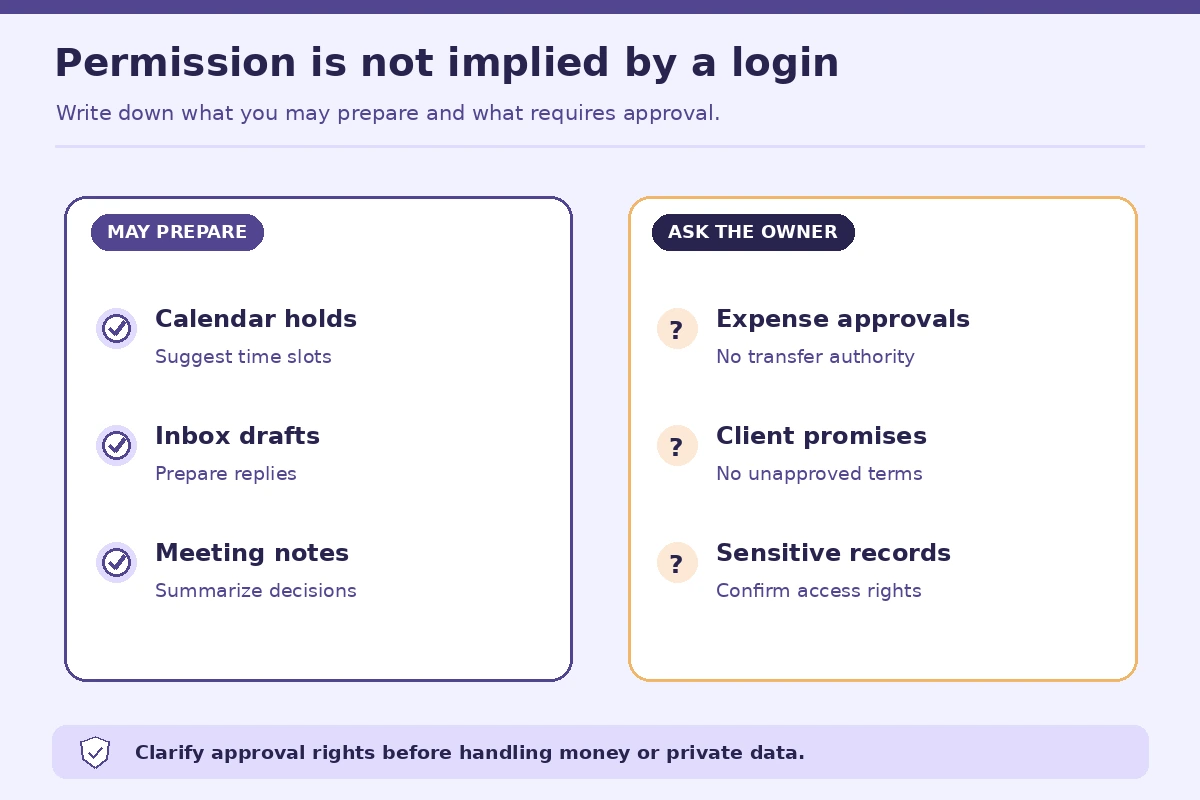
Handle access as a work requirement, not a casual favor. A legitimate client should be able to explain which systems you need, which actions are authorized and how access will be revoked when the assignment ends. Prefer accounts assigned to you with appropriate permissions rather than borrowing a manager’s personal password. Do not send login details through a public portfolio or a stranger’s messaging link. Ask whether any confidential customer, employee or financial records will be involved.
For example, an assistant may be allowed to draft a reply in a shared inbox but not send a refund promise. Someone may arrange a meeting but not commit the executive to an unapproved contract. Use a two-column permission map: “may prepare” versus “needs approval.” If the client cannot identify who approves sensitive actions, pause the task until the owner provides direction.
Build proof of an organized handoff
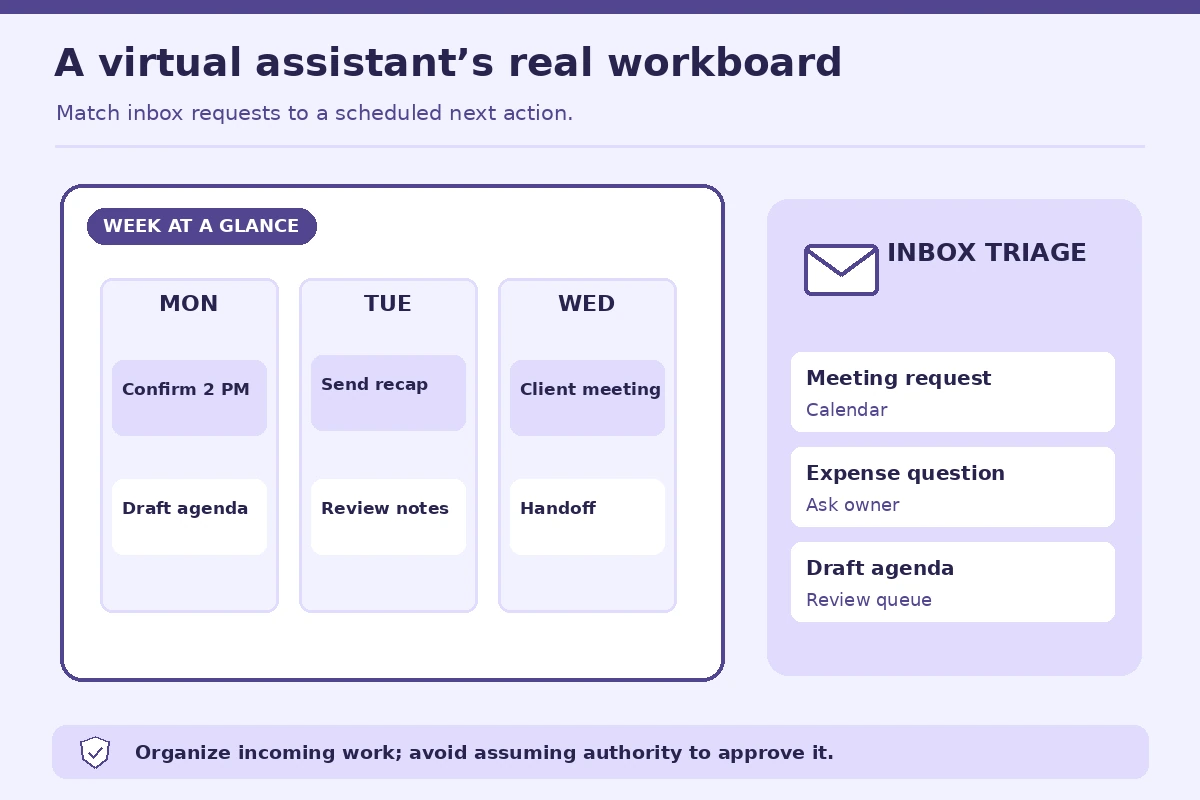
You can show administrative judgment without revealing a former employer’s data. Create an illustrative calendar conflict, a fictional inbox triage list and a clear status note that tells a manager what has been completed, what is waiting and what requires a decision. Label these artifacts as samples. A good sample does not pretend that fictional clients or fabricated appointment counts are past accomplishments.
If you have actual experience, describe it accurately: arranging meeting times, formatting documents, tracking requests or coordinating volunteers. Say which tools you used only if you really used them. A concise résumé bullet can explain the kind of handoff performed without attaching private emails or lists of contacts. The credibility comes from explaining boundaries and follow-through, not from claiming to manage a “six-figure business” that you never served.
Evaluate a client intake brief
Before work begins, write down the organization, contact, authorized tasks, excluded activities, tools, data sensitivity, working hours and review process. A hypothetical brief might allow calendar scheduling and draft agendas while withholding permission to approve expenses or disclose participant details. The distinction is helpful even for a short paid trial. Ask who answers when the normal contact is unavailable.
When work spans several clients, keep their records, appointments and communications separated. A draft made for one business must not be reused for another without permission. Determine whether you may use an automated writing or scheduling tool with client information; do not assume it is approved. An employer may have restrictions that are stricter than your usual preferences.

Recognize fake assistant recruiters
A common warning pattern is a message promising immediate home-based work with no meaningful interview, followed by a request for your bank details, a payment, or a check to purchase devices. The FTC warns that fraudulent recruiters can imitate real employers and quickly move candidates toward sensitive forms. Independently search for the official website and verify that the named person or recruiting process belongs to that organization.
Do not buy gift cards, transfer a check overpayment or grant remote control of your own computer to an unverified contact. Do not send Social Security numbers, tax forms or banking information merely to get an interview slot. If an employer asks for legitimate onboarding documents after a verified hiring decision, use an authenticated channel rather than treating every emailed form as safe. Report suspicious approaches rather than continuing a risky conversation.
Ask five questions before saying yes
What are the recurring deliverables? What hours require immediate attention? Which tasks need approval? How will access be granted and removed? Who confirms payment and any change in scope? These questions turn a broad job title into testable working conditions. Keep written answers next to the listing and compare them with the final agreement or offer.
You do not need to promise availability around the clock to sound reliable. Offer a realistic schedule and the tasks you can handle carefully. If the client wants a licensed, specialized, financial or legal judgment, ask for the responsible qualified reviewer instead of expanding your claim. A narrower, explicit assignment is more sustainable than a vague assurance that you will take care of everything.
How We Research Remote Job Roles
We compare occupation descriptions and relevant official guidance with the precise work-from-home search intent. We distinguish repeatable job-search decisions from employer-specific terms, credentials, publication authority and task availability. Every example in this article is fictional and intended as a worksheet, not an actual vacancy, employer policy, compensation estimate, legal conclusion or promise of hiring. We checked the linked resources on November 11, 2026 and do not claim to have verified private WordPress drafts or current openings.
Primary and consumer-protection sources checked November 11, 2026: www.onetonline.org — O*NET documents common administrative functions such as correspondence, scheduling, file organization and information handling.; consumer.ftc.gov — FTC identifies fake home-work opportunities, fees and check schemes as warning signs requiring independent verification.; consumer.ftc.gov — FTC describes fraudulent remote recruiters seeking early personal information and recommends checking sender identity and the recruiter.. These sources explain duties or warnings; they do not certify any specific advertised job.
Our guidance is informational and editorially independent. See the JobAsk affiliate disclosure for the site’s relationship and link policy. The internal next steps here are not paid endorsements.
No. Duties vary: some focus on scheduling, written communication or records, while others require live calls or customer coverage. Check the actual task list.
Ask the client how role-based access should be provisioned. Avoid sharing personal passwords or moving confidential records into unauthorized tools.
Use labeled fictional calendar, inbox and handoff examples, or authorized redacted past work. Explain scope, tools and decision limits honestly.
No. Listings may describe employment, contracts or agency placements. Review the actual agreement instead of assuming the classification from a title.
Unverified recruiters demanding money, check deposits, early banking details or instant sensitive onboarding are serious warnings. Verify the employer independently.