
Work-from-home social media jobs should tell you which communication tasks you own and who can publish or answer publicly. Writing captions, coordinating an editorial calendar, reviewing comments, preparing analytics notes and representing an organization are different levels of responsibility. A credible listing identifies platforms, audiences, review steps, account access and coverage needs. Before applying, compare those particulars rather than equating personal social media use with professional authority to speak for a brand.
Identify whether the job creates or publishes content
A social media coordinator might organize drafts, schedule approved posts, monitor questions and summarize campaign outcomes. A community specialist may respond to users and escalate difficult conversations. A public relations specialist may plan broader messages, handle media requests or coordinate an organization’s reputation. These tasks overlap but do not automatically share approval authority. O*NET notes that public relations work may specialize in social media; individual employers still set their own boundaries.
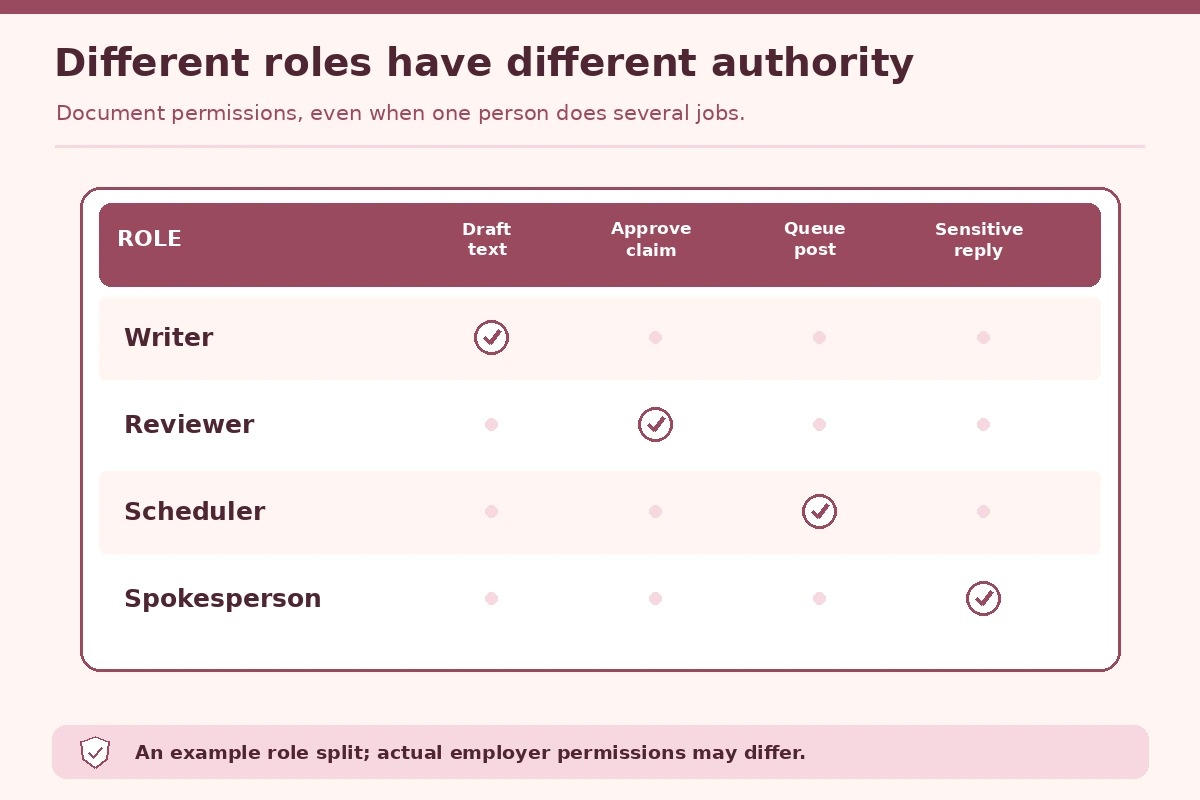
Read verbs in the posting carefully: “draft,” “schedule,” “approve,” “publish,” “respond,” and “represent” imply different decision rights. Ask who signs off on a sensitive statement and what happens outside regular business hours. A listing promising full account control to someone with no onboarding or policy access deserves additional scrutiny. You should not need to guess whether you can delete criticism or promise compensation to a customer.
Inspect the calendar and review workflow
A useful remote work process names the intended audience, post purpose, source material, content owner, review deadline and publishing date. Confirm whether you are expected to create original assets or work with an existing team, and who checks factual claims, rights and brand tone. A content calendar is not enough if no one can approve the message or handle a late correction.
Create a fictional one-week sample showing a draft post, a reviewer comment, a revised version and a final status. Use invented dates, brands and harmless messages; never display a client’s unpublished campaign. Show that you can retain change history and make a safe handoff. This is more informative than presenting a generic viral-post collage without context or proof of what you contributed.

Clarify who speaks for the organization
Questions from users range from ordinary requests for directions to complaints involving safety, confidential information or possible legal issues. An assistant may be authorized to answer routine questions from an approved response library while routing sensitive matters to a manager. Set up an escalation path with contact names or roles, response windows and a safe alternative when no approver is available.
Never promise a refund, disclose customer data, make clinical or legal statements or adopt an aggressive public tone merely because you can log into the account. Document which replies are pre-approved and which require review. If a sample complaint references personal information, replace it with a fictional placeholder in any training or portfolio material. Account access is not the same as authority to make commitments.

Screen platform and account permissions
A legitimate employer should explain how a team member gets access to business profiles, scheduling tools, approved assets and performance reports. Ask whether you receive individual authorized access and how permissions will be reduced when the role changes. Avoid using a personal password to run someone else’s professional presence or moving export files into an unauthorized service. Find out who owns the content archive and whether personal devices are allowed.
Working from home may involve login approvals, secure channels for creative files, asset licenses and time-zone coverage. A role that says “manage all our accounts” without an access procedure or content owner is not sufficiently defined. If a recruiter asks for your personal social login as a test, verify the request through an official organizational contact before revealing anything.
Show proof with roles and outcomes separated
Portfolio pieces should say exactly what you did: drafted copy, selected candidate images, compiled a calendar, prepared a reporting note or moderated approved comments. If you worked as part of a team, credit others’ roles appropriately and secure permission for external samples. Personal follower counts alone do not demonstrate the same skills as writing for a regulated service, nonprofit, university or customer support team.
For an independent sample, choose a fictional community event and build one calendar entry, two caption alternatives and a reviewer handoff. You can explain what success would be measured by without inventing real impressions, conversion rates or employer outcomes. A hypothetical example is a planning artifact, not evidence that a campaign ran or that it achieved a particular result.
Check workload beyond scheduled posts
Posting a few items per week may still include revision cycles, accessibility checks, user questions and urgent messages. Ask how many channels the role covers, who answers after hours and whether a separate customer-service team handles escalations. “Remote” may refer to where you sit, not to unlimited flexibility. Coverage needs and approval delays can matter more than the number of posts.
Check whether the job involves organic communication, paid advertising, community moderation or analytics reporting. A social media assistant should not claim responsibility for purchasing ads or setting budgets if those decisions belong to another team. Compare roles using a short matrix of drafting, publishing, customer responses, reporting and final authority. Mark unclear boundaries as questions before accepting an offer.
Verify the recruiter and the brand identity
A real employer or agency should be traceable through a credible official website or documented client relationship. Verify that the exact vacancy exists and that the contact email belongs to the organization. The FTC warns that remote-work scams can imitate employers, rush interviews and demand payment or sensitive information before a legitimate hiring process. A popular-looking social profile by itself does not verify employment.
Do not buy access to a supposedly exclusive queue of social media jobs, pay for required equipment through a recruiter’s private account or deposit a “reimbursement check” and send money back. If you receive a job offer through an unrelated direct message, verify it independently. Avoid sharing account recovery codes or business credentials with anyone whose identity and authority have not been confirmed.
Choose the narrowest credible commitment
A strong application could say, “I can draft and track scheduled content, prepare basic reports, and route sensitive public replies to the designated approver.” Adapt that sentence to your real experience and the specific job. Do not imply you personally managed a brand’s entire public reputation because you made a few school posts or scheduled volunteer messages.
Use your final comparison to confirm scope, platform access, reviewer, hours and proof requirements. The best role is not necessarily the one offering the most platforms or the largest promised audience. It is the role where you can responsibly perform the stated communications tasks and the organization has a workable approval and escalation process.
How We Research Remote Job Roles
We compare occupation descriptions and relevant official guidance with the precise work-from-home search intent. We distinguish repeatable job-search decisions from employer-specific terms, credentials, publication authority and task availability. Every example in this article is fictional and intended as a worksheet, not an actual vacancy, employer policy, compensation estimate, legal conclusion or promise of hiring. We checked the linked resources on November 11, 2026 and do not claim to have verified private WordPress drafts or current openings.
Primary and consumer-protection sources checked November 11, 2026: www.onetonline.org — O*NET identifies public communication, information responses and social media specialization as parts of public relations work.; www.bls.gov — BLS describes PR specialists drafting social content, monitoring public discussion and maintaining organizational image.; consumer.ftc.gov — FTC recommends independently verifying remote vacancies and avoiding upfront-payment and fake-check scams.. These sources explain duties or warnings; they do not certify any specific advertised job.
Our guidance is informational and editorially independent. See the JobAsk affiliate disclosure for the site’s relationship and link policy. The internal next steps here are not paid endorsements.
Only when the employer has explicitly authorized it under the relevant policy. Drafting or scheduling access does not automatically grant publication authority.
Not always. Planning content, publishing, reporting and responding to community questions are distinct responsibilities that a job may combine or separate.
Use authorized past work or clearly fictional content calendars and captions. Avoid confidential analytics, unpublished client plans and private messages.
Some require live monitoring, team reviews or evening coverage. Check the actual schedule and escalation expectations rather than assuming full flexibility.
Find the position through official employer channels, verify the recruiter and reject demands for fees, equipment-check transfers or account passwords.