
A maintenance technician resume objective should say what kind of building, equipment, or routine service work you can perform and how you handle tasks beyond your training. Maintenance postings range from apartment and facilities upkeep to specialized industrial repair. An applicant who completed basic repairs under supervision should not imply they are a licensed electrician, HVAC technician, or independent machinery specialist. A strong opening can identify honest work-order experience, preventive checks, and safe escalation, then name the role sought. This gives hiring managers an accurate starting point without overstating technical permission.
Identify the actual maintenance track in the posting
Read the employer’s task list before writing the objective. Some jobs emphasize routine building upkeep, inspection rounds, and work-order completion. Others require troubleshooting complex production machinery, electrical systems, or HVAC equipment. BLS describes general maintenance workers performing varied repairs and coordinating specialized tasks with qualified tradespeople. That occupational breadth does not qualify every applicant for every repair. Underline the systems you know and mark the credentials, driving needs, and training the employer explicitly requires.
A school custodian who logged broken fixtures may apply to facilities maintenance with relevant reporting experience, but should not claim industrial troubleshooting. A construction helper may bring tool handling and safety briefing experience without independent diagnosis skills. Write the objective for the job’s actual setting and entry level. If you are targeting a trainee job, say trainee; if the position demands a current license that you lack, an objective cannot substitute for that requirement.
Make a work-order log into proof
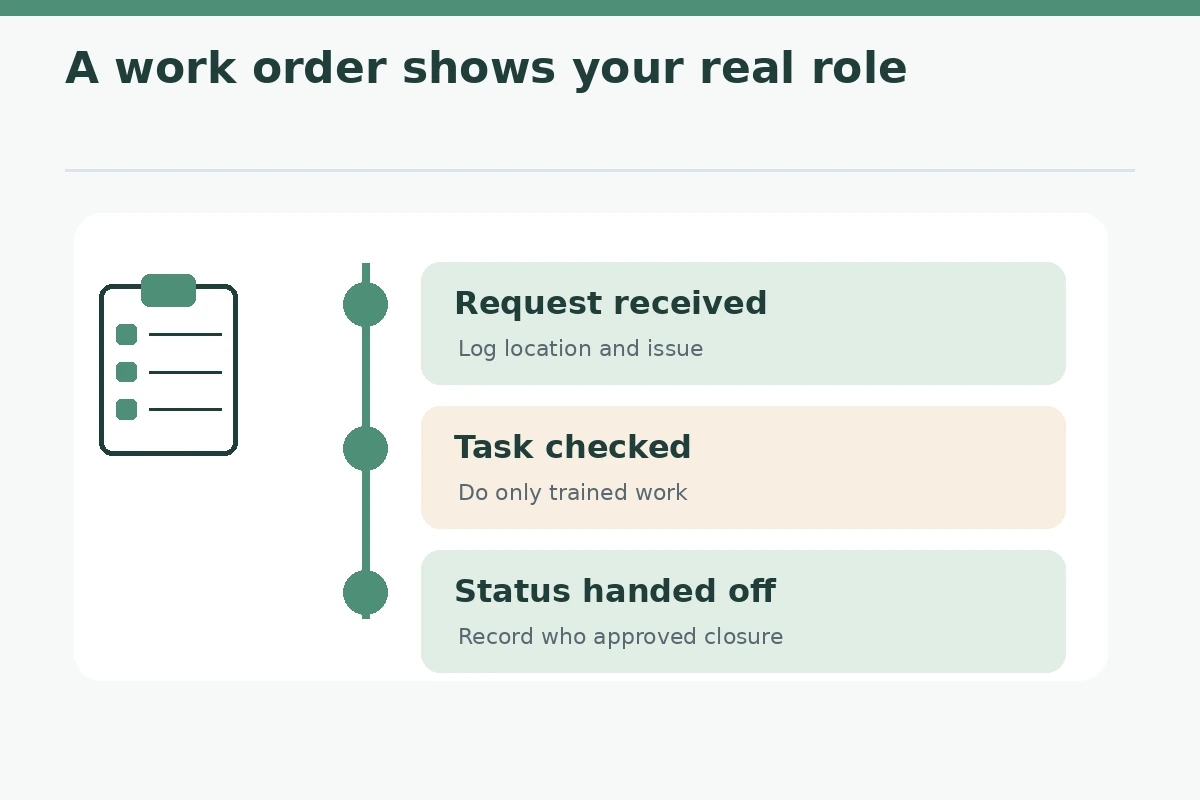
Think through one real task from request to closeout. Who reported the issue, how was it recorded, what inspection or authorized action did you take, and who approved completion? Work-order terminology becomes meaningful when it is tied to a specific system or paper log. You can describe a maintenance round, filter-change checklist, supply restock, or supervised minor repair when that work really happened. Do not turn a casual observation into a completed repair.
A credible hypothetical example is: “During a facilities internship, entered room numbers and reported leaking fixtures in the work-order system, then checked completion with the assigned technician.” It demonstrates orderly reporting and coordination, not an unsupervised plumbing repair. If you changed lightbulbs under a supervisor’s directions, say that; if a specialist handled wiring, show that you escalated instead. Focus on actions, evidence, and approval boundaries rather than dramatic equipment claims.
Write a concise trainee objective
Illustrative objective: “Facilities support worker seeking a maintenance technician trainee role; experienced in logging repair requests, checking routine upkeep lists, and referring complex issues to the assigned technician.” Replace the background and verbs to match your real history. This opening gives the employer the intended job and two pieces of relevant evidence. It does not promise that the candidate will independently fix energized equipment or handle regulated work.
The weaker alternative is “Expert technician who can repair any system with no supervision.” That statement is hard to prove and can suggest dangerous overreach. A repair trainee should not bury limited training under “expert” or copy manufacturer-specific qualifications from a posting. A better objective often emphasizes following written work instructions and reporting status accurately. Support that with a dated work-history bullet, training record, or verifiable course rather than an invented certification.

Show tool familiarity at the correct level
List tools you actually used and in what context. Cleaning equipment, hand tools, measurement tools, and maintenance software are not interchangeable, and their safe use varies by task. Observing a technician use a multimeter is not equivalent to testing energized circuits. If your experience is a school workshop, say “technical coursework” and include the safe activity you performed. Avoid saying “fully proficient” unless you can demonstrate independent use within your authorized role.
A work-history bullet can name a genuine preventive task, the checklist used, and the supervisor to whom you reported findings. Do not invent before-and-after savings or uptime improvements. If a posting mentions lockout/tagout, specialized equipment, heights, or chemical handling, confirm the exact training and employer procedures rather than claiming readiness from general DIY practice. An objective should never encourage someone to accept a task outside instruction or permission.
Separate a report from a repair authorization
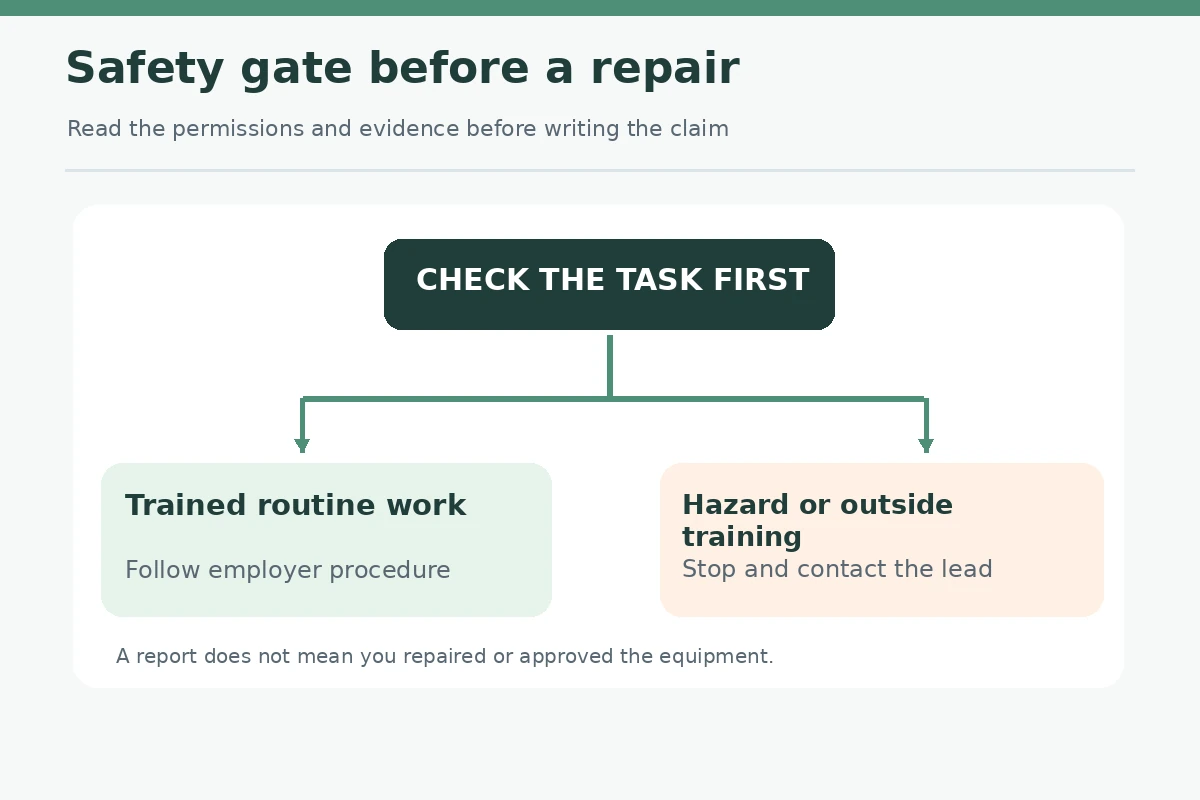
Maintenance work includes watching for hazards and recognizing when to stop. You may find a damaged cable, fluid leak, or strange machine noise during rounds. Reporting the condition and securing the situation through approved procedures is relevant experience even if you did not perform the repair. Licensed or specially trained personnel handle work beyond general maintenance scope. This boundary is central to a believable resume: “identified and reported” is not a weak substitute for “repaired” when it is the truth.
In your objective, avoid verbs such as “certified,” “approved,” or “diagnosed” when the real duty was to notify a lead. Mention a verified safety course if completed and current, with its exact name elsewhere. Do not use abbreviations you cannot explain. A hiring manager may ask who signed the work order or verified that equipment was safe to return to service. Your opening and experience bullets should give consistent answers.
Adapt an objective for an experienced worker changing sites
An experienced general maintenance worker moving into apartment maintenance may foreground resident requests, records, and actual preventive service. Someone moving into a hospital facility should review specific requirements rather than implying that prior building experience automatically qualifies them to work on regulated medical equipment. A transition objective can explain interest in the new environment, but it should distinguish transferable service habits from new technical systems requiring orientation.
CareerOneStop notes that an objective is useful when targeting a new job direction, while a summary can better present established experience. If you already have a well-documented history of maintaining equipment and serving work orders, a summary with verified systems may be stronger. Do not stack an objective and a summary that repeat the same claims. Choose the opening that helps the employer understand your background fastest.
Inspect the final wording and evidence
Check every technical term against a real task, course, or credential. Ask: what exactly did I inspect, perform, record, and refer? What was supervised? Did I sign off the work or only note that someone else had completed it? Keep the objective direct and short. A practical wording test is to ask whether the opening still makes sense if the employer removes generic words such as reliable, hardworking, and passionate. The remaining line should describe the job and evidence.
Finally verify that the equipment and work order examples below the opening support it. If the posting requires a driver’s license, trade credential, or availability schedule, address those details in the correct place and do not invent them in your objective. Review the exported resume on a phone as well as a computer; broken lines can make technical details hard to read. The goal is trustworthy matching, not a guarantee of a maintenance job.
How We Research and Verify Resume Claims
We reviewed the Bureau of Labor Statistics occupational profile for the tasks and role boundaries discussed above. For resume opening guidance, we checked CareerOneStop’s special resume tips for recent graduates and top-of-resume guidance. These resources do not confirm individual employers’ requirements or establish a candidate’s credentials. Compare the actual posting and your own documents before deciding what to claim.
All proposed resume lines and work scenarios in this guide are illustrative, not descriptions of real applicants or guaranteed hiring outcomes. We do not verify your credentials or imply employer endorsement. Source descriptions are paraphrased. Review the site’s affiliate disclosure; this article does not claim any paid employer placement or affiliate partnership.
More Resume and Cover Letter Guides
Use documented workshop, facility support, or supervised practice if the vacancy permits beginners. Do not call it paid employment.
Only if you have the appropriate actual experience and permission for the specific work. Reporting a problem is distinct from repairing it.
Yes. Describe entering or tracking requests honestly and do not claim you completed the underlying repairs.
Mention only real, current credentials. Give their official titles and issuing details in a credentials section.
Often, yes. A summary can foreground documented systems and responsibility while an objective helps explain a trainee or transition target.