
A laboratory technician resume objective should identify the kind of laboratory you are targeting, the procedures you performed, and the supervision or credential boundaries that apply. “Laboratory” could mean a university research group, product-testing facility, environmental laboratory, or a medical clinical laboratory. These settings may share careful records and sample labeling, but they do not share identical eligibility or permissions. Someone who completed a chemistry practical should not claim they analyzed patient specimens. A good objective shows genuine bench experience or coursework and names the next role with accurate scope.
Identify research, industrial, or clinical laboratory work
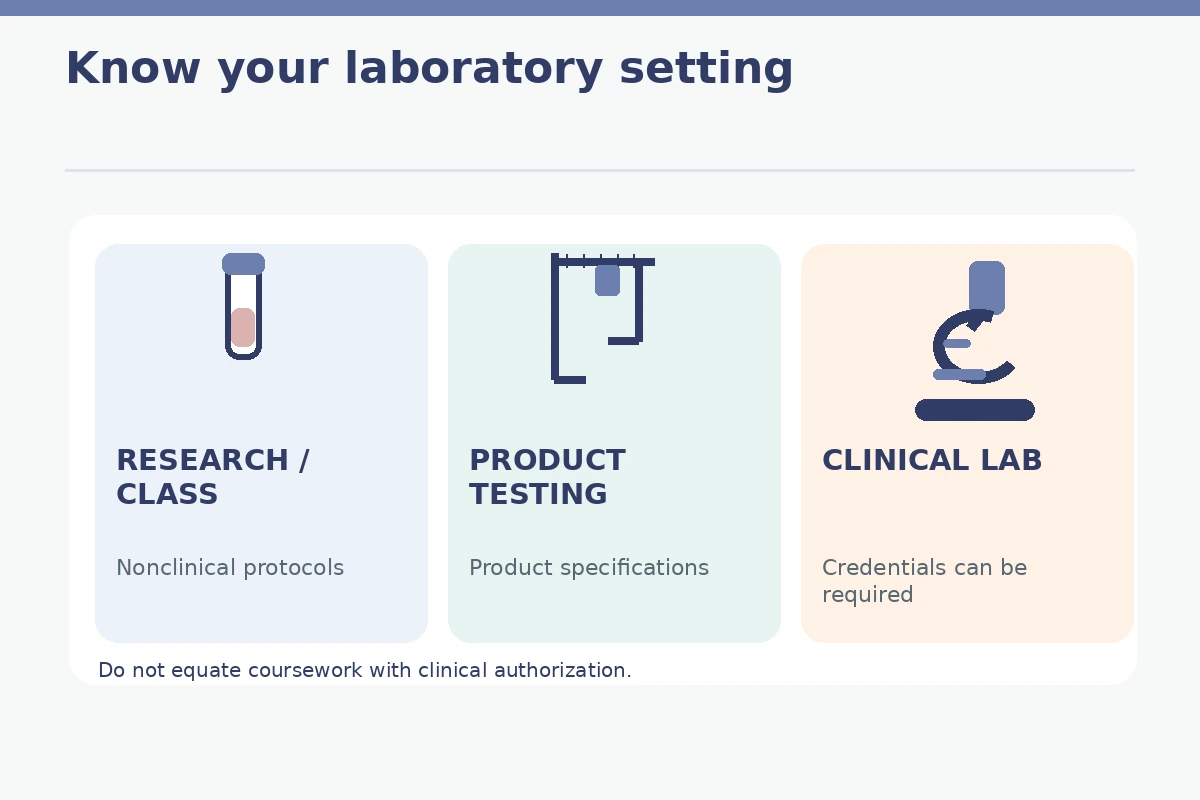
Start with the employer’s actual laboratory. Academic research support may involve solutions, nonclinical specimens, equipment logs, and structured data collection. Quality or product testing may focus on samples, specifications, and controlled procedures. Clinical laboratories handle medical specimens and diagnostic testing and can have state licensure or certification requirements. BLS says clinical technician and technologist responsibilities differ, and some jurisdictions regulate those workers. An ordinary research class does not confer clinical testing authorization.
Write a short eligibility note before drafting: program completed, instruments personally used, sample types handled, supervisor, and requirements still outstanding. The objective might target an academic lab assistant if your experience is course-based; a clinical technician objective requires accurate clinical education and credential wording. Do not imply permission to work with human specimens, hazardous material, or regulated equipment because you participated in a general science project.
Gather the evidence in a sample-and-method log
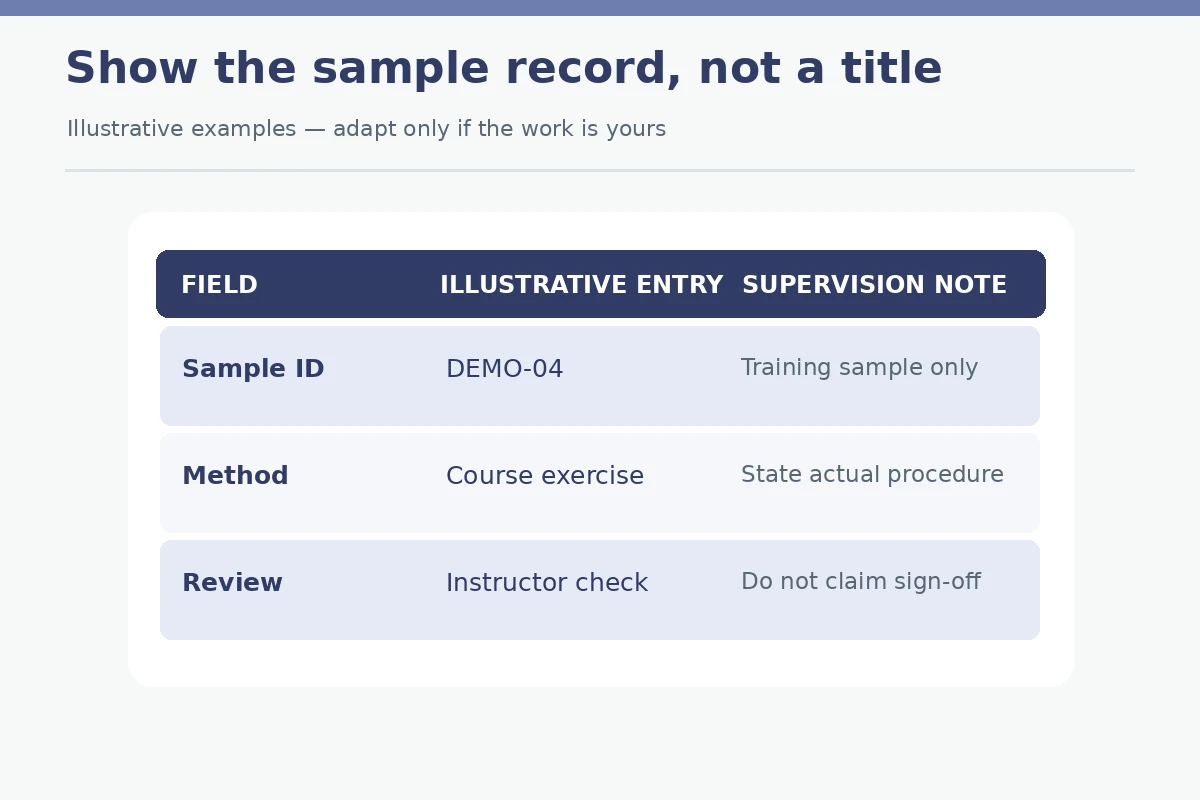
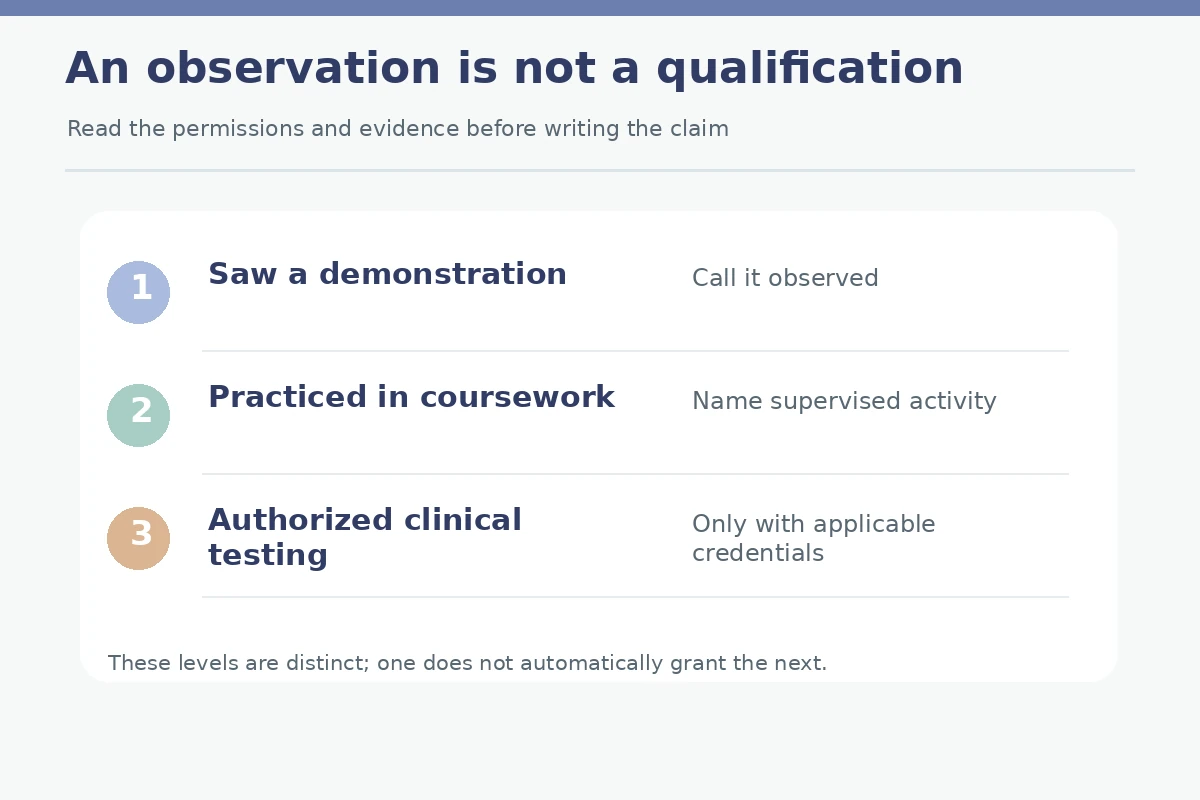
An effective evidence table lists the sample category, method, your action, and where results were reviewed. A chemistry student might have weighed nonclinical samples, recorded trial conditions, and checked calculations with a lab instructor. A research assistant may have prepared labeled materials and maintained a controlled notebook. Be explicit about what you did rather than listing a long menu of instruments from the job description. If you only watched a demonstration, separate it from hands-on work.
Practice projects can support precision, basic measurement, and chain-of-record habits. They do not establish authorization to interpret patient results, perform independent clinical tests, or sign quality reports. Do not include confidential patient identifiers, proprietary methods, or restricted sample details as portfolio proof. Use a hypothetical blank-form illustration or a general description of the record instead. Naming whether a protocol was provided or developed by you also avoids claiming someone else’s research contribution.
Use a beginner objective anchored in real coursework
Illustrative objective: “Biology student seeking supervised research laboratory technician support; completed course exercises in sample labeling, pipetting practice, and recording observations in structured notebooks.” That example should be adapted to real training, not pasted unchanged. If you have never used a pipette, remove it. The strength is the connection between the target environment, practiced actions, and supervision rather than a claim to be fully trained across laboratory methods.
A weaker objective says, “Lab expert ready to diagnose diseases and independently manage all testing.” That wording inappropriately asserts clinical scope for many early-career applicants. A safer objective for a candidate with the right credentials might mention their completed clinical laboratory technician education, but never invent licensure. The resume should identify qualifications precisely and in the relevant section. When an employer requires formal certification, the objective is not a workaround for missing eligibility.
Translate school projects into controlled tasks
Do not assume a science degree automatically proves the technical method a vacancy asks for. A class may teach scientific reasoning but give limited instrument access. Translate work into accurate verbs: prepared, labeled, measured, observed, entered, compared, and reported. For a supervised project, specify which portions were yours. “Recorded observations for a group experiment” is honest; “led laboratory quality control” may not be. Make the experience or projects section substantiate each objective claim.
A useful hypothetical example is a nonclinical water-testing class where a student collected samples according to instructions, logged collection details, and compared readings under instructor review. That can indicate comfort with documented processes, not a license to run environmental compliance testing independently. If you contributed to a team dataset, name your portion and give credit for shared work. Choose the facts most relevant to the target laboratory rather than copying every course title.
Explain equipment familiarity without exaggeration
Laboratory employers may use microscopes, balances, analyzers, or software systems with local procedures and competency checks. “Familiar with microscopes from class” is not equal to “competent to calibrate diagnostic analyzers.” Name instruments only if you actually handled them and can explain the standard setup, measurements, and review. If you used sample data in a spreadsheet instead of an instrument, say so. This lets employers judge your learning needs accurately.
Clinical labs may have additional legal and employer credential checks. BLS notes that some states require laboratory personnel licenses and that technicians and technologists often have different education pathways. A resume cannot resolve a credential gap through vague phrasing. Instead, check the worksite’s posted requirements, use the exact status of any credential, and identify whether your objective points to a supervised trainee or a qualified position.
Decide when an objective helps and when to use a summary
For a first lab role, a concise objective can connect science coursework to a specific setting. CareerOneStop recommends highlighting a degree, relevant skills or accomplishments, and the job target when recent graduates use an objective. If you have established lab experience, a summary describing validated methods and responsibilities may make better use of the opening space. Either way, do not duplicate an entire equipment inventory at the top; keep specifics in projects and experience.
A lab objective generally needs only one to three sentences. State whether you seek research support, quality testing assistance, or properly credentialed clinical laboratory work. A generic line about being eager to advance science can fit too many employers and gives no evidence. An accurate sample type, procedure, or documentation practice is more useful, provided you can safely disclose it. Keep all examples in the article separate from your own real history.
Run the sample-privacy and supervision audit
Before submitting, verify the laboratory type and training requirement, then check every technical noun against actual use. Were you responsible for sample labeling or only present while a colleague labeled samples? Did you record data or interpret it? Could you approve results, or did a supervisor do so? Replace imprecise verbs with observed tasks. Do not expose patient, client, or unpublished research data to demonstrate accuracy; a generic project explanation is enough.
The opening should be consistent with the dates and program names below. Mark “in progress” for incomplete training and use correct credential titles. Export the resume and check that the objective remains readable on a phone. A precise objective is the start of a verifiable story about training, careful records, and following laboratory instructions; it should never imply authorization that a program, employer, or state has not granted.
How We Research and Verify Resume Claims
We reviewed the Bureau of Labor Statistics occupational profile for the tasks and role boundaries discussed above. For resume opening guidance, we checked CareerOneStop’s special resume tips for recent graduates and top-of-resume guidance. These resources do not confirm individual employers’ requirements or establish a candidate’s credentials. Compare the actual posting and your own documents before deciding what to claim.
All proposed resume lines and work scenarios in this guide are illustrative, not descriptions of real applicants or guaranteed hiring outcomes. We do not verify your credentials or imply employer endorsement. Source descriptions are paraphrased. Review the site’s affiliate disclosure; this article does not claim any paid employer placement or affiliate partnership.
More Resume and Cover Letter Guides
Yes. Name a real experiment or measured task and state that it was coursework when appropriate.
No. Duties, samples, training, and credential requirements differ, especially for clinical testing.
No. Observation is not independent operation, qualification, or licensure.
Yes, accurately label it in progress, include anticipated completion if reliable, and do not describe it as earned.
A truthful, specific record of supervised procedures, sample logs, instrument use, and the person or process that reviewed the work.