
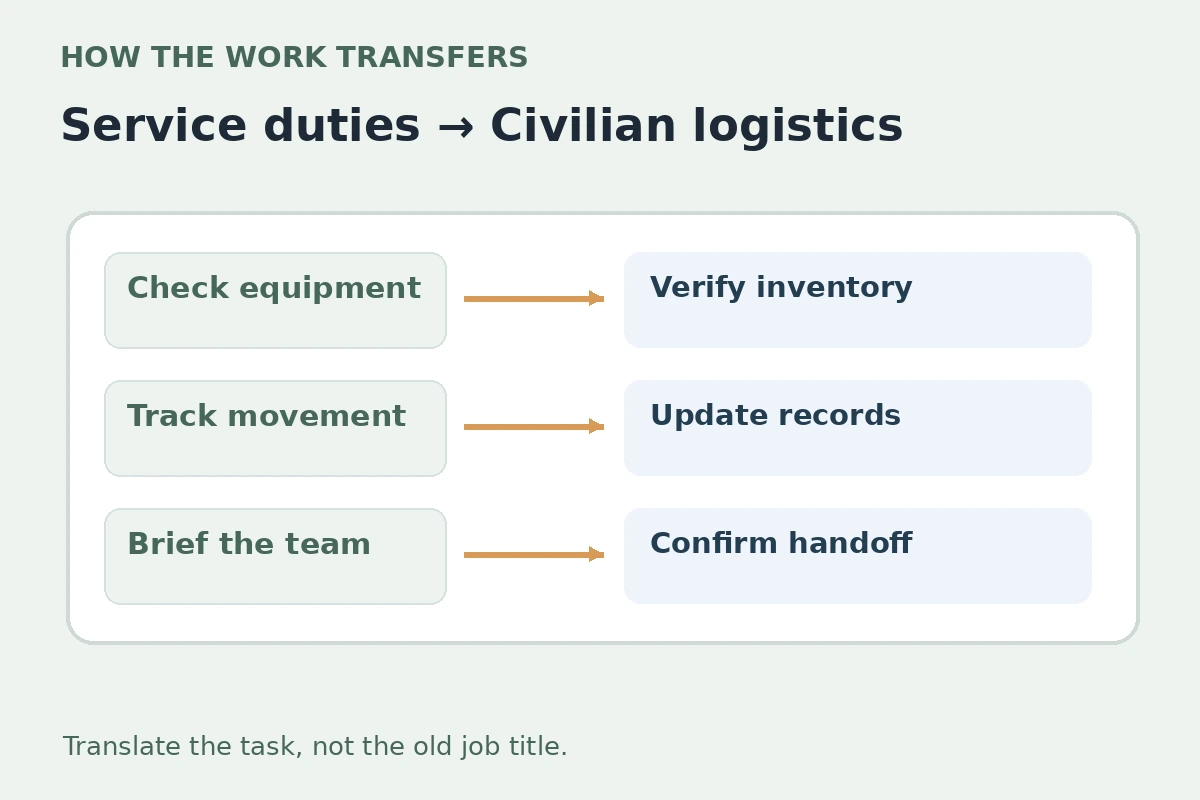
To use military transferable skills for civilian logistics in a career change, describe one task you performed, the evidence that supports it, and the closest duty in the target role. Do not treat the new title as something you have already held. Check equipment can demonstrate verify inventory, while track movement can show update records. The transfer is about a verifiable process, not guaranteed eligibility. Compare the target posting with your real responsibilities and mark any missing training or decision authority. The examples below are hypothetical phrasing patterns; use them only when they match your work, and keep confidential records out of applications.
Translate the duty before translating the title
A military occupational title can contain jargon a civilian logistics recruiter does not recognize. Start by listing the work you personally performed: tracking equipment, verifying inventory, preparing movement records, updating schedules, or briefing a new shift. Then choose a civilian description at the same authority level. For example, maintaining assigned supply records is not the same as directing a commercial distribution network. The Defense Health Agency advises explaining military skills in language civilian employers can understand. Keep your authentic service history while describing the actual work in plain terms.
Separate inventory handling from inventory ownership
Military supply assignments may involve physical counts, item identification, issue and return records, discrepancy reporting, and reconciliation procedures. Each can support an entry-level civilian logistics application if you really performed it. State whether you counted, updated, audited, or authorized a record change. Do not use ‘warehouse manager’ or ‘procurement director’ to summarize a supporting position. If a supervisor approved releases or orders, describe the preparation and escalation you owned. The receiving civilian employer can recognize accuracy and accountability without an inflated management title.
Make movement and dispatch experience understandable
Route coordination, load readiness, transport paperwork, and communication between teams may translate into dispatch or shipping support. Different military roles cover very different responsibilities, so avoid treating all service members as trained logisticians. Explain the records, timing, and confirmation steps you used at a level cleared for public discussion. A useful hypothetical bullet could mention checking movement documents and handing unresolved discrepancies to the responsible office. Never include sensitive routes, exact operational locations, restricted system details, or protected equipment information in an application.
Explain handoffs and incident reporting carefully
A well-structured shift briefing can demonstrate clear communication and continuity of operations. Describe how you summarized unresolved work, recorded the status, and identified the person receiving the handoff. That process is relevant to warehouse operations and transport coordination, but it does not imply authority over an entire civilian supply chain. When discussing incidents, focus on the generic decision sequence: recognize a discrepancy, verify available information, and use the approved reporting path. Do not disclose operational security details or suggest bypassing safety and reporting procedures.
Compare military discipline with employer systems
Civilian operations teams also use procedures, but their tools, commercial obligations, and regulatory environments differ. A military inventory application is not automatically equivalent to a warehouse management system, and an internal movement order is not identical to a commercial bill of lading. Review the posting for specific technology, documentation, driver’s licenses, and industry certifications. Mark which systems you have used, which share a general purpose, and which require training. Do not claim a credential based only on a similar task performed in service.

Use civilian occupation research to test fit
CareerOneStop’s mySkills myFuture can suggest occupations where workers use related skills, but suggestions are starting points rather than proof you meet employer qualifications. Compare logistics coordinator, shipping clerk, inventory control clerk, warehouse operations support, and dispatcher openings by actual tasks. Some managerial positions expect years of specific work experience. The BLS describes transportation and distribution management as oversight of staff, networks, inventory, and strategy. A verified recordkeeping background can be a strong stepping stone without directly qualifying you for those decisions.
Rewrite military jargon into verified skills
Replace unclear abbreviations with familiar actions: tracked, reconciled, logged, inspected, prepared, trained, briefed, and escalated. Keep your role’s actual scope. If you led a team, specify what tasks you assigned, checked, or coached, and avoid invented head counts. If you supported deployment logistics, do not imply civilian freight compliance expertise unless you separately acquired it. A plain-language bullet should answer what item or process you handled, which document was involved, and how the next person used your work.
Build a safe evidence portfolio
An applicant rarely needs to upload internal military records to prove a general business skill. Use a fresh fictional inventory sheet, an invented shipment checklist, or a blank handoff template designed from scratch. Label it as a practice sample. Do not share controlled forms, restricted identifiers, locations, clearance specifics, or internal system images. When discussing a real task, describe it at a safe general level and confirm any disclosure rules applicable to your service. Civilian employers can assess your process reasoning without access to protected operational information.

Prepare a civilian interview example
Choose one unclassified, shareable example where you found a record discrepancy or maintained continuity across teams. Explain the normal process, what you checked, whom you notified, and how the issue was documented. Avoid vivid operational detail and unsupported claims of strategic command. If a recruiter asks about unfamiliar civilian software, acknowledge the gap and explain how you learned previous record systems. The best story translates discipline into a repeatable workplace action without relying on military acronyms or overclaiming supervisory authority.
Plan the first step rather than a leap in title
Review the required schedule, on-site physical tasks, software, vehicle rules, and credentials for each posting. If you need civilian licensing or formal logistics training, confirm the employer’s exact standard before applying. Keep your military rank and occupational history accurate but explain functional duties in accessible words. Your final résumé and interview answer should demonstrate dependable records, appropriate reporting, and clear handoffs, while respecting information security and acknowledging which commercial responsibilities you still need to learn.
How We Research These Transferable Skills
JobAsk reviewed these public sources on November 17, 2026: Defense Health Agency recommends translating military terminology into recognizable civilian skills and using the Department of Labor occupation translator. BLS explains civilian transportation, inventory oversight, shipping, distribution, and management-level responsibilities. CareerOneStop mySkills myFuture compares skill use in a past job with other occupations and suggests careers to explore. The articles distinguish a general occupational task from the particular responsibility or credential of any one applicant. Examples are illustrative and not claims about an actual employer or candidate. Read our affiliate disclosure; this informational guide does not assume an affiliate relationship or guarantee hiring outcomes.
Explore Related Career Guides
Keep your factual title and add a plain-language description of the tasks you performed. Do not assign yourself an unheld civilian management role.
It may provide relevant evidence for recordkeeping, checks, and handoffs, but employers still set software, experience, license, and credential requirements.
Do not share restricted operations, sensitive routes, protected identifiers, internal systems, or records you lack permission to disclose.
Not necessarily. Describe the function you performed and distinguish general familiarity from proficiency with a specific civilian product.
Use CareerOneStop and other official occupation descriptions as research tools, then compare actual listings and qualification requirements.