
To use PhD transferable skills for industry in a career change, describe one task you performed, the evidence that supports it, and the closest duty in the target role. Do not treat the new title as something you have already held. Frame a question can demonstrate define constraints, while test a method can show record decisions. The transfer is about a verifiable process, not guaranteed eligibility. Compare the target posting with your real responsibilities and mark any missing training or decision authority. The examples below are hypothetical phrasing patterns; use them only when they match your work, and keep confidential records out of applications.
Identify the skill behind the dissertation label
A PhD signals sustained research experience, but an industry hiring manager still needs to know what you actually did. Start with activities rather than academic status: designed a comparison, managed datasets, wrote a reproducible method, documented a failed approach, or explained a technical result to collaborators. The relevant transferable skill may be experimental design, structured problem solving, or technical communication. Do not assume that every doctoral project included product management, regulated development, staff supervision, or customer delivery. Your evidence should survive a detailed conversation about the work.
Break research into decisions and deliverables
Choose one study or project and record the question, limitations, method, quality checks, output, and people involved. A laboratory researcher may show versioned protocols and repeatability checks; a social scientist may demonstrate coding frameworks or consent-aware data handling; a computational scholar may describe validated scripts and peer review. These examples translate into useful processes, but not necessarily the exact procedures of a commercial quality system. State which methods you used personally and which approvals came from a principal investigator or institutional process.
Use documentation as practical industry evidence
Industry teams need records another person can understand and reproduce. Academic notebooks, method sections, code comments, study plans, and systematic literature reviews may demonstrate documentation discipline. Describe how a collaborator could pick up your work without guessing. If a paper was coauthored, do not claim sole authorship of the full project. Similarly, using a common research tool does not make you a validated expert in a regulated production environment. Show the structure of your documentation with sanitized or original sample material, never restricted datasets or unpublished collaborator work.

Explain quality control without claiming release authority
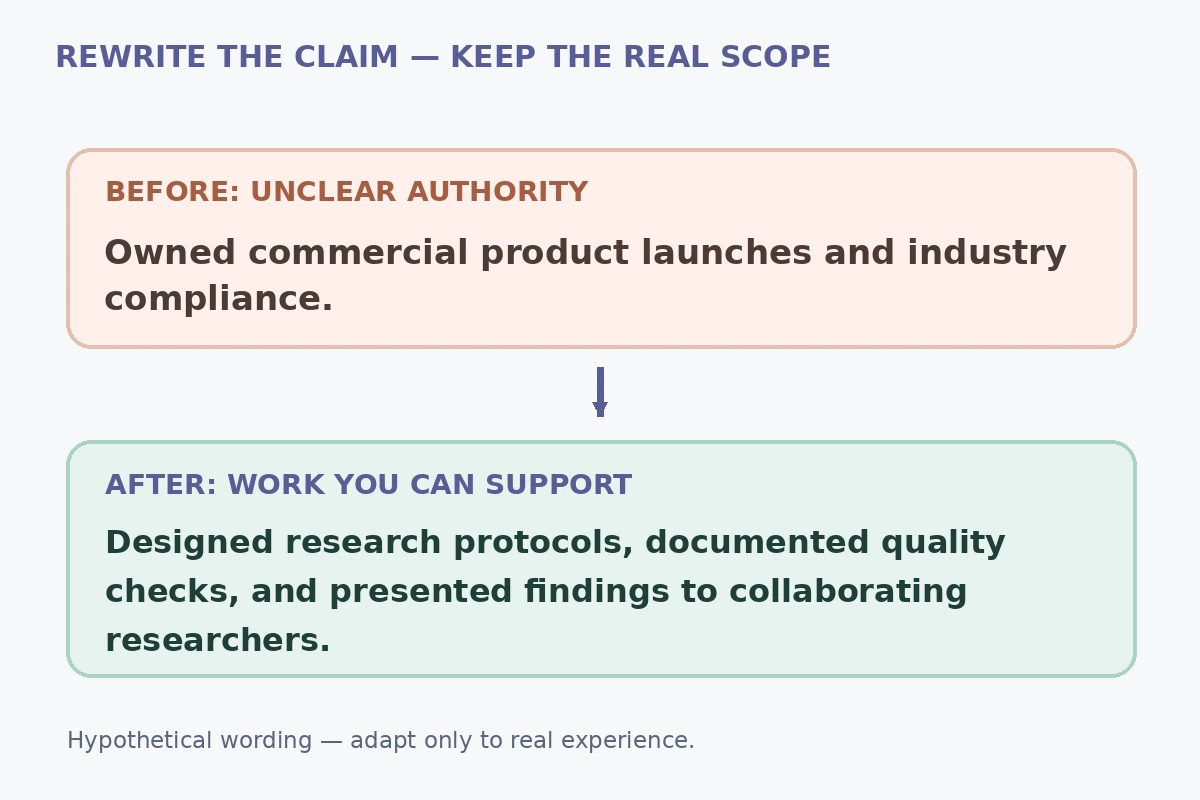
A researcher may have reviewed raw measurements, checked analysis assumptions, replicated an experiment, or flagged an inconsistent result. These are genuine quality practices. They should not be repackaged as signing off medical products, performing formal software validation, or certifying compliance unless that work occurred under the appropriate authority. In a résumé, words such as ‘tested,’ ‘verified,’ and ‘documented’ are precise when they refer to actual steps. The distinction between raising an issue and authorizing a release may be central in interviews for regulated industries.
Translate cross-disciplinary collaboration accurately
Doctoral work can involve supervisors, laboratory staff, statisticians, clinicians, field partners, or other departments. Describe the contribution you coordinated: agreeing on a dataset definition, handing off samples, resolving a terminology mismatch, or presenting findings to a nonexpert group. Avoid the unsupported phrase ‘led a global team’ if you only participated in meetings. If you supervised students or staff, say what you trained them to do and what formal responsibility you held. Industry employers often care as much about dependable handoffs as about the sophistication of the research topic.
Distinguish publication output from product outcomes
A peer-reviewed paper, conference talk, dissertation chapter, or deposited dataset is a real deliverable. A shipped product, commercial customer adoption, approved regulatory filing, or manufacturing process is a different kind of outcome. Do not translate a publication count into revenue or describe a prototype as a released product. Explain what the output showed, who reviewed it, and what decision it enabled. If the research remained exploratory, make that explicit. Clear boundaries make your analytical strengths more credible, especially when applying outside the university.
Choose target roles based on task overlap
Potential search terms depend on your discipline: research associate, scientific analyst, technical writer, data quality analyst, research operations coordinator, or laboratory project support. Some R&D roles require a particular technical background or industry specialization, while administrative roles may use your planning and documentation skills more directly. Read each posting and compare its actual tools and responsibilities with the research activities you performed. Do not assume a doctorate is a substitute for a specific license, clinical credential, or employer-required practical experience.
Develop industry fluency with labeled practice work
If a posting requests issue trackers, standardized reports, validation records, or stakeholder documentation that your lab did not use, practice a sample using fictional data. Describe the practice as independent training rather than prior employment. A short case study might outline a test plan, expected evidence, review criteria, and a handoff to an authorized approver. This shows a learning process without pretending you worked in a regulated environment. Ask industry contacts how they describe the same workflow before borrowing unfamiliar terms such as release, acceptance test, or design control.

Prepare a research-to-industry interview story
Select one real research obstacle: missing data, conflicting findings, a method that failed, or a collaboration deadline. Explain how you tested alternatives, maintained traceability, consulted others, and communicated limitations. The story should make sense without a dissertation defense. Do not overstate certainty or edit away unfavorable results. An industry interviewer needs to see the decision process, the pace of communication, and what you would do in a new organization with different review checkpoints.
Keep attribution and confidentiality intact
Before sharing a publication excerpt, laboratory chart, code sample, or project presentation, confirm you own the material or have permission to reuse it. Remove identifiable participant information and protected intellectual property. State your role within the lab or team accurately. A concise résumé bullet can emphasize method, artifact, and audience without giving a fictional commercial result. The successful transition is not an attempt to disguise academic training; it is a careful explanation of which parts of your research practice fit the new job and which parts require new learning.
How We Research These Transferable Skills
JobAsk reviewed these public sources on November 17, 2026: BLS details scientific project design, laboratory teamwork, technical reports, and communication of findings. O*NET describes medical scientist research, methods development, data analysis, publications, and collaboration tasks. CareerOneStop mySkills myFuture compares skill use in a past job with other occupations and suggests careers to explore. The articles distinguish a general occupational task from the particular responsibility or credential of any one applicant. Examples are illustrative and not claims about an actual employer or candidate. Read our affiliate disclosure; this informational guide does not assume an affiliate relationship or guarantee hiring outcomes.
Explore Related Career Guides
It can demonstrate planning, testing, documentation, and reporting. Do not equate it automatically with a commercial product release or formal project authority.
Name your own research, analysis, drafting, or review contribution rather than claiming sole responsibility for a collective publication.
Explain the exact checks you performed. Regulated compliance, product validation, and signoff require separate evidence and sometimes additional qualifications.
Use the structure best suited to the posting; make the relevant skills and deliverables easy to find while keeping your degree and employment history accurate.
Build labeled practice examples, take relevant training, and be explicit about what you have not used in paid or academic work.