
For a new employee, the most useful career goals for the first 90 days are usually about understanding the role, producing reliable work with the appropriate supervision, and asking for feedback—not announcing a promotion target before you know the team. Start by identifying the work assigned to you, the tools you are approved to use, and the people who review your output. A goal becomes credible when it connects a task you can practice with evidence your manager can inspect. A schedule labeled 30, 60 and 90 days is only a planning example; your actual onboarding cadence may be shorter or longer.
Start with what your role actually allows
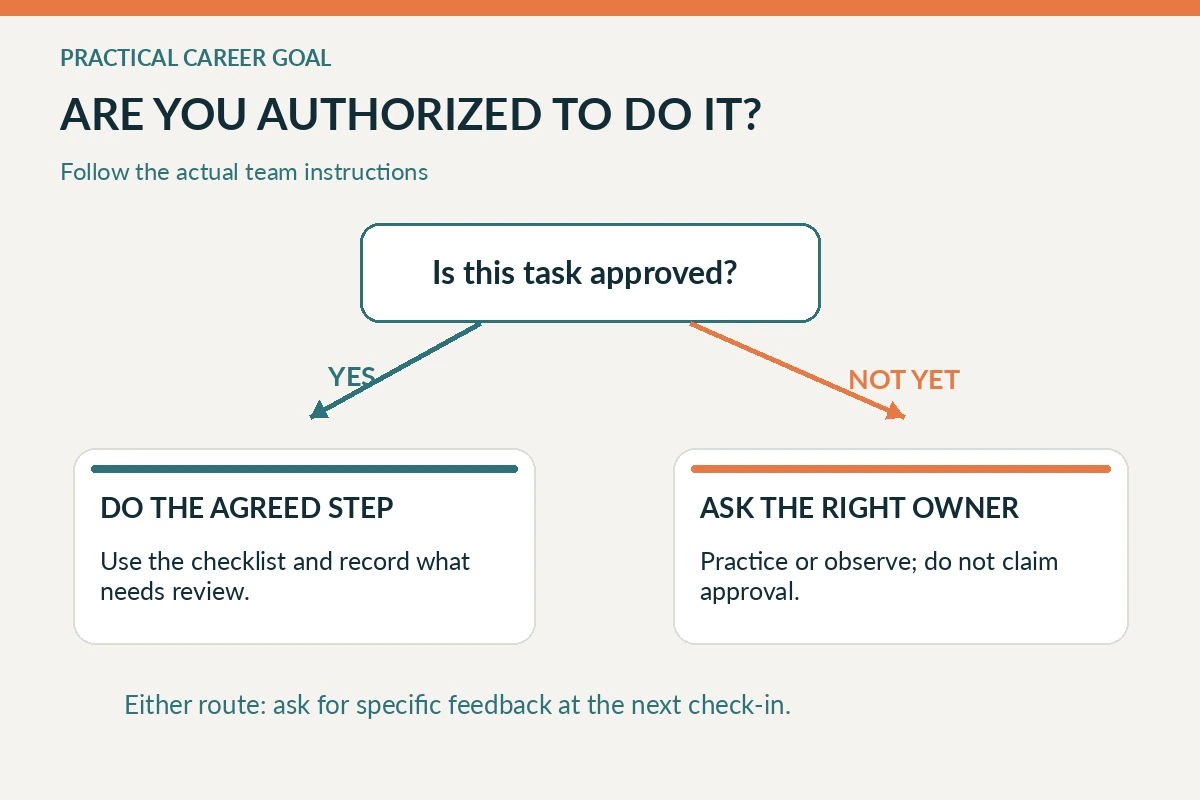
Read the written job description, onboarding guide and current priorities. Highlight what is expected immediately, what requires training, and which actions require authorization. In a hypothetical administrative role, scheduling an appointment using a training calendar might be appropriate before editing a live customer record. In a technical role, reproducing a test issue may be safe before changing production settings. Do not treat access to software as permission to alter records or promise results on behalf of the organization.
Build a 30-day map of people, systems and safe practice
During your first phase, list the recurring requests the team handles and the official location of instructions for each. Ask who owns final decisions and where you should raise uncertainties. Record the difference between attending a demonstration, practicing a procedure, and completing it independently. A practical goal statement is: “By the first scheduled check-in, I will be able to describe the request-routing process and demonstrate one approved practice task using the team checklist.” This is an illustrative statement, not a requirement imposed on every employer.
Avoid a learning plan made entirely of course attendance. Attach a small product to each activity: a question list, a correctly labeled sample, or a short explanation of how to find the governing procedure. Ask your supervisor which materials may be saved in a personal work notebook. Customer identifiers, confidential documents and private internal screenshots should not go into personal portfolios. Good early evidence shows an accurate learning process rather than the volume of information collected.

Turn the middle phase into supervised repeatability
At the next review, choose one recurring work item and define its start, quality check and handoff. For example, “For the next set of assigned practice requests, I will use the approved checklist, identify unclear fields, and bring exceptions to the designated reviewer.” Ask what a complete task looks like, what errors are common and how to request help without delaying the team. This lets the goal measure a controllable behavior and makes mistakes easier to correct.
Compare a vague goal such as “be more independent” with a statement that contains a boundary: “With supervisor approval, complete the standard preparation steps for assigned routine requests and route all nonstandard cases for review.” No invented completion percentage or client outcome is necessary. Keep a brief log with the activity, feedback received and revision to the process; avoid recording sensitive customer information. A supervisor can judge work quality more reliably than a self-awarded score.

Use a 90-day conversation to agree on ownership
By the third phase, show your manager two concrete examples: a task you now complete at the permitted level and a situation you still escalate. Ask whether the team wants you to expand your scope, strengthen consistency, or continue supervised practice. Promotion, access rights and workload changes depend on organizational decisions; a career goal is not authorization to assume those responsibilities. A strong next-step request is to shadow a colleague, document a handoff under review, or learn a neighboring workflow when capacity allows.
Try this hypothetical check-in script: “I can now prepare the routine intake record using the approved procedure. I still ask for help when the request contains conflicting details. Could we review one example together and agree which cases I should handle next month?” The script shows a capability, a limitation and a specific request for feedback. It also gives the manager a chance to correct your understanding before the wording reaches a self-evaluation.
Decide what counts as evidence before setting a target
Acceptable evidence may include an approved checklist, a training exercise, supervisor feedback, or a redacted explanation of how a workflow changed. Evidence should be relevant to the actual performance standard, not a fabricated award or an unsupported claim that clients are happier. If the job requires confidentiality, keep the review inside approved systems. Even a practice document can disclose internal procedures if shared publicly without permission.
In an individual development plan, pair the desired skill with an activity, an agreed reviewer and a review date. The U.S. Office of Personnel Management describes this combination in its career development guidance, but its federal context does not impose a particular plan on private employers. The transferable idea is partnership: make the learning need visible and revisit it instead of treating the document as a one-time performance score.
Adjust the plan when priorities or training access change
A 90-day outline may fail because an instructor is unavailable, an assignment changes, or urgent team work arrives. Record the reason rather than claiming you completed a task you never attempted. Substitute an approved observation or practice exercise only if it develops the same skill. If your employer does not hold formal 30-, 60- and 90-day reviews, propose a brief check-in at a reasonable interval without implying that management owes you a particular schedule.
Close the period with a small table for yourself: skill attempted, evidence, reviewer feedback, unresolved boundary and proposed next step. An employee who can say “I know when to escalate and I am improving accuracy on the standard cases” communicates more than someone who claims to have mastered everything. Keep a personal copy of generalized development goals, not customer files or proprietary training material. Update the plan when your actual responsibilities change.
How We Research and check these examples
This guide uses occupation or competency descriptions from the primary organizations linked below. The hypothetical goals are teaching examples, not reported employee results, prescribed quotas, legal advice or guaranteed promotion pathways. Work duties, approved tools, private records and supervisor authority differ by employer. Confirm your team’s actual procedures before using a template.
Primary sources consulted on November 9, 2026: U.S. OPM career development. GitLab handbook. IIBA business analysis standard. For transparency, see the JobAsk affiliate disclosure; this article includes no paid affiliate recommendations.
Explore Related Career Guides
No. Set a limited goal around understanding assigned processes and demonstrating approved tasks; complex roles and training schedules differ.
Ask which work product and quality checks matter most, then suggest an observable learning activity and agree on a check-in.
You can record completed training accurately, but do not substitute it for independent task proficiency or an earned credential.
Explain the error category, correction, and review step without exposing private information or inventing a positive outcome.
No. It is a practical sample structure, not a universal employer policy. Follow the actual onboarding and review process.