
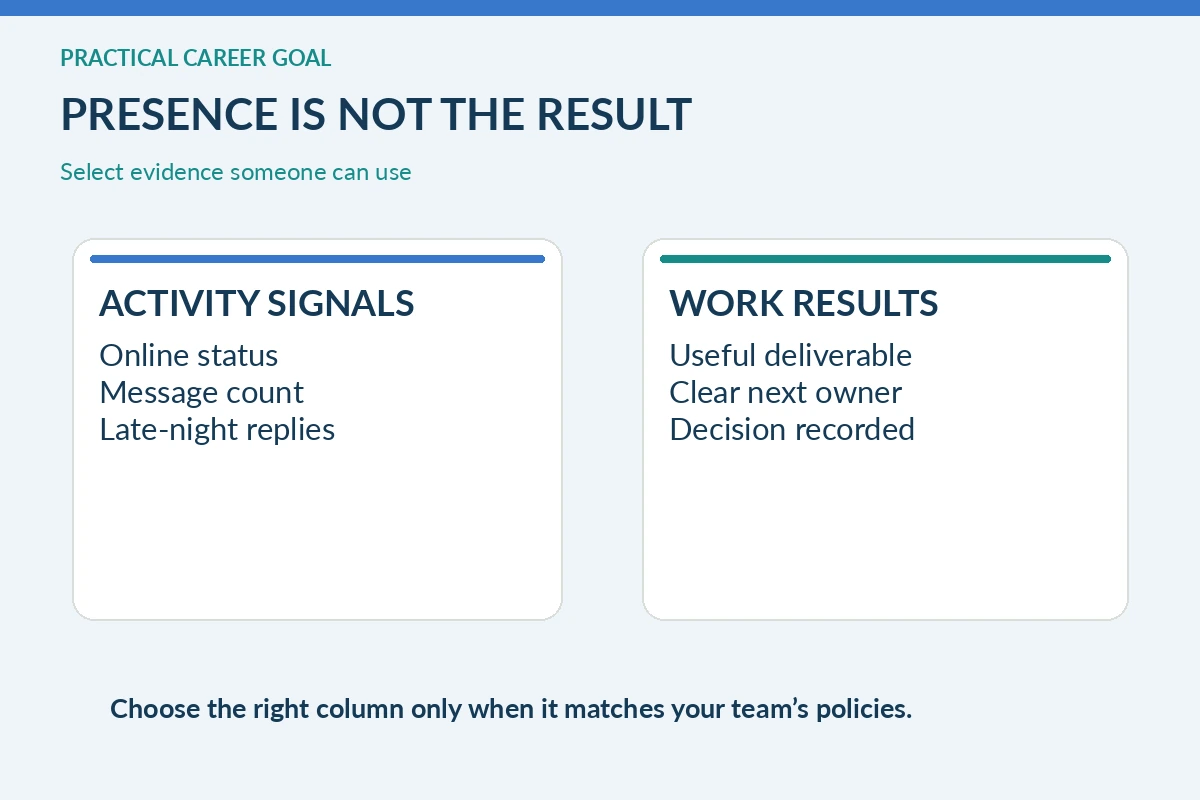
Good development goals for remote workers describe what colleagues can use: a completed deliverable, clear handoff, documented decision or promptly surfaced blocker. They should not depend on being constantly online, collecting screenshots, or sending messages simply to prove activity. Start with one recurring collaboration problem: requests that lose context between time zones, scattered approvals, or unclear ownership after a meeting. A goal such as “make the next action visible at the end of each assigned work cycle” is more useful than “be active in chat throughout the day.”
Choose a result goal instead of a visibility contest
Remote arrangements vary. Some organizations have set response-time rules, required overlap hours or secure systems for documentation; others work almost entirely asynchronously. Follow your employer’s policies rather than importing another company’s playbook. GitLab’s public handbook illustrates one organizational approach to written decisions and asynchronous communication, not a universal rule for remote jobs. Agree with your supervisor on the actual work output and where information must live.
Write updates that a teammate can use without a meeting
A useful async status update answers four questions: What changed? What remains open? Who owns the next step? When is the next check? For a hypothetical project-support task, write: “Draft comparison completed; two unresolved supplier fields need owner review; I linked the approved document; I will check for the response at the next scheduled handoff.” The example provides context without overstating approval or publishing restricted figures. Keep the update in the workspace the team uses, not on an unapproved public page.
Separate facts from assumptions. “The reviewer approved the changes” is different from “I sent the changes for review.” If the status of a decision is unknown, say so and provide the relevant question. Use thread links or document references only when recipients already have permission to view them. A teammate may need a summary rather than direct access to confidential source material. Your development evidence is the clarity and completeness of the handoff, not the number of chat messages sent.
Improve one documentation habit at a time
Documentation is not merely typing more. Select a recurring task where the existing record is unclear, and ask whether the team wants a clearer checklist, decision note or handoff template. The smallest useful document tells a newcomer how to find the source of truth, what counts as done, what requires review and where to escalate. Resist the temptation to create competing versions of official instructions in your personal files. Seek approval before editing authoritative process documents.
A realistic goal might be: “During the next review cycle, propose a short handoff checklist for assigned routine tickets; ask the process owner to review it; incorporate accepted changes into the approved location.” The observable outputs are draft, feedback and approved revision—not an invented claim that meetings were eliminated. If the proposal is declined, record what you learned and move to a more relevant problem; the exercise may still develop judgment.

Set a blocker rule and preserve decision ownership
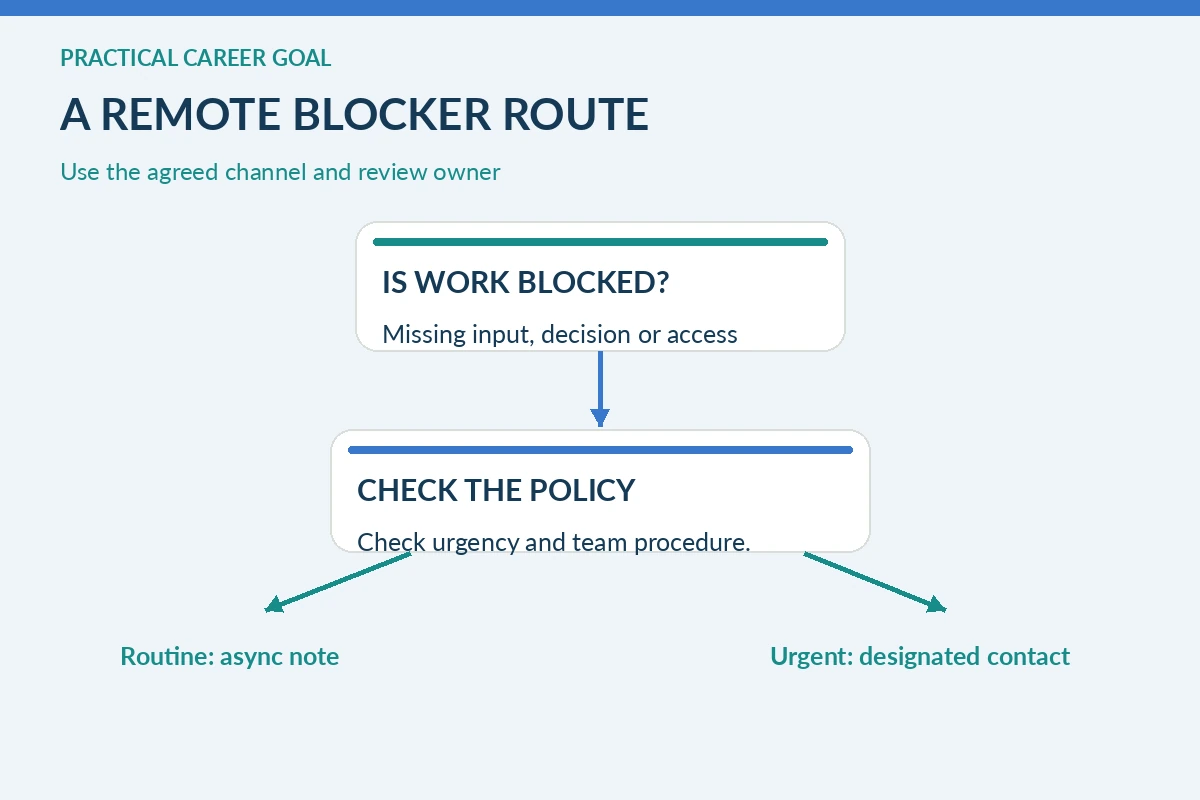
Remote teams cannot rely on a coworker noticing that you look confused. Define when a task is blocked, what information belongs in an escalation, and which channel should be used for urgent problems. A good blocker message describes the work item in permitted terms, the specific missing decision, what has already been checked and the time at which a response is needed. Do not share passwords, customer records or private screenshots just to make a question easier to answer.
Create an escalation ladder with your manager. Some issues can wait for an asynchronous comment; others require immediate contact under team policy. If you are not authorized to approve a release or change a customer account, remote distance does not change that boundary. Development can mean spotting the decision point earlier, collecting clean context and routing it to the correct owner. That is a meaningful outcome without claiming authority you do not have.
Measure collaboration with reviewable evidence
Possible evidence includes an agreed checklist used for a handoff, a versioned decision note, fewer repeated clarification questions in a selected work sample, or supervisor comments on update quality. Do not fabricate efficiency percentages or infer improved productivity from green online indicators. If your organization has an existing quality rubric, use its definitions; otherwise agree on qualitative criteria such as completeness, accuracy, timeliness within normal work hours and appropriate escalation.
Review your goal across the boundary of a full work cycle. Did the next person understand what they needed? Could they locate the right approved document? Did anyone mistake a pending decision for an approved one? Ask for one example of good communication and one instance to clarify. Document feedback without attaching internal chat logs to a public portfolio. Work samples should be shared externally only with explicit permission and careful removal of sensitive data.
Make development sustainable across time zones
A clear remote goal respects working-hour agreements and accessibility needs. Sending updates at all hours is not the same as collaborating effectively. Agree on the expected response window and what an actual emergency looks like. When a colleague is in another time zone, leave enough context for them to continue without a second round of questions. When a discussion requires real-time negotiation, schedule it intentionally and summarize the decision afterward in the approved place.
At the end of the development period, show a simple before-and-after: previously a handoff omitted owner or review status; now your agreed template contains those fields. That is a specific improvement in your communication practice, not evidence that the entire team became faster. The next goal might address decision summaries, cross-functional explanations or mentoring. Choose one that matches the role you actually hold and the support your organization can provide.
How We Research and check these examples
This guide uses occupation or competency descriptions from the primary organizations linked below. The hypothetical goals are teaching examples, not reported employee results, prescribed quotas, legal advice or guaranteed promotion pathways. Work duties, approved tools, private records and supervisor authority differ by employer. Confirm your team’s actual procedures before using a template.
Primary sources consulted on November 9, 2026: GitLab handbook. GitLab handbook. U.S. OPM career development. For transparency, see the JobAsk affiliate disclosure; this article includes no paid affiliate recommendations.
Explore Related Career Guides
Not on their own. They can reward noise. Prefer useful deliverables, understandable handoffs and feedback from the team.
Only with explicit permission. Internal processes, personal data and customer details may be confidential.
Follow your team’s required channels and response windows. Apply the clarity principle within the actual policy.
Use approved samples and a reviewer’s concrete comments about accuracy, completeness, handoff quality and appropriate escalation.
No universal expectation follows from remote status. Confirm hours, on-call duties and urgent procedures with your employer.