
Quick answer: Nursing students can list clinical rotations under a distinct Clinical Experience or Clinical Rotations heading, especially when they have limited paid nursing work. Give the placement site, unit, dates or verified hours, and a concise description of what you performed under supervision. Do not call a student placement a staff RN position, imply licensure you do not hold, or disclose any patient-identifying detail.
Build a Clinical Rotations Section With Verified Facts
Start with a list of completed placements from your approved school records. Record the facility, broad unit or care setting, month and year if known, and hours only when you can document them. The University of Minnesota nursing resume guidance recommends showing clinical practicum and rotation experience and hours completed. A placement in medical-surgical care, community health, pediatrics, or behavioral health should be labeled by its actual setting; do not rename it to match a job posting. If a rotation is still in progress, say so and avoid claiming completed hours.
Keep Student Nurse Titles Separate From RN Employment
Use labels such as “Student Nurse — Clinical Rotation,” “Nursing Practicum,” or the title required by your program. A student who observed a procedure did not independently perform it; a student who assisted under a licensed clinician should preserve that qualifier. Avoid listing an unearned RN, LPN, or specialty credential. The hospital or site name provides context but does not make you its employee. If you also held a paid CNA or medical assistant role, list the paid work separately with its own credentials, dates and duties.

Describe Units and Hours Without Guessing
An employer may want to know whether a candidate rotated through acute care, long-term care, community care or another setting. List unit names plainly and use documented hours from your school portal or placement summary. Do not include patient census figures or unit capacity unless reliable and genuinely relevant. The University of Maryland nursing resume guide identifies unit and hours as helpful clinical placement details. Do not copy another student’s hours or imply that time spent in simulation equals time in a hospital placement. The site’s terminology and the program’s verification record take priority.
Explain Scope of Practice Through Supervision
For student-level bullets, “measured and reported,” “documented observations under instructor review,” or “practiced patient communication within placement guidelines” may be more accurate than “managed treatment.” Avoid stating you independently administered medication, performed procedures, or made clinical decisions without a verifiable authorized role. Requirements differ by program, jurisdiction and site. A resume is not a substitute for a license, certification or employer assessment. When unsure whether a task is appropriate to mention, ask your clinical instructor and describe the part you actually completed.

Choose Two Placement Details That Match the Opening
For a hospital residency, focus on relevant units, teamwork, patient communication, documentation procedures and approved skills. For community health, highlight outreach experience and accurate records if they were part of the rotation. Do not imply that a general clinical rotation meets a specialized competency requirement in the job advertisement. Penn Nursing sample resumes illustrate how students can combine clinical experience with education, certifications and other work. Keep the bullets short enough to leave room for degree status, verified credentials and relevant paid work.
Protect Patients and Facility Confidentiality
Never include names, ages combined with identifying details, room numbers, screenshots of charts, or case descriptions that could identify a patient. Do not attach confidential worksheets or photos from clinical sites. It is usually enough to describe a category of work, an approved documentation system if you used it, and the reporting chain. If you want to show a learning reflection, make it nonidentifying and confirm your program permits sharing. The strongest clinical resume demonstrates care and judgment without exposing a patient or employer record.
Compare a Student Placement With a Staff Nurse Claim
Hypothetical example: A candidate completed a supervised placement in a medical-surgical unit. “Staff RN — directed patient care independently” would be false if that was only a student rotation. A clearer entry is “Student Nurse, Medical-Surgical Clinical Rotation | Spring 2025,” followed by “Collected assigned observations and communicated changes to the clinical instructor.” The exact sentence should change to match the real student’s permitted work and documented site. No claim here is a verified account of a particular hospital or individual.
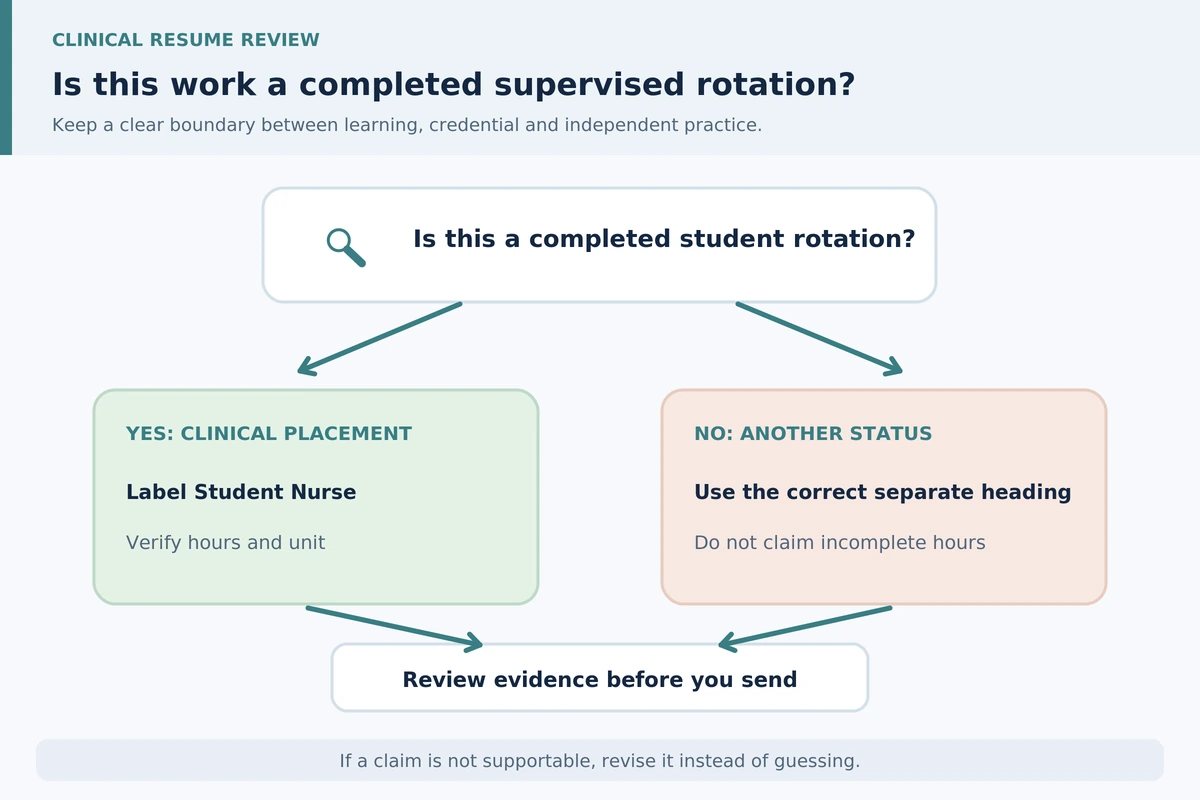
Review Each Rotation Before Submitting
Check the final draft against your school record, placement schedule and credential status. Make sure the unit name is accurate, the hours reflect what you completed, and the student title is unmistakable. If you list multiple rotations, consider a compact table-like entry for shorter placements and a few relevant bullets for a capstone or immersion. If an employer asks for detailed clinical competencies, follow its separate form instead of overloading the resume. Treat licensure, immunization or screening requirements as separate employer instructions, not inferred from a clinical résumé description.
Practical Rewrite Checklist Before Applying
Use this final five-point check for clinical rotations on a nursing resume: (1) Does the label accurately show who you worked for or where the learning happened? (2) Can you support the dates and frequency without stretching a short role? (3) Does the first bullet give a task and method rather than an empty adjective? (4) Are credentials, confidentiality and approval boundaries respected? (5) Can you explain the entry in ordinary language to an interviewer? The governing principle is simple: A completed placement proves supervised learning in a setting; it is not a claim of independent clinical authority. Rewrite or remove any claim you cannot substantiate, even if a resume template suggests a more impressive phrase.
How We Research and Review Resume Advice
This guide draws on the linked career-service and professional sources listed in the article. We compare those sources with the specific task, label and scope shown in the worked examples; the examples are hypothetical and should not be copied as personal achievements. A local structural check cannot verify an applicant’s credentials, past work, permission to share information or a WordPress publication. We do not promise a job, an interview or ATS performance. See our affiliate disclosure; these guidance links are informational and no paid referral is represented.
Related Guides
- Tell Me About Yourself in a Nursing Interview: Clinical Evidence First
- New Graduate Nursing Cover Letter: Explain Clinical Training Honestly
- Registered Nurse Resume Summary: Show Licensure and Clinical Scope
- Nursing Assistant Resume Summary: Show Basic Care and Team Communication
- Medical Assistant Resume Summary: Confirm Credentials and Patient-Care Scope
A separate Clinical Experience or Clinical Rotations heading often makes student placements easier to distinguish from paid employment.
Identify it as a clinical placement site, not paid employment, unless you were also formally employed there.
Use documented hours when helpful or requested. Do not guess or count future and incomplete hours as finished.
Avoid patient-identifying information. Describe approved tasks, settings and supervised learning without sharing private cases.
No. Clinical education, graduation, examinations and licensure are distinct; only claim credentials you actually possess.