
With about one year of work experience, lead with the evidence most relevant to the role you want, not an artificial claim that you are already a seasoned specialist. Use clear dates and titles, describe tasks you personally completed, and keep education or project sections when they add qualification the paid role does not show.
One year could mean a full-time first job, several part-time assignments, a structured internship, or a combination of work and study. Your resume should describe that reality accurately. There is no required mix of pages, projects, or bullet counts that turns the duration into a stronger qualification.
Start with the specific target job
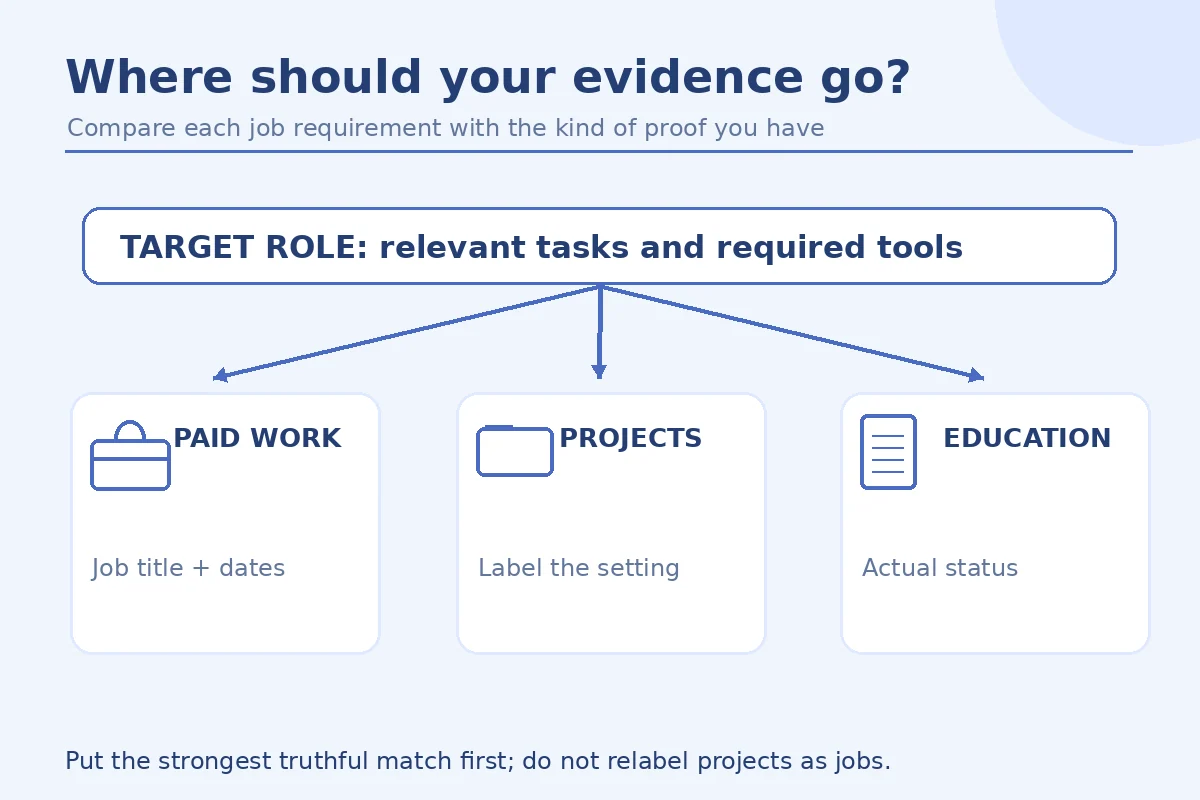
Read the posting and identify its day-to-day tasks, required tools, schedule or worksite expectations, and any licensing or training requirements. Separate what you have done from what you have only studied. Your first substantial section should let the employer see relevant proof without guessing whether your experience was paid employment, coursework, or volunteering.
For a similar second job, work experience may appear before education. For a new technical direction, an authenticated class project or relevant training can deserve an early, clearly labeled section. Keep real employment dates visible whichever choice you make.
Group the first year without distorting chronology
List your role, organization, and start and end dates—or Present if you still hold the role—with consistent formatting. When the period spans two employers, give each its own dates. Do not group them under a combined employer name to make the work appear continuous.
If your experience includes a short internship followed by a part-time position, show the employment type where it adds clarity. You can emphasize a relevant task without inflating your title from intern to coordinator, or describing supervised work as independent authority.

Write bullets that show the actual contribution
For each relevant position, name the task, method, or object of your work. Replace vague entries such as “Helped with customer service” with a truthful specific example: “Recorded customer requests and escalated unresolved returns to the shift lead.” This is an illustrative line; use it only when it matches your experience.
Do not invent numerical results to make an early role look impressive. A verified count or improvement can be useful, but the scope of a small accurate process is better than an unsubstantiated claim that you increased revenue or managed a team.
Use projects to cover genuine evidence gaps
Projects can document work that your job has not yet offered: spreadsheet validation, classroom research, a website prototype, a community event, or an inventory exercise. Label the source and setting, such as “Course Project” or “Volunteer Event,” and state your individual actions and the outcome you could observe.
If the team delivered a prototype, distinguish your own role in gathering requirements, testing, writing, or design. Do not present the entire team output as a solo achievement. Link to a sample only when you have permission and it is appropriate for an employer to view.

Place education and credentials where they add value
A recently completed relevant qualification may still deserve prominent space. Use its actual status: completed degree, coursework in progress, or completed training. Do not transform a course completion into professional certification or imply a license that has not been granted.
Keep a concise skills section with tools you have used and tasks you can demonstrate. For example, name the spreadsheet functions or ticketing activities you performed rather than saying “expert in all office software.” Skills should connect naturally to the role or project descriptions.
Choose a clean layout that supports the evidence
A straightforward reading column makes it easy to connect dates, employers, and bullets. Use standard headings, consistent type, and enough spacing to distinguish one experience from another. Avoid filling empty space with a long generic summary, awards unrelated to the target job, or decorative icons.
One page can work well for many early-career resumes, but it is not a guarantee or a mandatory rule. Follow the employer’s submission instructions and keep whatever length lets the relevant, verified information remain readable. University of Pennsylvania Career Services generally favors concise resumes for undergraduates and recent graduates.
Audit the page for honest seniority signals
Look for verbs that imply authority: led, approved, supervised, owned, and certified. Replace them when your actual role was to assist, prepare, test, observe, or escalate under supervision. The goal is not to undersell real work; it is to make your responsibility credible and checkable.
Finally, compare the wording against the job description without copying qualifications you do not meet. The employer should be able to identify the kind of work you are ready to do and what you would still need to learn. Your first year is evidence of practice, not a reason to claim mastery of an entire profession.
A quick allocation exercise can help when the year contains several kinds of experience. On a separate sheet, write one line for each relevant requirement in the job posting. Next to each line, identify whether your strongest truthful evidence came from paid work, a supervised internship, independent coursework, or volunteering. Then decide where that evidence belongs on the resume. An employer should not need to infer that your class project was a full-time position or that a training exercise gave you approval rights. If a project and a paid role demonstrate the same skill, keep the clearer example and use the saved space for a different qualification. This avoids repetition without making your experience look bigger than it was.
How We Research These Resume Format Choices
We compared the page’s specific formatting problem with guidance from CareerOneStop and university career services. Recommendations are practical editorial judgments, not claims that any format guarantees an interview, acceptance by an ATS, or an employer response. All names, roles, and resume sentences introduced as illustrative examples are hypothetical. Follow your target employer’s current instructions and verify your own qualifications.
Source notes: University of Pennsylvania Career Services explains content ordering, internship experience, project evidence, and layout trade-offs. CareerOneStop describes resume structures, consistent labels, straightforward fonts, and single-column layout safeguards. CareerOneStop recommends tying experience examples to relevant work and documenting the tasks an applicant actually performed. Harvard Career Services favors specific factual language, consistent formatting, and evidence-oriented descriptions. We may update these sources if guidance changes. Visit our affiliate disclosure; these informational links do not imply a paid partnership.
More Resume and Cover Letter Guides
It is genuine experience, but the level of a particular role depends on the work performed and the employer’s requirements. State the work honestly.
Yes when they add relevant evidence that your paid job does not show. Identify projects as projects rather than employment.
Yes if it adds a specific, substantiated focus. It is optional; do not use it to repeat generic adjectives.
No. Use verified quantities when meaningful, but accurate tasks and decisions are useful even without numerical outcomes.
Generally keep them distinct when their organizations, dates, supervision, or employment types differ, so the work history remains accurate.