
Online courses on a resume belong in a clearly labeled Education or Professional Development area when they help establish a real job-relevant skill. State the exact course, provider, and completion status. A course is not automatically a degree, occupational certification, or license, and watching lessons is not the same as receiving a completion record. This guide gives a decision tool and honest hypothetical lines so you can explain what you actually studied and what project evidence you can show.
Which online learning belongs on the page
Put an online course on your resume when you can explain how it relates to the job and exactly what you completed. A short introductory lesson can be valuable, but it should not displace a relevant job, project or earned credential. Start by reading the target job description and highlighting two or three skills you can genuinely demonstrate. Then look at the course syllabus, assignment record or certificate to determine whether the training provides evidence of those skills. If the job requires a license or accredited qualification, a self-paced course is not a substitute. Your resume should help a reader evaluate your learning without needing to guess what the program awarded.
Distinguish a course from a degree or certification
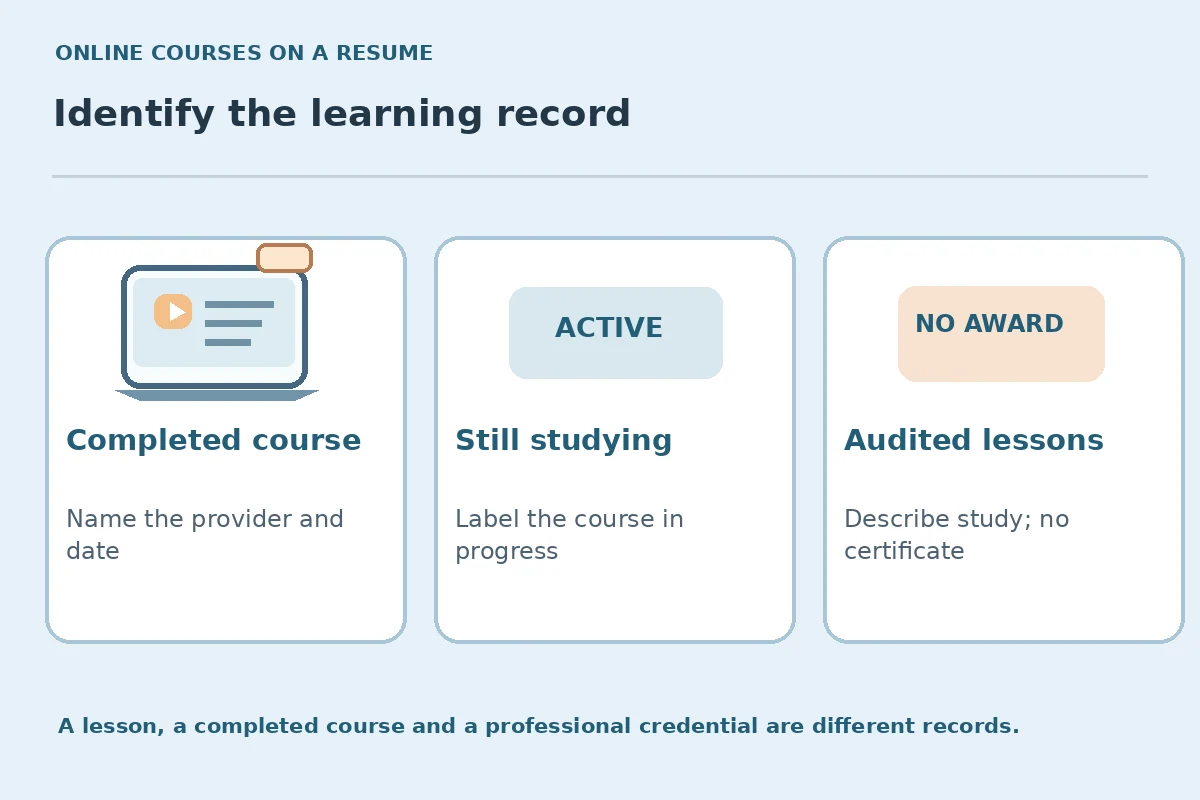
There are at least four different claims: attending an online class, completing it, receiving the provider’s certificate of completion and earning an external occupational certification. They are not equivalent. For example, watching a set of project-management lessons does not make you a certified project manager. Likewise, taking a university-created course through a platform does not necessarily mean you enrolled as a degree student at that university. Name the platform where helpful, but identify the actual institution or training provider as the source of the learning. Use the precise document title if one was issued. Never replace a modest record with a more impressive-sounding credential.
Write a compact entry with verifiable details
A useful entry gives the exact subject, the educational provider and your status. For a hypothetical example: “Introduction to Spreadsheet Modeling — Sample Learning Institute, online; completed May 2026.” If you are working toward completion, write “In progress” rather than an invented graduation date. If you audited a class without an assessment, simply name it as study or independent learning. Do not invent course hours, grades, certificates or transcripts. When dates may help explain recency, include an actual month or year; older courses may be less useful when the tool or field has changed. Keep a fuller private training record for interviews.
Choose between Education and Professional Development
CareerOneStop describes education sections that may include classes and professional development, not just degrees. Place one or two relevant online courses under Professional Development or Additional Training when you already have a clear degree history. For a recent graduate with a directly relevant course and class project, a short line under Education may be easier to scan. Whichever location you choose, do not mix a course provider with the college where you earned your degree in a way that implies degree credit. Clear section headings also make it easier for a hiring manager to distinguish education, work experience and a portfolio.
Pair coursework with an actual deliverable
A project explains why the training mattered. If you built a hypothetical inventory spreadsheet in a class, say that it was an academic exercise and identify what you personally did. You might write, “Class project: checked missing product IDs and documented the formulas used to flag duplicates.” That is narrower and more credible than “Optimized enterprise supply chain data.” If you have permission to share an example, link to a sanitized portfolio file. If the course used private classmates’ or employers’ data, describe the method without publishing the records. No course completion alone proves that you have used the method in production.
Avoid unnecessary badges and oversized lists
A row of ten unrelated online course badges can obscure stronger qualifications. Select only the small set that maps to the advertised duties. Delete a basic course if later job experience already proves the same work more convincingly. Keep course names readable rather than packing them with unexplained acronyms. If the training is incomplete and you are not actively enrolled, avoid implying that completion is imminent. If a required qualification is absent, do not hide the absence behind a long course list; state your current level and pursue only suitable openings.
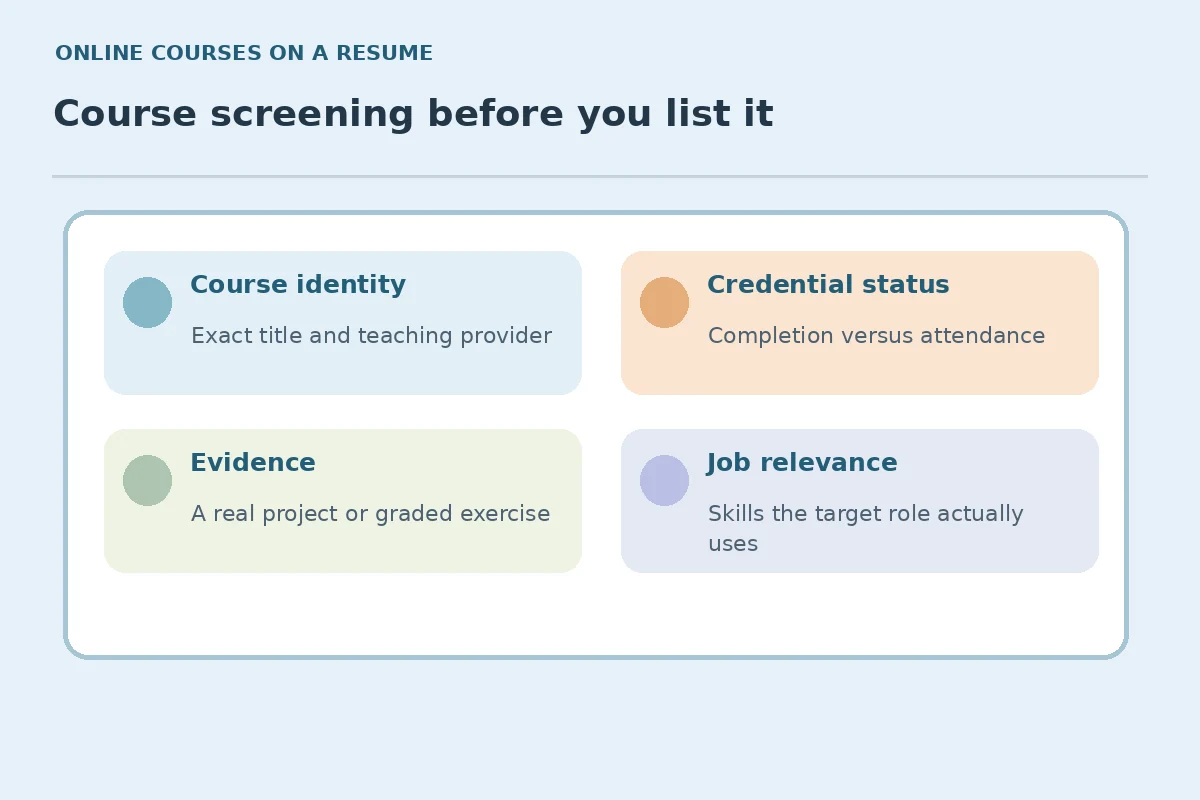
| Item to check | What the resume should show |
|---|---|
| Course identity | Exact title and teaching provider |
| Credential status | Completion versus attendance |
| Evidence | A real project or graded exercise |
| Job relevance | Skills the target role actually uses |
Compare misleading course claims with accurate resume entries
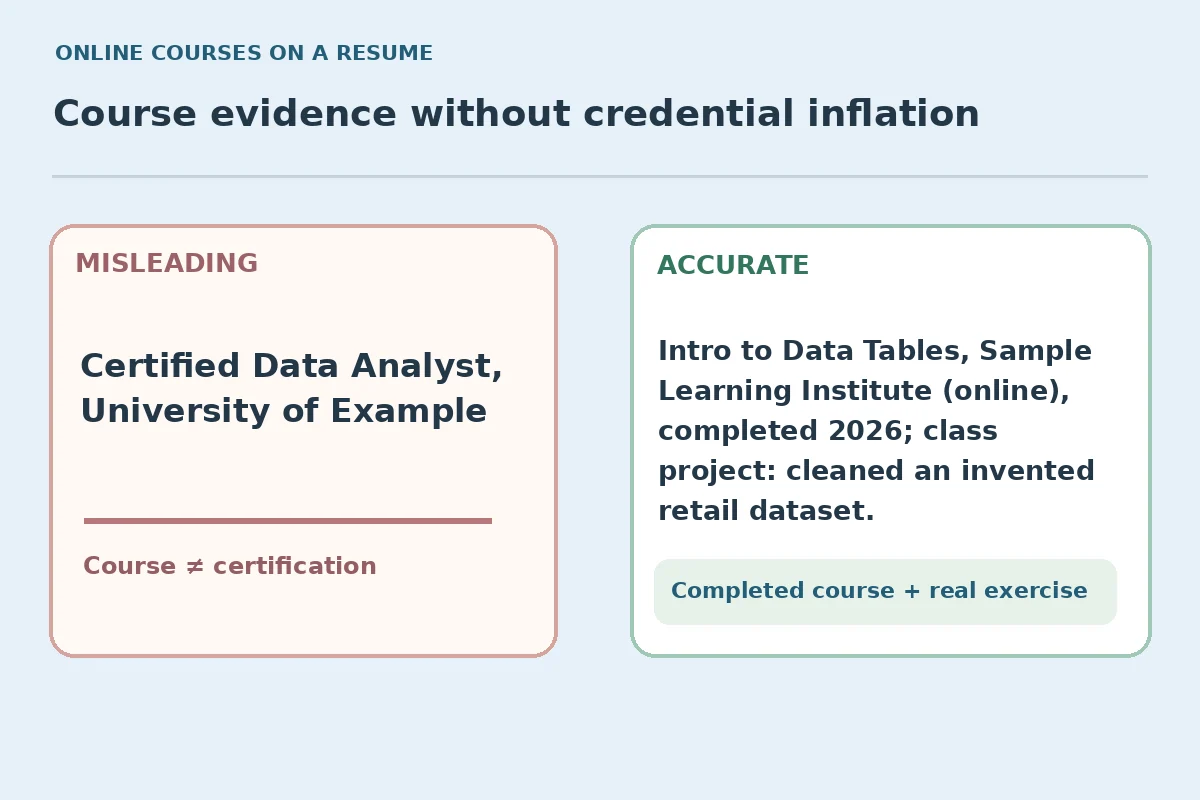
Consider these hypothetical lines. Weak: “Certified data professional — University of Example.” Accurate: “Intro to Data Tables, Sample Learning Institute, online, completed 2026; class project: cleaned a fictional inventory file.” The second gives the reader a teaching provider, level, completion status and specific exercise. It also avoids a claim to professional certification. You can apply the same editing test to coding tutorials, design workshops, writing courses and accounting refreshers. Check that every institution, title and date can be substantiated by a class record or actual work file.
Prepare a short interview explanation
If an interviewer asks about an online course, explain what task you learned, what assessment or project you completed, what went wrong and how you corrected it. A transparent answer is more useful than repeating marketing copy from a course landing page. For instance, describe a spreadsheet exercise that originally misclassified blank cells and the checks you added to flag missing entries. Do not claim business savings or client outcomes from a simulated assignment. If you are still learning, say which units remain and how you practice independently.
Check the final resume and application form
Before submitting, compare the wording of each line with the course account or record. Recheck the exact provider name, the completion date and whether a certificate was actually granted. Some application forms separate degrees, credentials and training: put the course in the correct field even if your resume groups them elsewhere. If an employer requires documentation, share only the requested record through its official process. Test the PDF after export so hyperlinks, dates and headings remain readable. Your goal is to show real, job-relevant learning, not to make the entry sound like a degree.
How We Research Education and Credential Guidance
JobAsk checked these education, career-service and occupational sources on November 17, 2026: CareerOneStop explains how to list education, training, awards and study in progress without misrepresenting a degree. UC Davis recommends distinguishing education from workshops, training and coursework, including incomplete programs. Harvard career guidance recommends choosing relevant coursework, honors and academic projects for the target job. We compared guidance on education records with the distinctions that an applicant must verify with a real provider, school or regulator. Requirements vary by employer and jurisdiction; a cited educational resource is not proof that a particular applicant has a credential. All example schools, award names, documents and people in this article are hypothetical and are not evidence of a real award, employer endorsement or employment outcome. We do not promise hiring, testing results or acceptance by an applicant tracking system. There is no claimed paid partnership in this article. Read our affiliate disclosure for relationship transparency.
More Resume and Cover Letter Guides
Yes, if you genuinely studied the material and it relates to the role. Label it a course or training activity and never imply an award was issued.
You may when they are relevant and genuinely active; write “In progress” and do not list an unearned completion date as achieved.
Not necessarily. State the course and delivery relationship accurately rather than suggesting degree enrollment or university attendance you did not have.
Education or Professional Development can work. Use the heading that separates the course from formal degrees and helps the target employer find it.
They serve different purposes. The course record verifies learning; a truthful, shareable project can demonstrate how you applied it.