
A referral cover letter can mention how you learned about an opportunity, but a personal connection is not a substitute for job qualifications. Confirm whether the person agreed to be named and what they actually recommended. Then write the rest of the letter around the posting: one compelling reason for applying and one or two examples that show relevant skills.
Harvard’s cover letter guidance explicitly allows applicants to mention a referral in the opening, and UC Berkeley emphasizes employer-specific fit and examples. These are writing principles, not evidence that any referral guarantees an interview or earns special review. The employer may have its own referral system, so check the posting before assuming that a letter replaces formal submission.
Confirm the Contact Has Agreed to Be Mentioned
Before writing the opening, ask the contact whether it is appropriate to use their name and whether they intend to submit a referral through the employer’s official process. A conversation about the organization is not automatically a formal referral. If you only heard about the job through a networking event, say that rather than describing the participant as your sponsor.
Record the relationship accurately: coworker, former classmate, professional connection, or someone you met during an information session. You generally do not need to describe private details of the relationship. If permission is not clear, omit the name, apply using the posted channel, and explain your interest based on public information.
Distinguish a Referral From an Informational Conversation
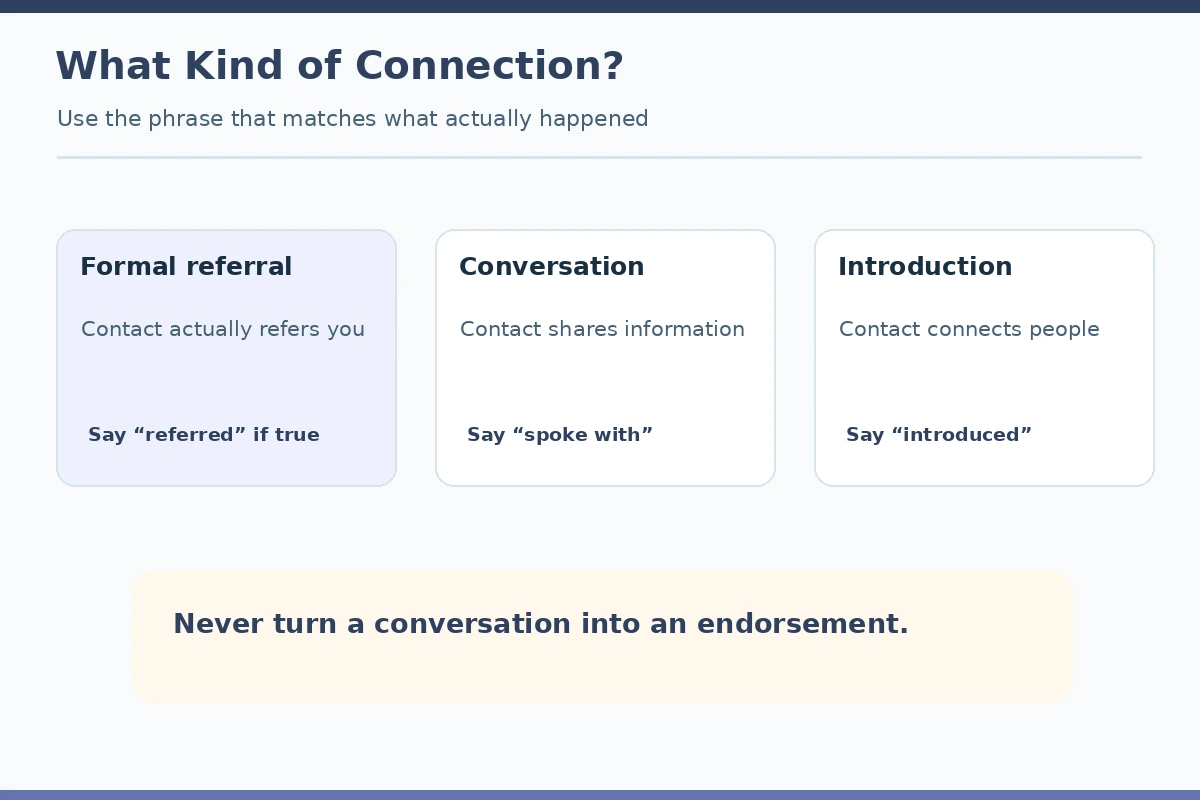
A formal employee referral may involve an internal submission step, while an informational conversation simply helps you understand the role. An introduction means a person connected you to someone else. These distinctions matter because language such as “endorsed,” “recommended,” or “referred” describes different actions. Choose the one the contact can truthfully confirm.
Hypothetical comparison: “Jordan Lee referred me for the open coordinator position” fits only if Jordan actually made that referral and agreed to be named. “I learned about the team through a conversation with Jordan Lee” is safer when Jordan provided information but did not make a formal recommendation. Neither sentence supplies evidence of the applicant’s skills.
Put the Connection in a Brief, Accurate Opening
The opening should still identify the position and a concrete fit. Mention the contact naturally, usually in one sentence, then pivot to a relevant qualification. Do not write a paragraph listing everyone you know at the company, or suggest that your contact made promises about hiring decisions.
Hypothetical opening: “At Jordan Lee’s suggestion, I’m applying for the Program Assistant position. My experience tracking requests and preparing clear handoff notes aligns with the role’s coordination work.” Use this only if Jordan really suggested the application. Otherwise remove the referral phrase and preserve the evidence-based opening.
Demonstrate Qualifications Independently of the Referral
Choose two abilities from the job advertisement and pair each with a real example. Good evidence explains the setting, your personal contribution, and a factual result or lesson. Avoid praising a friend’s opinion of you as though that proved the technical skill. A letter should remain convincing even if the reader has not met the person you named. For a step-by-step method, see how to start a cover letter with a specific, credible opening.
For example, a candidate could describe preparing weekly attendance records for a community organization if that occurred. The applicant should not invent volumes, financial figures, or praise from a supervisor to strengthen the narrative. University guidance favors a specific story because it explains how you can contribute to the target role.

Use the Employer Application Process as Written
If the employer requires an online application and offers a separate employee-referral workflow, these may be distinct steps. Ask the contact what they are comfortable doing, and follow public instructions yourself. Do not send resumes to unverified addresses or assume that a personal message replaces an official application or security checks.
If the application has a “How did you hear about us?” field, answer according to the provided choices. Ensure the person’s name, title, and team are correct if you include them. Avoid exposing an employee’s private contact details in the letter. When in doubt, the best course is to omit unsupported relationship claims.
Build a Concise Middle and Closing Paragraph
An effective body tells one relevant story and links it explicitly to the employer’s work. The closing restates interest, thanks the reader, and indicates openness to a conversation. Do not ask the hiring manager to honor a promise they never made or imply that the referee can direct the decision.
Hypothetical closing: “I would welcome a conversation about how my documentation and customer-support experience could contribute to your team. Thank you for considering my application.” The sentence makes no claim about endorsement or selection. Use your own voice and replace broad nouns with the job’s actual responsibilities.

Proofread the Referral Language for Accuracy
Read the name and relationship aloud. Check spelling and whether the contact’s role has changed. Verify that the referred position is still the one you are applying for. Then remove extra personal details and test the letter without the referral sentence: if it no longer explains your fit, strengthen the work example before sending. Our internal position cover letter guide goes into more detail.
Keep a copy of the message you sent and be prepared to explain how you know the person without oversharing. If the contact later declines to participate, use a version of the letter that states only your independently verified interest. Your experience, not the acquaintance, is the part you control. If that is your next decision, our part-time job cover letter guide explains how to match skills and availability.
How We Research These Cover Letter Examples
We checked UC Berkeley’s cover letter guidance on connecting experience and qualifications to a specific employer, and the University of Washington’s recommendations on using concise stories, concrete contribution, and accurate formatting. These sources support a writing approach, not a guarantee that any letter leads to an interview. The example wording in this article is explicitly hypothetical and must be replaced with the reader’s real experience.
We also reviewed additional guidance relevant to this scenario. The examples do not represent real applicants, employers, internal company policies, hiring outcomes, or verified referrals. No affiliate partnership is claimed here; see our affiliate disclosure for site-wide information.
Related Guides
- Cover Letter When You Do Not Meet Every Requirement: Explain the Fit Honestly
- Job Application Referral Email: Mention a Real Contact With Permission
- Social Worker Cover Letter: Connect Practice, Ethics, and Fit
- How to Tailor a Cover Letter to a Job Posting Without Copying It
- Cover Letter With No Experience: Honest Examples That Show Potential
You can when they have agreed to be named and the connection is relevant. Explain the role and your fit in the same opening.
Not necessarily. A conversation is not the same as a formal endorsement or internal referral submission.
Only if that wording accurately reflects what they said. Sharing information alone may not be a recommendation.
No. Hiring practices vary, and a referral is not a guarantee of review, interview, or selection.
Leave the name out, follow the official application channel, and make your case with job-relevant evidence.