
Quick answer: To find part-time medical assistant jobs that genuinely fit, compare the clinic’s required coverage hours with the tasks you are trained and permitted to perform. A posting may combine appointments, patient intake, vitals, inventory and charting. Part-time hours do not reduce requirements for supervision, confidentiality or state-specific clinical scope. Ask about credentials and onboarding before you represent yourself as ready for procedures.
This is a US-focused search and application guide, not a live job board or a claim that a particular employer has an opening. Examples below are hypothetical. Verify each employer, worksite, schedule, pay arrangement, policy and qualification against the actual posting before applying.
Separate the Medical Assistant Role From Similar Titles
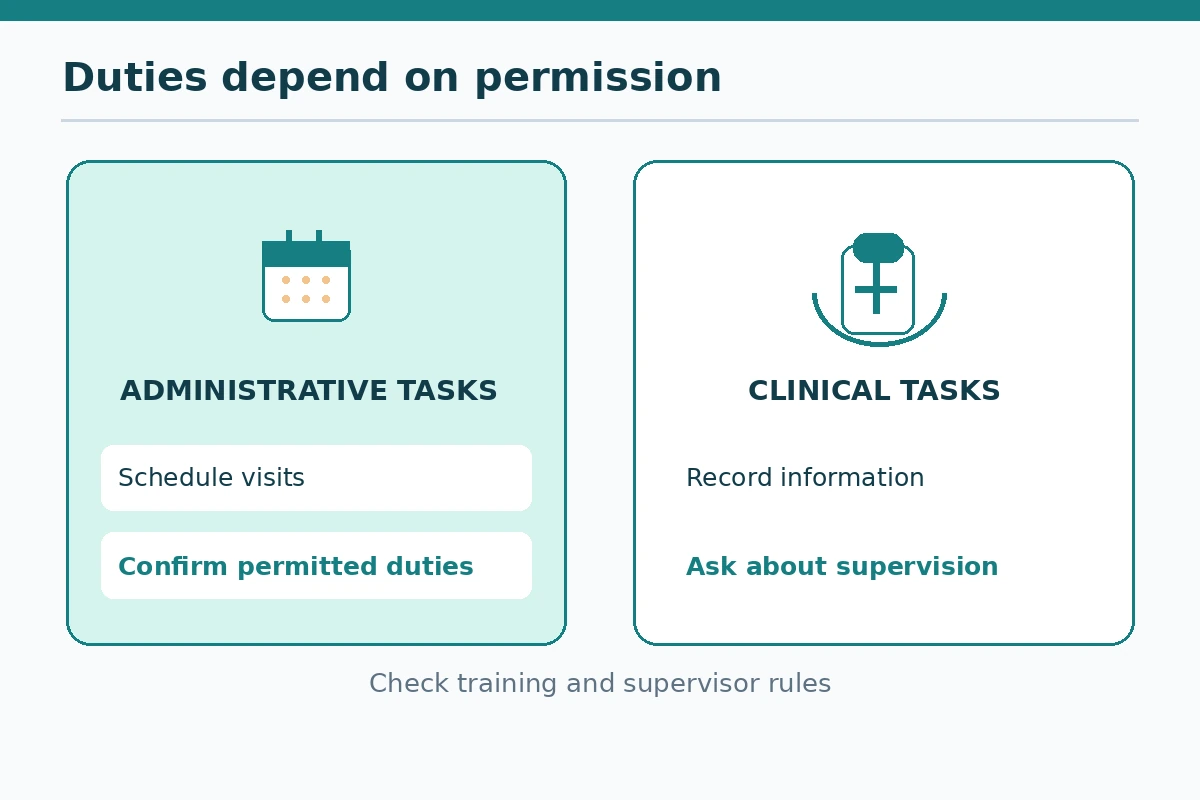
A medical assistant job is not interchangeable with a physician assistant, registered nurse, nursing assistant or receptionist role. Medical assistants may do administrative work, clinical work or a mix depending on the practice. The Bureau of Labor Statistics identifies scheduling, record handling, measurements and examination support among common tasks, but it does not mean every applicant may perform each item in every state. Compare the exact tasks in each vacancy instead of relying on the title.
Read the wording closely: “assist with patient intake” may involve greeting, documenting history, recording values or setting up a room. “Support injections” is not permission to administer them. Check whether the employer expects a credential, recent supervised experience, training on a particular records system or a specific certification. If you are still enrolled in training, say that plainly and distinguish completed competencies from skills you hope to learn.
Build a Two-Gate Checklist Before You Apply
First check the scope gate: for each stated clinical duty, write down your training, current credential status, applicable state rules and who supervises the work. A clinic should be able to describe its protocols and the accountable licensed professional. If the description is ambiguous, do not infer authorization from a past workplace or from a broadly worded online listing.
Then check the coverage gate: map the actual clinic opening, expected arrival for room preparation, break policy, closeout work and required overlap with other staff. A “Saturday morning” position can include earlier setup and later patient chart follow-up. Ask whether initial training is scheduled on weekdays; a part-time role may still require several consecutive training shifts.
Compare Clinic Settings and Patient Interaction
Primary care, specialty clinics and urgent care offices can organize assistants differently. One location may assign separate reception and clinical teams; another may rotate staff between front desk and exam rooms. Ask whether the shift is in person, who checks patients in, how results and callbacks are routed, and whether you are expected to float between locations. Travel between sites can make a short shift considerably less practical.
Look for clear reporting relationships and a realistic workload rather than a vague promise of “all clinical duties.” Patient data must stay inside approved systems and workplace channels. Do not offer to use your personal phone or email for identifiable health details. If a posting asks you to make independent clinical judgments without appropriate authorization, seek clarification before pursuing the position.
| Clinic posting says | Look for | Ask before accepting |
|---|---|---|
| Front-desk support | Scheduling, phone calls, secure records | Who handles medical questions? |
| Mixed clinical / admin | Permitted tasks, training, supervisor | Which duties require supervision? |
| Weekend clinic coverage | Opening, intake, cleanup, handoff | Is orientation on weekdays? |
Write Evidence That Matches the Posted Tasks
Use a resume bullet only for work or training you actually completed. For example, a candidate with supervised practice might accurately say they prepared exam rooms, verified supply lists and documented observations under a named type of supervision. Do not add numbers such as patients per hour, error rates or vaccination counts unless you have records that substantiate them and permission to disclose them.
School lab practice, externship experience and paid employment belong under correctly labeled sections. “Observed venipuncture in an externship” is different from “performed blood draws independently.” Prepare a one-sentence explanation of your current status, your hours of availability and the specific kinds of clinic support you can safely offer. The hiring manager can then decide whether training and supervision fit the vacancy.

Ask Specific Questions in a Screening Call
Useful questions include: Which duties are administrative, which are clinical, and which require an additional credential? Who reviews chart entries? Is there a designated escalation process for patient concerns? How much time is reserved for training, and does that training occur within my available hours? Are shifts fixed or updated with patient volume? Asking these questions demonstrates care for both patients and the team.
Avoid volunteering protected patient information from a previous role as proof of competence. Discuss your process instead: you used the approved record system, verified identifiers under clinic protocol and escalated unclear instructions. If asked about a tool you have never used, describe the comparable software you know and the training you would require, not a fabricated proficiency level.
Check the Application and Employer Identity
Apply using the employer’s verified careers page or the channel named in the genuine posting. Compare the facility name, physical location, department and hiring contact across official sources. CareerOneStop recommends keeping a record of the positions you applied for; add clinic, shift, credential requirements, date and follow-up status so you do not mix similar listings.
The Federal Trade Commission warns that job advertisements can be used to collect money and personal information. Be wary of an unsolicited “clinic recruiter” pushing a payment, an identity-document upload to an unfamiliar link or an immediate offer with no real interview. Independently contact the practice through its published number rather than relying on contact details inside a suspicious message.

Decide Whether the Schedule Is Sustainable
A part-time clinic job can be appealing when you want predictable hours, but compare the full burden: transport, preparation, chart completion, cleaning and team handoffs. Ask whether last-minute coverage or weekday meetings are optional or expected. The right choice is not simply the shortest stated shift; it is one where safe staffing, clear supervision and your actual availability match.
Before accepting, ask the clinic to confirm the job title, reporting line, site, regular shift window, training arrangements and any credential documents it must verify. Keep your own copy of the posting and the written offer. If an expected duty appears in the offer that was never discussed, request clarification before the first shift rather than attempting it without authorization.
How We Research and Verify These Job Examples
We checked US Bureau of Labor Statistics occupational guidance, US Department of Labor-sponsored CareerOneStop application advice, and Federal Trade Commission scam-prevention material on 2026-10-29. Relevant references: Source 1, Source 2, Source 3. Occupational descriptions explain common duties, not the requirements of every employer or state. The examples here do not verify any specific vacancy or guarantee an interview.
All sample actions, candidate experiences, team processes and interview questions are illustrative; adapt only to verified facts and current employer procedures. The site’s affiliate disclosure explains site relationships. No paid placement, special access to employers, or hiring outcome is implied.
Related Guides
- Part-Time Library Assistant Jobs: Check Circulation Tasks and Weekly Hours
- Part-Time Medical Receptionist Jobs: Front-Desk Duties and Scheduling
- Medical Assistant Resume Summary: Confirm Credentials and Patient-Care Scope
- Medical Assistant Interview Questions: Patient Care, Records, and Scope of Practice
- Tell Me About Yourself as a Medical Assistant: Clinical and Front-Desk Fit
Some employers train eligible workers, while others require specific credentials. Check the posting and relevant state requirements; do not infer eligibility from an occupation-wide summary.
Only where applicable state rules, the employer’s protocols, training and supervision permit. A shift assignment alone does not authorize a procedure.
Label it as in progress, name the verified setting and tasks, and distinguish observed, supervised and independently authorized work.
Ask for the exact onboarding schedule before applying or accepting. Do not promise availability you cannot provide.
No identifiable patient details. Describe your method and use a fictional example if the employer wants to discuss documentation.