
Part-time parking attendant jobs can range from issuing entry tickets at a garage to directing customers toward spaces or moving cars as a valet. These are different work arrangements. Before applying, determine whether you will remain in a booth, walk through active vehicle lanes, handle fees, or drive customer vehicles. Ask about shift finishing times, weather protection, incident reporting and the actual employer. The Bureau of Labor Statistics identifies parking attendants as workers who may issue tickets, tend vehicles or collect fees; it does not imply that every position combines all those tasks.
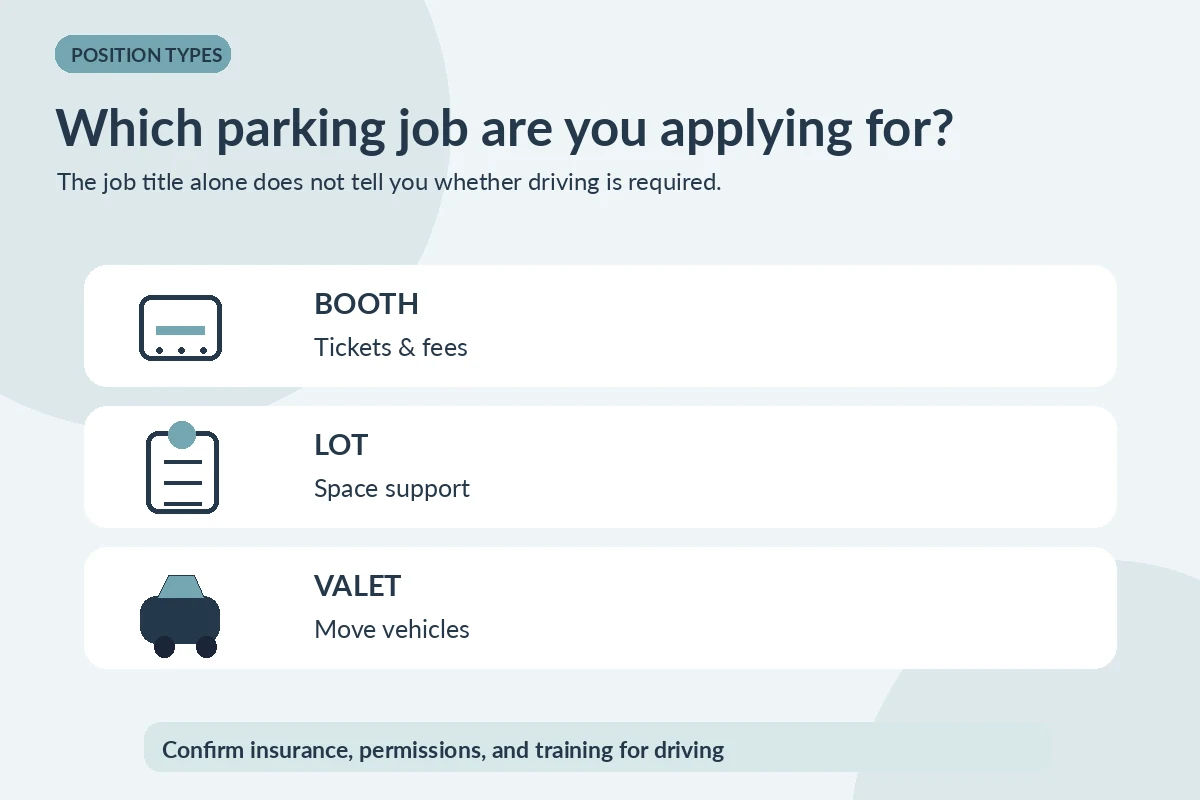
Distinguish booth cashier, lot attendant and valet work
A booth-focused role may involve operating a ticket terminal, explaining rates and handling a payment exception. A lot attendant may patrol assigned areas, report blocked spaces and assist customers. A valet assignment adds vehicle receipt, key control, driving and handoff procedures. Titles are not standardized across employers, so a posting called parking assistant may describe one or several of these tasks. Ask which duties are routine and what happens if the regular valet or cashier is absent.
BLS describes the parking attendant occupation broadly, including issuing tickets, parking vehicles and collecting fees. Do not infer that you have permission to drive a customer’s car or authorize a refund without specific training and employer direction. If a listing mentions maintaining equipment or enforcement, ask whether those duties mean reporting faults or performing skilled repairs or issuing legal citations.
Compare scheduled events with everyday garage coverage
Parking shifts may follow a facility’s normal operating hours or spike during stadium events, concerts and other scheduled activities. An event assignment may have irregular finishing times, while a commuter garage may have a more consistent morning or evening block. Ask for the expected end of shift, whether staff remain until the lot clears, how shift cancellations work and what travel options exist after late closures.
For an illustrative event shift, a worker may help set up entry signage, support vehicle arrivals and close the equipment area after the venue empties. That is a planning example, not a confirmed employer schedule. Compare the total time spent on site with the actual paid hours, especially when duty periods are short and transport costs are substantial. Do not assume that advertised “event staff” hours are weekly guaranteed hours.
Check vehicle-handling and license requirements
Driving customer cars introduces responsibilities absent from many booth roles. Read whether the position requires a valid license, a qualifying driving record, employer insurance procedures or training on different vehicle types. These requirements vary; avoid claiming a universal license threshold or insurance arrangement. If you do not want to drive, explicitly search for booth cashier, ticket attendant or entry-gate support rather than relying only on the broad term parking attendant.
Ask who holds keys, how existing damage is documented, which areas are authorized for vehicle movement and who resolves customer disputes. A new employee should not invent a key-transfer method or take a vehicle outside a designated route. The employer should provide a clear workflow and explain what to do if a vehicle cannot be safely operated or a customer demands a task outside policy.
Evaluate traffic and pedestrian safety before accepting
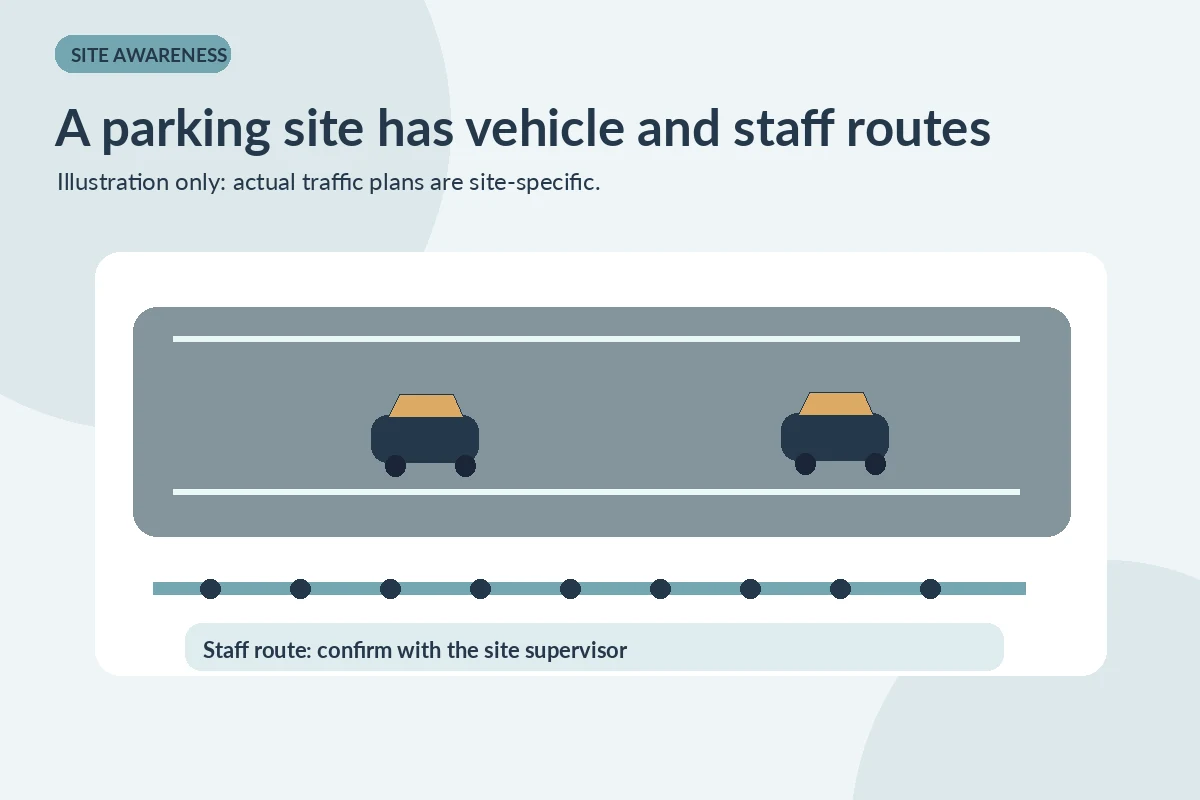
Garage and lot work can take place close to moving vehicles, ramps and entrances with limited sight lines. OSHA has documented struck-by hazards in vehicle-handling workplaces; this is a reason to examine traffic separation and training, not a prediction that an individual job is unsafe. Ask where staff are permitted to walk, how drivers are directed, whether high-visibility equipment is supplied and how a malfunctioning gate or blocked emergency route is reported.
Do not step into traffic, attempt improvised lane control or work on broken barriers without training and authorization. Find out who supervises an evening or lone-worker shift and whether a radio or reliable contact is available. Also check weather exposure, standing time and restroom access. A busy parking facility needs more than a generic instruction to “be careful”; it should explain workable procedures for the assigned tasks.
Ask how tickets, fees and personal information are handled
Parking systems may produce tickets with time stamps, payment records and access information. Ask which transactions the attendant may process, how exceptions are documented and who authorizes refunds, discounts or lost-ticket decisions. If payment cards are involved, staff should use employer-approved systems rather than personal devices. Avoid storing customer license plates or other identifiers outside the assigned system or sharing them casually.
During an interview, describe the sequence you would follow when a customer disputes a charge: listen, check only authorized records, explain published policy and refer exceptions to a manager. Do not promise that you could reverse a charge unless the job explicitly grants that authority. Helpful customer service is compatible with protecting the employer’s controls and the customer’s information.
Find authentic employer openings and present relevant skills
Search official garage operators, universities, hospitals, transit facilities, convention centers and venue career pages for parking attendant, parking cashier, lot attendant or valet associate. Verify whether the employer is a facility or a contracted parking operator. The location and operator matter because event schedules, parking arrangements and training differ. Use the official application link rather than paying an unknown intermediary for access to shifts.
Useful resume evidence can come from ticketing, retail cash handling, hospitality, safe route awareness and reliable shift attendance. A hypothetical line might say: “Explained posted entry procedures, logged gate issues and referred fee exceptions to a supervisor.” Only mention moving vehicles if that was part of your real job. The FTC recommends independent verification of unexpected offers and warns against demands for advance payment.

Compare the offer by task, travel and responsibility
Write down the actual shift windows, parking or travel arrangements, whether driving is required, provided equipment and the expected end of event duties. Ask about paid induction, how overnight shifts are covered, and whom to call for customer conflict or a vehicle incident. A slightly longer commute may be workable for one long shift but not for several short, uncertain calls. Assess the full arrangement instead of comparing only job titles.
Before saying yes, request clarity about vehicle use and key custody, payment authority, emergency contacts and whether you will be alone on site. If essential information is missing, seek the written job description or a supervisor discussion. A well-defined parking role gives you realistic duties, an actual reporting line and procedures you can follow without guessing.
Compare the posting with a task and permission checklist
Use the comparison below as an interview worksheet, not as a statement of policy for a specific employer. Duties, schedules, training, safety practices and authorization depend on the organization. Ask for a job description or written procedure when those details are unclear.
| Position type | Likely task focus | Key question |
|---|---|---|
| Booth cashier | Tickets, published fees, payment support | Who approves exceptions? |
| Lot attendant | Space information and site observation | Where is the safe walking route? |
| Valet | Vehicle receipt and movement | What driving authorization applies? |
How We Research Part-Time Job Opportunities
On 2026-11-06 we compared these specific duties with the official occupational and safety sources below, reviewed the WordPress inventory supplied for this project to avoid overlapping existing part-time job guides, and checked public search context. This article is general US job-search guidance, not a list of currently verified openings or legal advice. Illustrative shifts, counts, scripts and resume statements are hypothetical. Employer procedures and local training requirements control. See the JobAsk affiliate disclosure for information about commercial relationships.
Sources reviewed on 2026-11-06: U.S. Bureau of Labor Statistics — BLS describes the main occupational tasks of parking attendants and typical entry-level preparation.; Occupational Safety and Health Administration — OSHA documents traffic and struck-by hazards in a vehicle-moving workplace, supporting the need to ask about safety controls.; U.S. Federal Trade Commission — FTC provides verification guidance and alerts jobseekers to advance-fee and identity-theft scams..
No. Some positions are booth or lot based; valet roles may include driving. Confirm the actual tasks in the advertisement.
Some event venues and garages use late or irregular shifts. Ask for finishing times and cancellation arrangements.
Ask about staff walking routes, vehicle separation, visibility equipment, supervision and response to gate failures.
Only when authorized by the employer’s procedures. Clarify the escalation route for payment exceptions.
Confirm the operator on an official site or known phone number, and do not pay for the promise of employment.