
Part-time school crossing guard jobs often fit around morning arrival and afternoon dismissal, but the calendar may include a large unpaid gap between two duty periods. Start by checking the hiring employer, the assigned crossing location, the precise duty window and the training provided. Adult crossing guards help students cross at designated locations under local program procedures; they are not general traffic police. The National Highway Traffic Safety Administration describes trained crossing guards as one element of a wider school-route safety program and notes that communities decide locations and program details.
Understand who hires and assigns adult crossing guards
School crossing guard programs may be operated through a school district, municipality, police department or contracted organization. Do not assume the nearby school itself is the legal employer. Search the district and local-government employment pages as well as the official program contact. Review whether the role is school-year-only, substitute or assigned to one location. A substitute opportunity can sound flexible but may require availability at different crossings on short notice.
The National Highway Traffic Safety Administration emphasizes local decisions about guard locations and program criteria. This means a requirement from one city does not automatically apply to another. Ask where you would report, who issues assignments, how changes are communicated and who handles incidents. If a listing is vague about the employer or asks for payment to secure a job, verify it independently before continuing.
Calculate split-shift time and reliable transportation
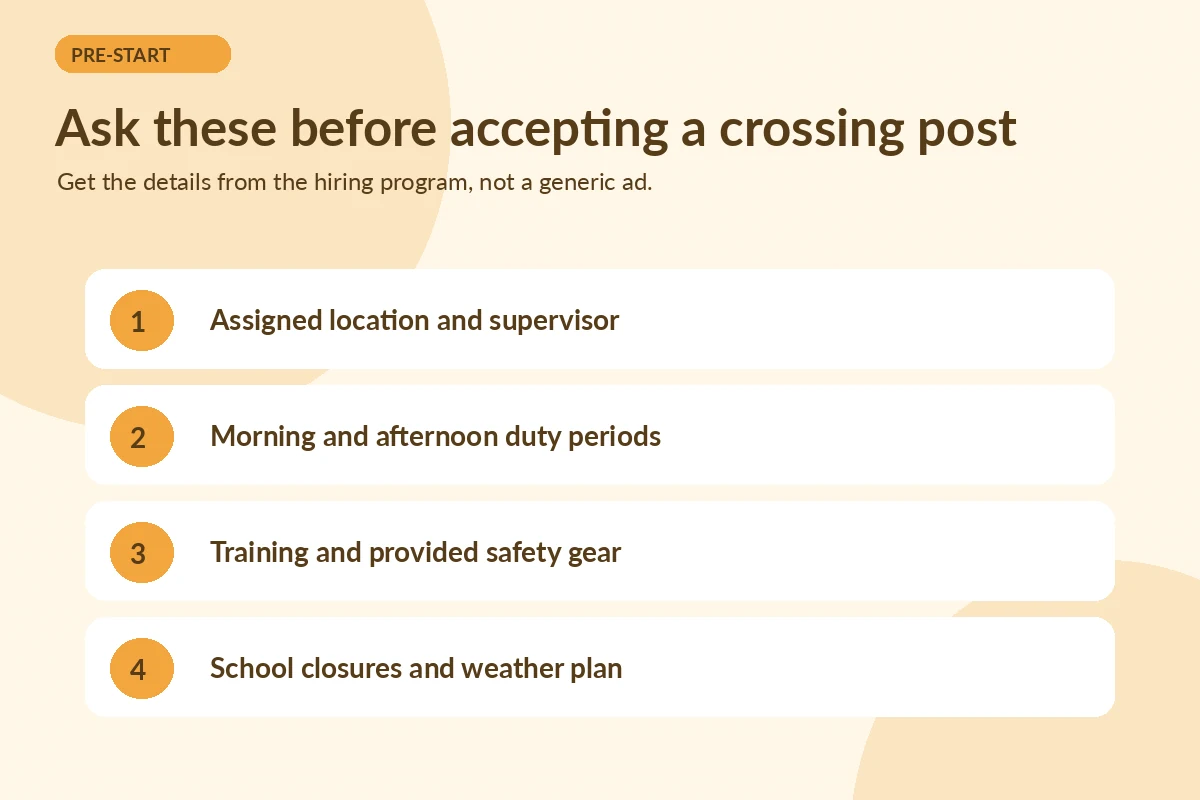
The biggest schedule issue is often not total weekly hours but two separate trips to the worksite each school day. One illustrative schedule might have a morning session and a second dismissal session, with a long gap between them. These times are examples only; schools vary by calendar, grade level and bus schedules. Ask for the actual paid reporting windows, how weather closures affect shifts and whether training meetings are scheduled outside crossing periods.
Write down both commute legs and any time needed for parking or walking to the assigned post. Compare the arrangement with a continuous part-time shift elsewhere. If you have childcare, a second job or public transit constraints, check whether an early dismissal, delayed opening or summer break changes the schedule. Confirm whether the posted figure is a guaranteed number of hours or only a typical estimate.

Review site training and traffic-control boundaries
Crossing guards should receive site-specific preparation and directions from the responsible program. The Federal Highway Administration’s current Manual on Uniform Traffic Control Devices is the national reference for traffic control devices; local authorities implement applicable standards and program rules. An applicant should never use an online diagram as a substitute for supervised training at the assigned crossing. Learn whom to contact when signage is missing, sight lines are blocked or a driver ignores instructions.
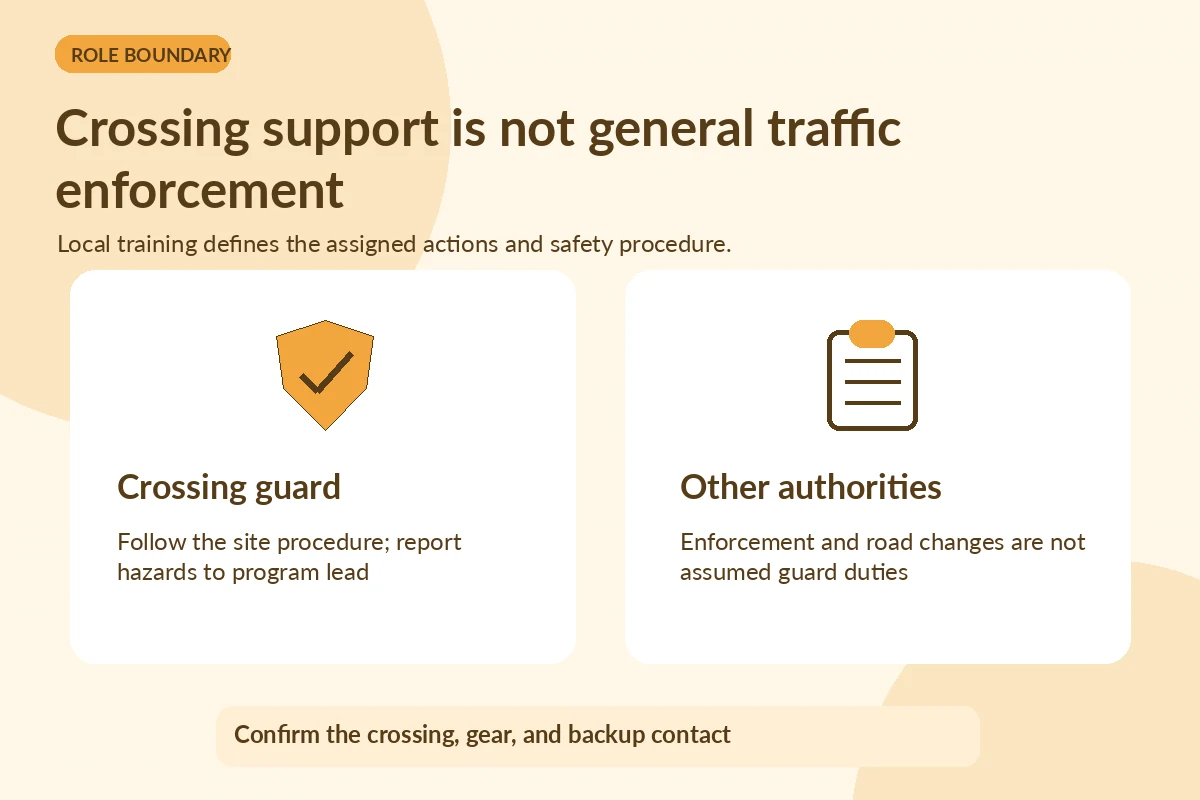
There is an important boundary between the role of a crossing guard and general enforcement. Crossing guards work within authorized procedures for helping pedestrians cross; they do not independently issue traffic citations or invent new traffic signals. Ask what safety equipment is supplied, how weather affects the assignment, whether a backup guard is available, and what incident reporting is required. Clarify duties before agreeing to stand at an unfamiliar crossing.
Make sure the job conditions are sustainable
This work is typically outdoors and requires sustained attention to changing movement around a roadway. Ask whether the site has accessible reporting arrangements, what breaks or shelter are possible between duty periods and how the employer handles heat, rain, ice or severe weather. Do not assume every applicant must meet identical physical criteria; employers should explain the actual essential functions and relevant hiring procedures for the specific assignment.
If you are comparing crossing duty with a classroom or bus job, keep the responsibilities separate. Being present near students does not automatically mean supervising them after school or operating school transport. An advertisement that bundles such duties should specify appropriate preparation, work hours and authority. Decline to treat a role label as permission to perform tasks outside your training.
Find postings and evaluate the employer contact
Useful search phrases include adult school crossing guard, school safety aide, crossing guard substitute and pedestrian safety assistant. Search official school district HR pages and local-government job boards. Some openings may be listed as part time, hourly, seasonal or substitute. Compare the description rather than relying on a search snippet. Confirm the reporting location, whether a specific crossing is assigned and how long the school-year appointment lasts.
Be careful with third-party listings that omit the city or program operator. The FTC recommends contacting the real organization through an independently verified channel before giving personal details. An authentic posting should explain application steps and generally how hiring communications will arrive; an unsolicited demand for fees or financial-account data at the application stage is a warning sign.
Show reliability and communication without overstating skills
A relevant application might describe punctual attendance, communicating clear directions, following a published procedure and escalating a concern to the responsible person. Examples from customer-facing employment, school volunteering or supervised community events may transfer, but they are not equivalent to being a trained crossing guard. State only current certifications or authorization. If the posting requires a driver’s license or background process, follow the listed instructions and avoid volunteering sensitive records in an initial email.
A hypothetical resume line could say: “Opened and closed a supervised community program on schedule, logged daily attendance and reported safety issues to the coordinator.” It presents dependability without suggesting authority over road traffic. Use the interview to ask how new guards are trained, paired or observed, and whether there is a written procedure for unsafe driving reports.
Choose between assigned and substitute coverage
A regular post may offer more predictable workdays but less control over the morning and afternoon windows. Substitute assignments may differ in travel distance, crossing layout and notice. Ask how substitutes are oriented at each location and whether they can refuse assignments that conflict with other commitments. A substitute should not have to improvise procedures at a new crossing because no trainer or contact is available.
Before accepting, compare the actual daily duty blocks, paid training, seasonal end date, reporting line and supplied equipment. If any central question has no answer, request it in writing. The right part-time crossing guard role is one whose supervision and schedule are realistic for you, not one selected solely because its weekly hours look small.
Compare the posting with a task and permission checklist
Use the comparison below as an interview worksheet, not as a statement of policy for a specific employer. Duties, schedules, training, safety practices and authorization depend on the organization. Ask for a job description or written procedure when those details are unclear.
| Posting field | Verify | Why it matters |
|---|---|---|
| Morning and dismissal blocks | Exact reporting windows | Two commutes may be needed |
| Assigned crossing | Location and backup contact | Training depends on the site |
| School calendar | Closures and year-end dates | Income and hours may fluctuate |
How We Research Part-Time Job Opportunities
On 2026-11-06 we compared these specific duties with the official occupational and safety sources below, reviewed the WordPress inventory supplied for this project to avoid overlapping existing part-time job guides, and checked public search context. This article is general US job-search guidance, not a list of currently verified openings or legal advice. Illustrative shifts, counts, scripts and resume statements are hypothetical. Employer procedures and local training requirements control. See the JobAsk affiliate disclosure for information about commercial relationships.
Sources reviewed on 2026-11-06: National Highway Traffic Safety Administration — NHTSA explains adult crossing guard functions, local program decisions and student safety roles.; Federal Highway Administration — FHWA maintains the current MUTCD reference for traffic control devices, with local implementation requirements.; U.S. Federal Trade Commission — FTC advises independent verification of employer contacts and avoidance of upfront fees..
Many programs operate around school arrival and dismissal, but exact windows vary. Confirm the paid duty periods with the hiring organization.
No. The authorized crossing guard role is distinct from general law enforcement. Follow the employer’s specific training and procedures.
Depending on the community, a school district, municipality, police department or contractor may handle hiring.
Hours and pay treatment depend on the employer’s terms. Ask directly about cancellations, delayed starts and paid training.
The employer should explain required instruction and supervised preparation. Do not assume online advice replaces local site training.