
A pharmacy technician cover letter should demonstrate careful work, truthful credentials, and respect for pharmacist supervision. Show a real example of checking details, following a procedure, or communicating a discrepancy rather than saying that you “dispense medications independently.” Include only training or registration you can verify and meet the specific posting and state requirements.
Pharmacy technician roles vary by employer, workplace and jurisdiction. Retail, hospital and other settings do not have identical duties or training requirements. The U.S. Bureau of Labor Statistics describes technicians as supporting pharmacists, and PTCB stresses honest credential representation. Treat the employer’s posting and applicable licensing authority as the decisive sources for your own application.
Start With Credential Status, Not a Slogan
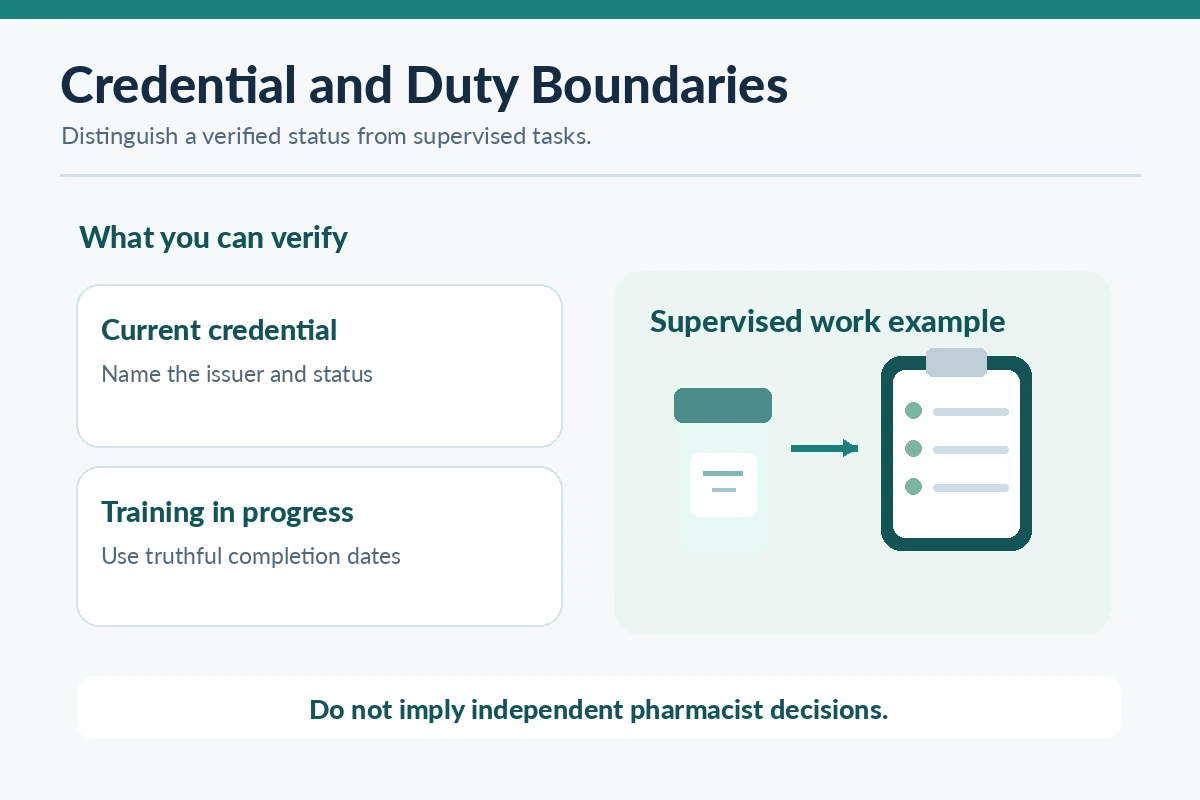
Before drafting, record which credential you actually hold, the issuing body, and whether it is active. Separate an application in progress, a completed course, a provisional status and a current certification. If a job requires particular state registration or training, do not infer that national certification automatically satisfies it. Place your verified status early when the posting names it as essential.
Pick an Accuracy Example You Can Explain
Accuracy can come from trained work, coursework, a supervised externship or another responsible role. A suitable example may involve matching identifiers against approved records, documenting a mismatch and asking the authorized professional to review it. Do not include patient names or prescription details in an application. Your goal is to show a repeatable checking habit, not a secret success rate.
Describe Supervision and Escalation Precisely
The strongest technician letter distinguishes tasks performed under supervision from decisions reserved for a pharmacist or another licensed professional. Describe when you stopped, who reviewed the question and how you recorded the resolution within policy. Avoid language implying that you independently selected drug therapy, advised patients beyond training, or made clinical decisions simply because you handled a medication-related workflow.
Translate Customer Contact Into a Safe Example
If you helped customers in retail or another service role, explain calm communication, identity or privacy safeguards, and knowing when to hand a specialized question to the correct staff member. A pharmacist consultation request is not a weakness. A cover letter should not suggest that speed or customer satisfaction justifies bypassing controls or revealing personal health information.
Match the Setting in the Advertisement
A retail posting might focus on inventory counts, communication and documented procedures; a hospital posting might require different training, equipment or workplace protocols. Do not copy one environment’s tasks into another. Read requirements carefully, especially around certification, registration, restricted tasks, privacy training and scheduling. The cover letter can explain readiness to learn but cannot replace required authorization.
Write an Opening With a Verified Qualification
Lead with the exact technician role and one qualification you have already earned or one relevant verified preparation step. “I am completing a technician training program” is different from “I am certified.” Both may be legitimate, depending on the advertisement. Then add a factual example of precise record handling rather than unsupported claims about medication safety outcomes.
A Hypothetical Scope-Aware Letter
Example for a fictional posting: “Dear Hiring Team, I am applying for the Pharmacy Technician position. I am completing a pharmacy technician training program and am reviewing the registration requirements stated in your listing; I would not represent myself as registered before that status is confirmed. In a supervised training exercise, I compared item identifiers with the approved worksheet, recorded a discrepancy and asked the instructor to verify the correct next step. In a separate customer-service role, I practiced careful record handling and referred questions outside my authority to a supervisor. I would welcome the chance to support accurate, respectful pharmacy operations while following your training, supervision and privacy procedures. My resume lists my completed coursework and actual experience. Thank you for your consideration.” Replace the educational status and tasks only with your true facts.

Avoid Private Patient or Employer Information
Do not attach screenshots of prescriptions, patient details, pharmacy system records or internal procedures. If an interviewer wants an example, describe a generic workflow without disclosing confidential content. A supervised classroom exercise should be described as classroom work rather than real dispensing experience. Authorization to work with data does not mean permission to publish it as portfolio proof.
Run a Final Credential and Language Check
Review the role title, state and workplace, the dates of your training, the exact credential acronym, and any status claim. Remove wording suggesting independent dispensing, diagnosis, treatment advice or guaranteed perfect accuracy. Verify that any pharmacy software you mention is genuinely familiar. Keep the message concise enough that the employer can see qualifications, safe judgment and fit quickly.

Prepare a Credential-Safe Evidence Inventory
Keep a private checklist with completed courses, practice environments, current credential records and the exact boundaries of your work. For each example, note whether it was classroom practice, supervised placement or paid pharmacy employment. Review the terminology before using words such as prepared, processed, verified or dispensed; these can suggest different authorized duties. If your training included inventory tasks, describe the records and the supervision you had instead of implying you independently assessed prescriptions. For a candidate coming from another industry, patient privacy may be unfamiliar, but precise record handling and respectful escalation remain relevant if honestly described. Never attach a photograph of a patient label or use a fictional case as a real achievement. A conservative letter that identifies the correct next reviewer can communicate professional judgment more persuasively than a claim of exceptional clinical ability that you cannot support.
How We Research Cover Letter Guidance
This guide starts with the U.S. Department of Labor-sponsored CareerOneStop cover letter advice, which recommends tailoring concise letters to a specific opening and using genuine skills and achievements. It also compares duties with official occupational or professional sources, rather than assuming that every employer uses the same job description. The letter samples above are hypothetical and should be rewritten from your own records.
For this occupation, the supporting references include BLS occupational profile and professional guidelines. Use the actual posting and appropriate state or workplace rules for final requirements. We do not guarantee interviews, hiring or automated screening results. See our affiliate disclosure for site relationships; no affiliate recommendations appear in this guide.
Related Guides
- Pharmacy Technician Resume Summary: Credentials and Pharmacist Review
- Tell Me About Yourself in a Pharmacy Technician Interview: Accuracy First
- Pharmacy Technician Interview Questions: Accuracy and Patient Support
- Part-Time Pharmacy Technician Jobs: Verify Credentials and Weekend Hours
- Virtual Assistant Cover Letter: Demonstrate Reliable Remote Support
Apply only where the requirements permit it, and describe your true stage of training or authorization.
Yes, if you have the credential or clearly explain that preparation or testing is still in progress.
Yes, label it as supervised coursework or training and do not imply independent workplace practice.
Do not share identifying or confidential patient information. Use a generalized process example.
Demonstrated accuracy, documented handoffs, safety boundaries and employer-specific qualifications.