
If you are applying for a new job while your current manager does not know you are looking, you can prepare professional references without automatically putting that manager on your contact list. Ask permission from former supervisors or other people who directly observed your work, verify their contact details, and tell the recruiter that current-employer contact must be discussed with you first. The right response depends on the employer’s stated requirements; a reference request, an employment-verification request, and permission to call your current manager are not interchangeable. The example messages below are hypothetical and should be adapted to the actual hiring process.
Separate reference conversations from current-employer contact
A professional reference speaks to performance they observed; a workplace verification process may merely confirm titles and dates. Recruiter forms sometimes put both under the word ‘references,’ but the difference matters if your current employer has not been told about your search. Read each field closely. Is the recruiter asking for people to discuss your work, or asking permission to contact your present employer? Do not answer one question by assuming it resolves the other. State exactly what you have authorized, preferably in a traceable email.
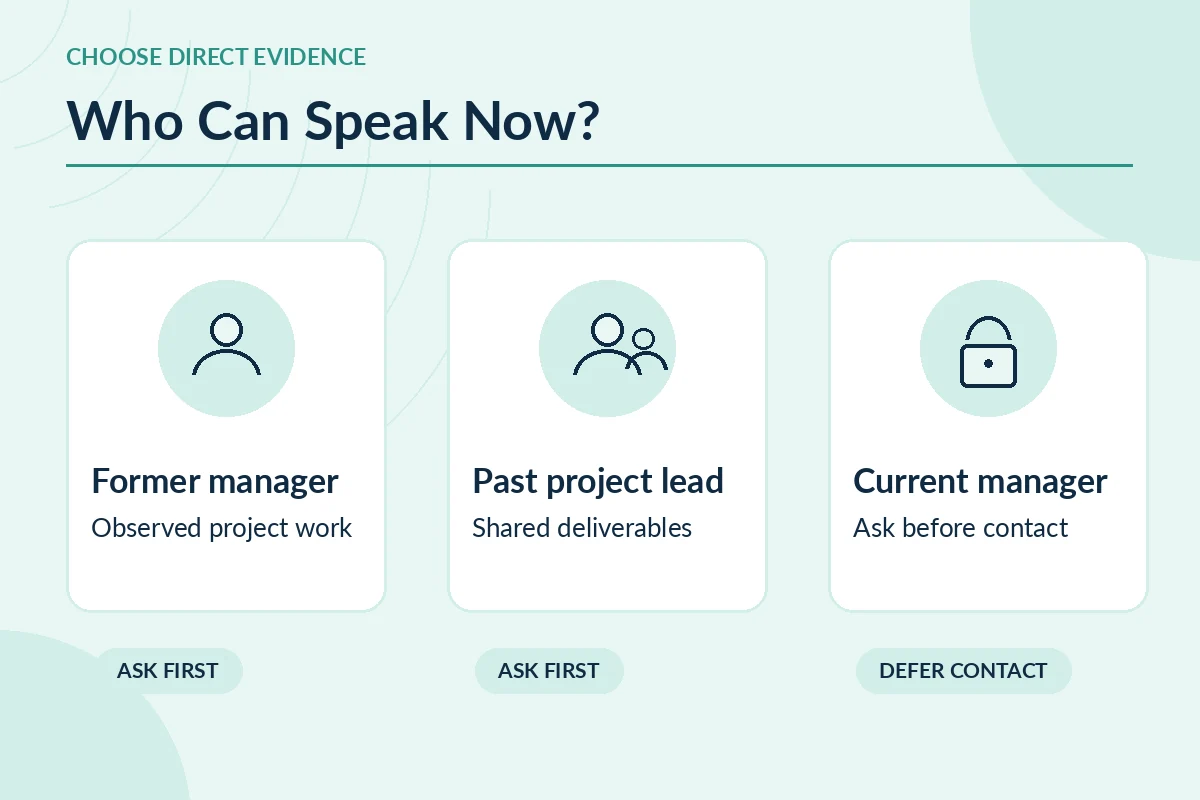
For example, an applicant may share a former team lead and a volunteer supervisor who agreed to be contacted while withholding contact permission for the current manager. That is not a request to hide employment history or misstate dates. It is a boundary on when contact can happen. A hiring organization may need additional verification to complete its process; ask how it handles confidential candidates instead of promising that the alternate list will always be accepted.
Choose people who can describe your work without disclosure
Start with two or three people who already know your search is underway and can discuss relevant assignments: a past manager, a former colleague who supervised a project, an internship lead, or a client when permission and confidentiality allow. A prestigious title is less useful than clear first-hand evidence. Choose someone who can describe the role you held, how you met deadlines, and the kind of feedback you received. Ask whether they are comfortable giving a detailed, accurate reference rather than just confirming they remember you.
Avoid recruiting a current coworker merely because you trust them socially. Even a well-intentioned coworker may reveal your plans in normal office conversation. If you do use someone at your current organization, discuss confidentiality explicitly and decide whether the risk is acceptable. Do not pressure anyone to keep a secret, and do not send nonpublic project files to make a referee sound informed. Use public job descriptions and your own nonconfidential resume instead.
Write an explicit request with a clear contact boundary
A specific request is more respectful than sending a name to an employer without warning. A concise message can say: ‘I am exploring other roles confidentially. You saw my work on [actual project]. Would you be comfortable serving as a professional reference if an employer reaches the final stage? I would not share your details unless you agree.’ Replace the bracket with a true fact. A former manager can decline, or can offer a limited factual reference under company policy. Either answer gives you information before a deadline.
If they agree, ask for their preferred professional email, phone number, current title, and the relationship you should list. Explain when the employer may reach out and whether you will send another alert beforehand. Do not imply that a referee should memorize a script or guarantee a positive assessment. They should offer independent, truthful observations. Save the date and substance of their consent in your own private tracking notes, not in the public resume.

Explain the confidential boundary to the recruiter
When an application asks to contact your current supervisor, avoid inventing a previous employer or submitting someone else’s information. A usable reply is: ‘My current employer is not aware of my search. Please do not contact them at this stage. I can provide former supervisors who know my work, and I am happy to discuss verification timing later.’ That sentence distinguishes the restriction from a refusal to provide all references. If the form offers ‘not at this time,’ use it when it is true; if the form is ambiguous, ask the recruiter before submitting.
Some employers have a fixed process or need to complete checks before final hiring. Clarify the exact stage at which they expect current-employer contact, who would call, and whether another form of verification is acceptable. Request a written acknowledgment if confidentiality is especially important. A polite boundary is not a guarantee the employer will accommodate it, but it makes the decision visible and gives you a chance to discuss workable alternatives.
Prepare a reference sheet that cannot leak private details
Create a separate, securely stored reference sheet with each person’s full name, current title, employer, relationship to you, and their agreed phone or email. Label former relationships clearly: ‘Former project supervisor at [former organization]’ is more accurate than implying that person currently manages you. Keep the file off public resumes, shared portfolio pages, and broad job-board profiles. Share it only with the intended recruiter through a legitimate application channel when requested.
Double-check each person before sending the sheet. A manager may change organizations, and work email addresses may expire. Never scrape phone numbers or guess an address. For a high-volume search, keep an internal log of which employers have received which contacts. That helps you tell references about incoming calls and limits unnecessary distribution of personal information.
Use a two-stage checklist before approval
At the first stage, confirm the employer’s request, your available approved references, and whether any reference has a conflict of interest. At the second stage, if the process truly requires your current supervisor, decide when you are willing to permit contact and what consequence early disclosure could have. You may seek advice from a trusted career adviser or employment professional when your situation is unusually sensitive. Do not claim any universal legal right to prevent a particular hiring check; employer procedures vary.
Keep a clear paper trail: requested date, allowed contacts, deferred contacts, any recruiter reply, and follow-up date. The checklist should not become a strategy for hiding material facts. Your titles, dates, reasons for leaving, and application answers must remain accurate. The point is informed permission and timing, not manufacturing an alternative employment history.

Update the reference team once the employer may call
Once you reach the relevant stage, send each consenting referee the role title, a short description, the name of the hiring organization if appropriate, and the timeframe the recruiter shared. Include your current resume so they can recognize how you describe your own experience. Mention a real project they witnessed, not a requested sales pitch. An independent reference may highlight strengths and limitations you did not anticipate. Resist any attempt to coach them into claiming they saw events they never observed.
After the process ends, thank your references whether or not you receive an offer. If the hiring team asks to contact the current manager after a conditional decision, revisit your boundary deliberately and tell the manager yourself before authorizing a call, if that is the course you choose. If you decline, respond promptly and let the recruiter explain possible consequences rather than silently disappearing.
Handle pressure and unusual reference requests cautiously
A recruiter who asks for immediate permission can be following a legitimate workflow, but urgency alone does not eliminate your need to understand the request. Check the sender’s identity using the employer’s published channels before sharing colleagues’ phone numbers. If you receive a generic online form asking for an entire staff directory, ask what minimum information is needed. A normal reference list is a small set of willing people with relevant knowledge, not a bulk contact export.
Do not promise a recruiter that your references will be positive. A suitable reference is a person able to speak responsibly about specific work. If a former supervisor is unable to comment because of employer policy, present a different consenting reference and explain the limitation if asked. A professional answer is precise, calm, and consistent with the rest of your application.
How We Research Professional Reference Advice
We checked guidance from ocs.yale.edu; csus.edu; colorado.edu; careers.bu.edu about selecting people who observed real work, requesting permission, describing professional relationships accurately, and limiting claims to what a reference can genuinely know. The sources describe general career practices rather than rules at every employer. Example names and events here are hypothetical and do not represent an actual reference check, legal conclusion, or hiring outcome. Follow the instructions of the specific hiring organization and use only approved contact information. For commercial relationships and links, review our affiliate disclosure.
More Resume and Cover Letter Guides
Not automatically. Explain that your current workplace is unaware of the search, ask whether alternative references are acceptable, and follow the employer’s specific process.
State your actual permission and timing clearly. Some hiring processes may require later verification, so discuss options rather than treating the form as a guarantee.
Possibly, if the person directly observed your work, agrees to be contacted, and meets the employer’s requested type of reference.
Usually keep it separate and supply it only when requested. A public resume is not a safe place for other people’s contact details.
Ask permission before listing them, then send a short update with the role and expected timing whenever their details are shared.