
A project manager interview thank-you email should thank the interviewer, recall a real project challenge discussed, and connect it to one verifiable way you manage risks, owners, or decisions. Choose a narrow example: clarifying an approval path, reporting a blocked dependency, or documenting a change request. Do not retell a client’s confidential program or claim authority over decisions someone else made. A direct subject line such as ‘Thank you — Project Manager interview, [Your Name]’ is enough. This article focuses on one question: how do you show competent judgment in a brief follow-up without sending an unsolicited project plan?
Distinguish an interview problem from a live project commitment
First decide whether the interviewer described a hypothetical exercise, a publicly described project, or a confidential internal situation. You may refer to a general challenge discussed—cross-team dependencies, unclear requirements, schedule risk—without replaying the company’s business details. If a specific client, cost, launch date, or security issue was shared under interview expectations, do not repeat it in a message that might be forwarded broadly. A thank-you email should prove you listened, not show that you can reproduce private meeting notes from memory.
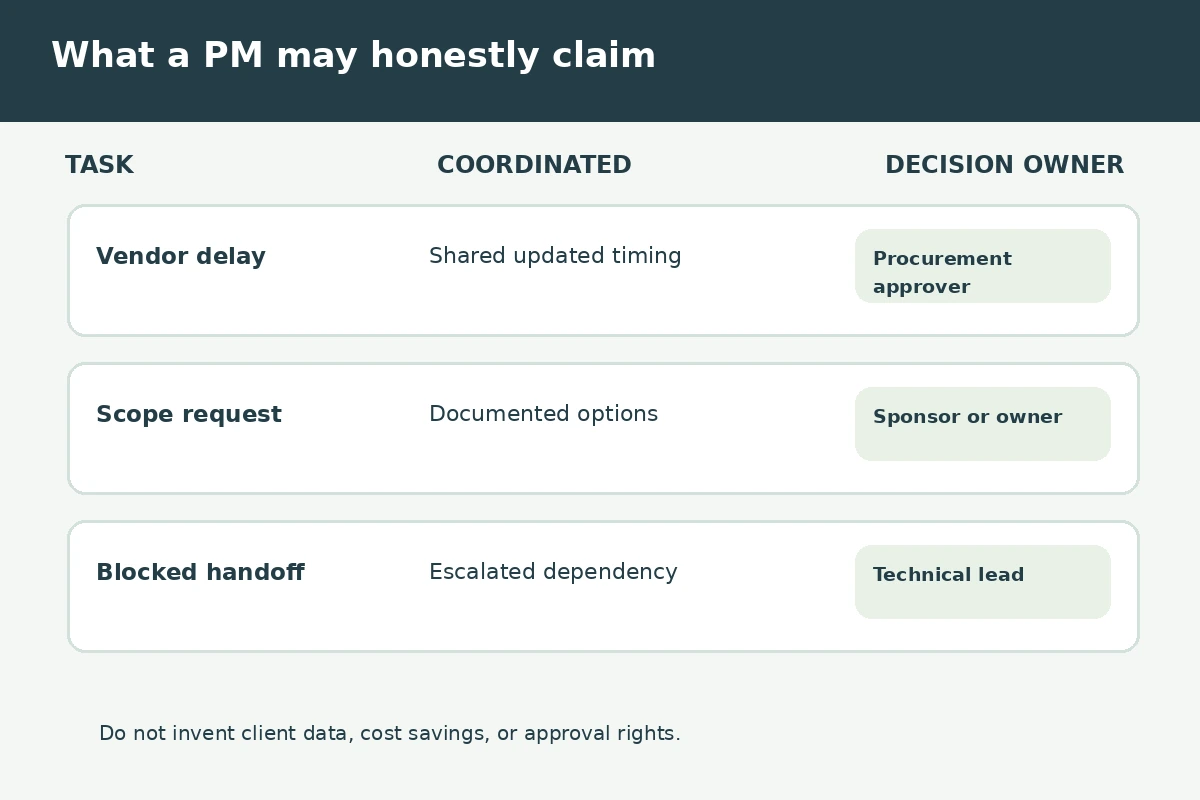
Keep the real decision boundary visible. Project managers may coordinate schedules, stakeholders and deliverables, but contract approval, budget authorization, technical sign-off and product decisions can belong to others. BLS describes broad project coordination activities; a particular job may allocate power differently. State the action you owned, such as maintaining a risk log or preparing options for a sponsor. Avoid claiming that you approved a scope change when your actual role was to document it for review.
Choose one interview detail with operational meaning
If the conversation focused on missed milestones, write a line about surfacing dependencies early and assigning a named owner to each unresolved issue. If the manager discussed communicating to executives, mention presenting a concise decision record with options, tradeoffs and responsible approvers. If the panel emphasized handoffs across product and engineering, connect that to your real experience clarifying acceptance criteria. These are alternative angles, not a checklist to cram into one email. The right choice comes from what the person asked and what you can truthfully show.
PMI identifies honesty and responsibility as central project-management ethics values. That is especially relevant when writing about outcomes. ‘I kept the issue register current and escalated timeline risks to the steering group’ is bounded and plausible if true. ‘I saved every project and guaranteed delivery’ is not. Even an accurate percentage should be used only when you have a verifiable calculation, permission to share it, and appropriate attribution. A brief thank-you rarely needs confidential metrics at all.

| Situation | Good evidence to mention | Boundary to check |
|---|---|---|
| Risk flagged | Document issue and impact | Sponsor or owner decides |
| Dependency blocked | Confirm responsible party | Team lead reviews change |
| Schedule update | Present realistic options | Authorized approver signs off |
Build a project manager note with a specific risk example
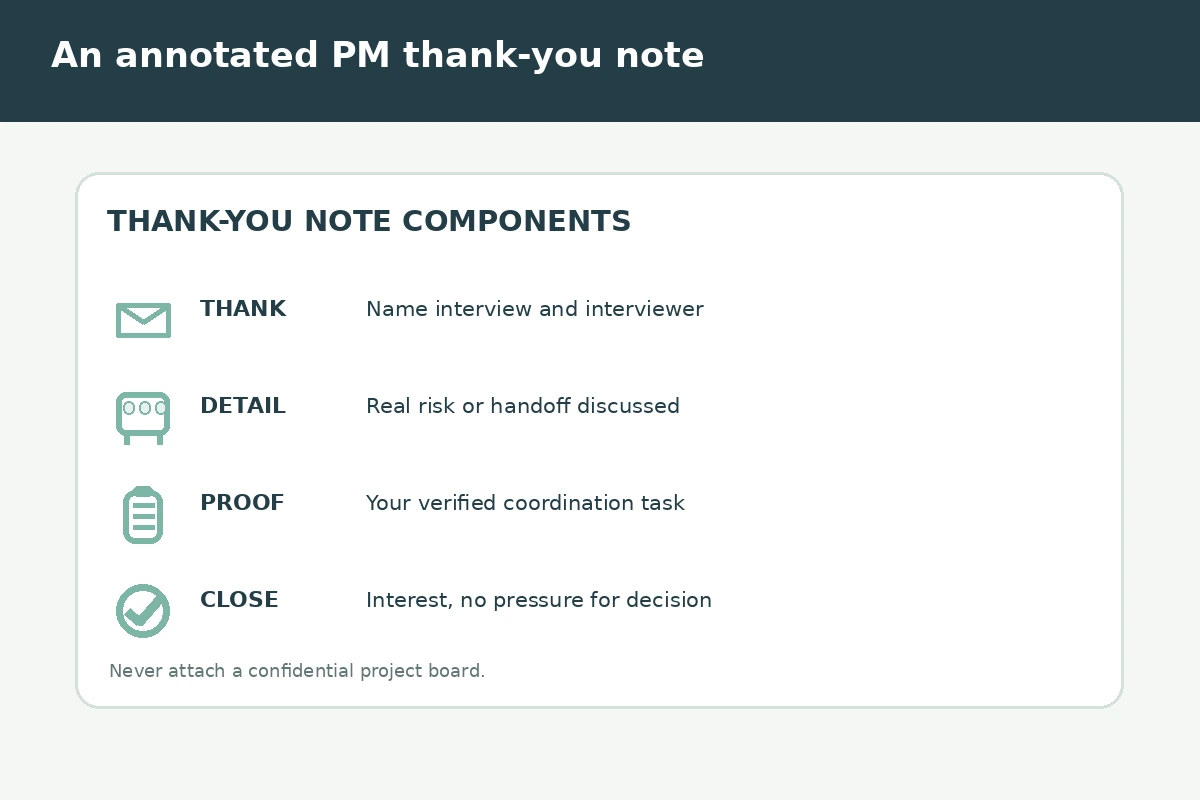
Hypothetical model: Subject: Thank you — Project Manager interview, [Your Name]. Dear [Interviewer], I appreciated our conversation about the Project Manager position and the team’s approach to cross-functional handoffs. Your point about making schedule risks visible early connected with my experience tracking dependencies and routing decisions to the assigned owner. I would welcome the chance to support that kind of clear communication and structured escalation in this role. Thank you for your time and insight. Best, [Your Name]. Replace the bracketed fields and ensure the conversation really occurred.
If the role centered on agile delivery, do not sprinkle terms such as Scrum or velocity into the message unless they were relevant to the interview and to your experience. If the discussion centered on compliance or safety, use the correct level of caution and name review paths rather than improvising promises. The mail should read like a thoughtful professional note, not a transcript or a consulting proposal. One accurate decision example is more persuasive than a paragraph of every project-management framework you know.
Separate evidence of coordination from authority to approve
Create a private three-column note before writing: the issue observed, the action you actually took, and the approver or team who made the final decision. If you identified a vendor delay and informed procurement, don’t write that you ‘renegotiated the contract’ unless that happened. If you prepared revised dates for a sponsor, you did not necessarily authorize the scope change. This discipline makes the thank-you more credible and helps you follow up in a future interview without changing your story.
When an employer asks for a work sample, use only sanitized documents you own or have permission to share. A redacted timeline may still identify a client by unusual milestone names or embedded metadata. Do not attach internal project boards, risk registers, invoices, stakeholder contact lists, or recorded meetings merely because the interviewer liked your example. Ask which format and secure submission channel are preferred. A thank-you message can offer to provide an approved sample later, but should not volunteer confidential material.
Handle second-round interviewers without duplicating the message
A technical lead may focus on dependencies and acceptance criteria, while a sponsor may ask about decision visibility. Send personalized notes only through professional addresses provided for hiring. You can tailor a sentence to each conversation without telling one panel member what another privately said. If the hiring team prefers all communication through a recruiter, use that route. Follow-up etiquette differs across organizations; a generic ‘thanks to the team’ through the recruiter may be more appropriate than guessing individual contact details.
Do not attach a revised risk matrix that nobody asked for. Unsolicited deliverables can seem as if you are overriding the evaluation exercise or proposing a solution without access to real requirements. If the interviewer requested a clarification, answer the narrow question with enough context to be understandable and no proprietary content. If a question exposed a knowledge gap, avoid writing a defensive essay; acknowledge a concrete point you learned and keep the note focused on appreciation and interest.
Review the message against fairness and accuracy
Before sending, check the project or product names you are permitted to mention, the interviewer’s job title, the intended role, and the correct company spelling. Replace unsupported adjectives such as ‘world-class’ with a factual reference. Do not imply private recruiting decisions or a guarantee of project success. In project work, candor about owner, dependency and review is more useful than inflated certainty. Keep the total email concise enough to read between meetings without losing the specific point.
Save the email and the recruiter’s stated timeline. A thank-you is not a request for a status decision, nor an opportunity to pressure the hiring manager about another offer you do not have. If you need to share a real deadline, do so as a separate factual scheduling communication. PMI’s ethics guidance supports accurate and responsible professional representation; treat your written follow-up as another sample of the judgment you would exercise on the job.
How We Research This Interview Email Guide
We reviewed the following university, professional and occupational sources on November 16, 2026: PMI identifies honesty, responsibility, respect and fairness in project-management ethics. BLS describes project management specialists coordinating budgets, schedules and staffing. Tufts career guidance on prompt, specific, professional thank-you emails. We also reviewed the supplied WordPress list, including drafts, to avoid repeating existing article titles and search intents. Guidance from different career offices can vary; where it differs, follow the employer’s actual process. All sample emails are hypothetical and require personalization. No paid services are recommended here. See the JobAsk affiliate disclosure.
More Interview Preparation Guides
Only if reliable, permitted and attributable to your actual work; the note usually works without private figures.
Avoid sending an internal or confidential artifact unsolicited. Offer an approved sanitized sample only if requested.
Refer to the general issue type without repeating client names, budgets, unpublished plans or sensitive context.
Yes when the approach really came up and you used it in the capacity you claim. Do not add jargon solely for appearance.
Use the hiring team’s preferred route and tailor notes to actual conversations rather than duplicating a mass message.