
After a nursing interview, send a short thank-you email that appreciates the nurse manager or interview team, references one real discussion about the unit, and connects it to your verified experience or supervised training. Do not identify patients or claim procedures outside your licensure, competence or assigned scope. A useful subject is ‘Thank you — RN interview, [Unit] — [Your Name].’ BLS describes registered nurses as coordinating care and working with interdisciplinary teams, while NCSBN emphasizes that legally permitted practice depends on jurisdiction and competence. Your email should respect both realities, not promise that you can perform every task on day one.
Identify the unit question you can answer honestly
Look back at the interview notes: Did the manager discuss orientation, handoffs, patient education, escalation to senior staff, or teamwork across shifts? Pick one topic that actually came up. If a unit emphasizes structured onboarding, a new graduate can express appreciation for the explanation of preceptorship without pretending to be independently experienced. An experienced RN might mention an approved example of shift communication or care coordination. Do not assume staffing ratios, patient acuity, technology, or the hospital’s patient population from a marketing page if the interview never established them.
Think of the unit name as a useful disambiguator, not as a credential. ‘Medical-surgical RN interview’ communicates more than ‘Thank you for today,’ but do not label an interview ‘ICU’ if the posting was for a general float pool. Confirm the organization’s preferred titles and the interviewer’s correct role. A recruitment coordinator may organize interviews while a nurse manager evaluates clinical fit; these recipients can receive different, appropriately focused messages rather than an identical clinical pitch.
Connect one strength to supervised and licensed work
A legitimate follow-up sentence may say, ‘I appreciated our conversation about how the team escalates changes in patient status; my experience documenting handoffs under the unit’s procedures would help me learn the workflow.’ This is an illustrative sentence to adapt, not an endorsement of any particular hospital. Only use it when you truly performed the work. For new graduates, be explicit about student clinical rotations and supervision instead of promoting those hours to independent RN experience. For experienced nurses, specify your own practice area rather than importing responsibilities from another specialty.
NCSBN’s nurse practice act resources remind applicants that scope is tied to the relevant jurisdiction’s law and rules. If you are waiting for licensure or are applying across jurisdictions, do not write ‘fully licensed’ until it is accurate. Likewise, do not suggest that a nursing assistant, student, licensed practical nurse and registered nurse all have interchangeable authority. It is entirely professional to express your readiness to learn local policies and ask about orientation, not claim competencies you have not demonstrated.

| Situation | Good evidence to mention | Boundary to check |
|---|---|---|
| New graduate | Supervised placement and orientation | Do not claim independent practice |
| Experienced RN | Verified unit and teamwork tasks | No confidential patient outcomes |
| Pending license | Accurate credential status | Verify jurisdiction requirements |
Use a concise nurse thank-you message model
Hypothetical email: Subject: Thank you — RN interview for [Unit], [Your Name]. Dear [Nurse Manager Name], thank you for speaking with me about the RN position on [unit]. I appreciated learning how the team handles [specific orientation or handoff process discussed]. My [actual clinical rotation or relevant nursing experience] has strengthened my attention to clear documentation and timely escalation. Our conversation increased my interest in the opportunity, and I would welcome any next steps through the recruitment team. Thank you again, [Your Name]. Replace every bracket; delete any claim that you cannot support.
The message works because it contains a specific interview moment, an accurately framed capability, and no personal patient details. A senior RN may replace the training line with a concrete, permitted workflow example: ‘In my current role I coordinate discharge teaching with the assigned care team.’ A new graduate might say, ‘My supervised clinical placement taught me to confirm questions promptly with my preceptor.’ Never fabricate licenses, certifications, specialty assignments, or clinical outcomes to make a thank-you email sound stronger.
Keep patient narratives and interview records private
One of the simplest errors is describing a memorable patient to prove empathy or clinical judgment. Do not include an individual’s name, dates, unusual condition, room number, photograph, record screenshot, or a combination of details that may identify them. You can reference a general skill such as patient education, chart accuracy, or team escalation without exposing a particular case. An interview is also not a license to share former employer protocols, staffing complaints, or patient records in an email. Treat private information as out of scope for the follow-up.
Avoid overclaiming unit performance. ‘I improved survival’ or ‘I eliminated medication errors’ makes extraordinary causal claims that a thank-you note cannot substantiate. If a documented initiative was team-led, use ‘contributed to’ and name your actual responsibility only when it is appropriate to share. If the interviewer asked about a safety incident, do not send a long self-defensive explanation of an unresolved case. A short acknowledgment of the conversation, or a discreet question through the proper clinical/recruiting channel, is more appropriate.
Differentiate a new-graduate note from an experienced RN note
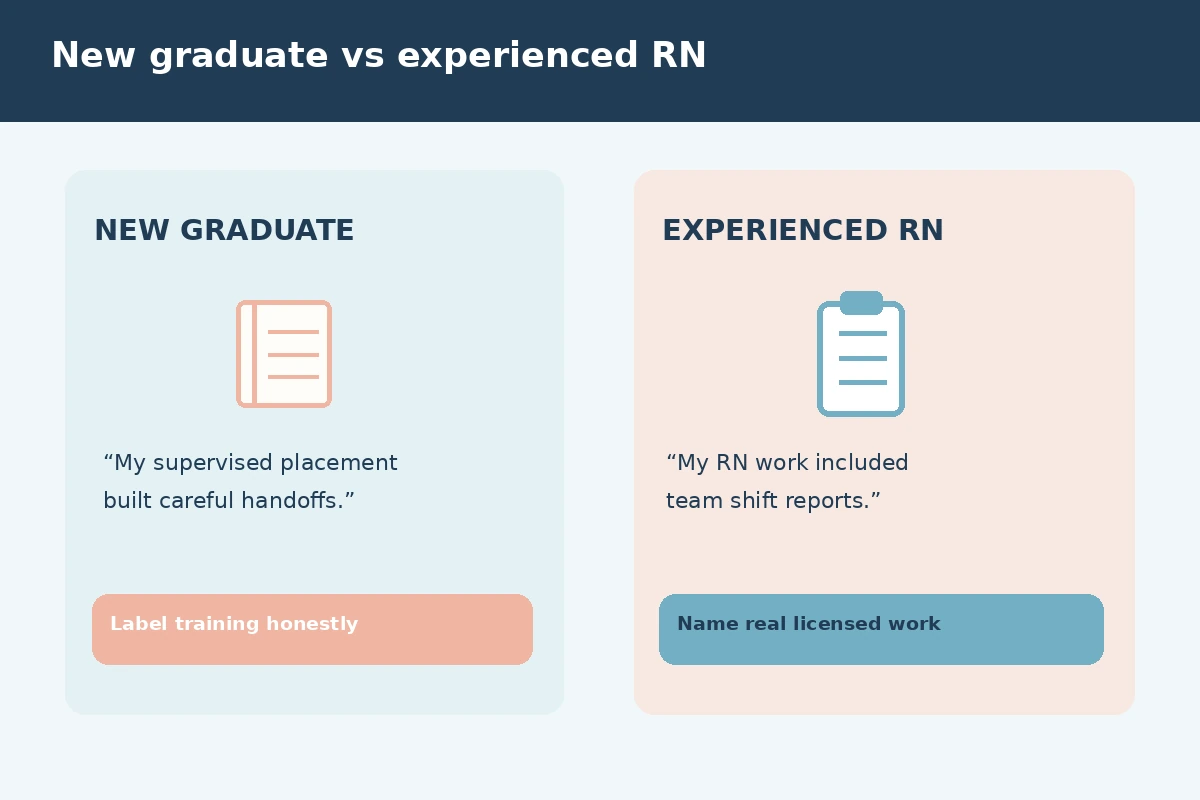
For a new graduate, the strongest angle is a match between supervised learning and the hospital’s actual training plan. You could say you valued hearing how preceptors provide feedback and how the unit handles escalating concerns. You should not imply that coursework confers independent responsibility for advanced procedures. For an experienced RN, focus on one transfer-relevant practice supported by real employment: admission handoffs, team communication, or patient education consistent with your practice. Do not say you have done specialized procedures that you merely observed.
If the role is for a nurse practitioner, licensed practical nurse or nursing assistant rather than an RN, do not recycle an RN letter with a changed job title. Qualifications, legal permissions and typical duties differ. The BLS RN profile supplies occupational context, not an individual employer’s exact job description. Confirm the posting, licenses, and the facility’s training expectations. The best thank-you is narrow enough to be true and professional enough to stand on its own if forwarded to a different hiring panel member.

Send through the correct channel and proofread clinical titles
A university career center recommends prompt follow-up and mentioning actual interview details; that is a courtesy guideline, not a guaranteed hiring advantage. Send to the nurse manager if a professional contact address was given, or ask the recruitment contact to pass on your thanks. Do not guess personal addresses or message staff through private social accounts. If you are awaiting an occupational health or credential review, keep those documents in the employer’s secure onboarding system rather than attaching them to a thank-you email.
Before sending, verify license abbreviations, degree names, dates, the unit’s name, and the spelling of each interviewer’s name. Read the message once as a nurse manager: does it respect patient confidentiality, supervised training, and team roles? Read it again as a recruiter: is it short, clear and appropriately addressed? Save your note and wait for the stated timeline before asking about status. A thank-you is not the appropriate vehicle for soliciting privileged patient or staffing information.
How We Research This Interview Email Guide
We reviewed the following university, professional and occupational sources on November 16, 2026: BLS describes registered nurses’ care coordination, education, assessment and teamwork. NCSBN explains state nurse practice acts and jurisdiction-specific scope. NCSBN nursing scope decisions depend on authorization, education and competence. University of Alabama career guidance on interview notes, timely thanks and specific conversation details. We also reviewed the supplied WordPress list, including drafts, to avoid repeating existing article titles and search intents. Guidance from different career offices can vary; where it differs, follow the employer’s actual process. All sample emails are hypothetical and require personalization. No paid services are recommended here. See the JobAsk affiliate disclosure.
More Interview Preparation Guides
You may reference the public unit or specialty discussed, but avoid details about individual patients or nonpublic clinical information.
Use your actual current status rather than claiming a credential before it is issued; check the relevant board of nursing.
Yes, when clearly labeled as supervised clinical education, not independent employment or licensed practice.
Usually keep official credential documents within the recruiter’s requested verification channel; mention them accurately if relevant.
Use the approved recruiting contact or short personalized notes when addresses are provided. Avoid mass-sending identical messages.