
A quality control inspector resume objective should name the inspection work you can actually do and the role you want next. If you have checked dimensions, logged defects, or reviewed a checklist under supervision, that is more persuasive than saying you are “passionate about quality.” The opening must distinguish collecting measurements from approving a product. Inspectors often compare items with documented specifications, but a new applicant should not claim authorization to release, reject, or certify parts unless that was genuinely their responsibility. Use two concise sentences, then support them with dated work, training, or project evidence below.
Match the objective to the inspection environment
Begin with the actual vacancy. A food-packaging line, an electronics assembly site, and a machine shop can all advertise inspection work, yet the checks and required training differ. Circle the nouns in the posting: incoming material, dimensional measurements, visual defects, production records, or final inspection. Select one task you have done or formally studied. The Bureau of Labor Statistics describes inspectors using specifications, gauges, and reports, but that occupation summary is not evidence that a particular job trains every new hire on every instrument.
Write the objective for the role rather than for an abstract career in manufacturing. A student who completed a supervised metrology exercise may target an entry-level quality inspector position emphasizing careful measurement and documentation. A production operator who performed authorized first-piece checks can say so more directly. Neither candidate should borrow an aerospace standard, inspection certification, or approval title from the posting merely to sound qualified. Those belong only when the experience section or credentials substantiate them.
Build a real tool-and-evidence inventory
Create three columns on paper: instrument or method, actual task, and traceable evidence. If you used a caliper in class, record the exercise and whether someone reviewed your work. If you observed a coordinate-measuring machine, say “observed” rather than “operated.” If your only experience is visual sorting at a volunteer event, do not rename it precision dimensional inspection. A credible objective can identify attention to specifications without pretending unfamiliar instruments are mastered.
For example, a hypothetical learner might have compared sample lengths against an instructor-supplied tolerance sheet and recorded readings in a lab log. That supports “coursework in dimensional measurement and organized inspection records,” not “qualified to certify production parts.” In a real job, errors can prompt quarantine or escalation under local procedures; your resume should explain what you did when the result was uncertain. Actual evidence can include a redacted training log, project rubric, or supervisor-verified task description.

Use an honest objective example for an early career applicant
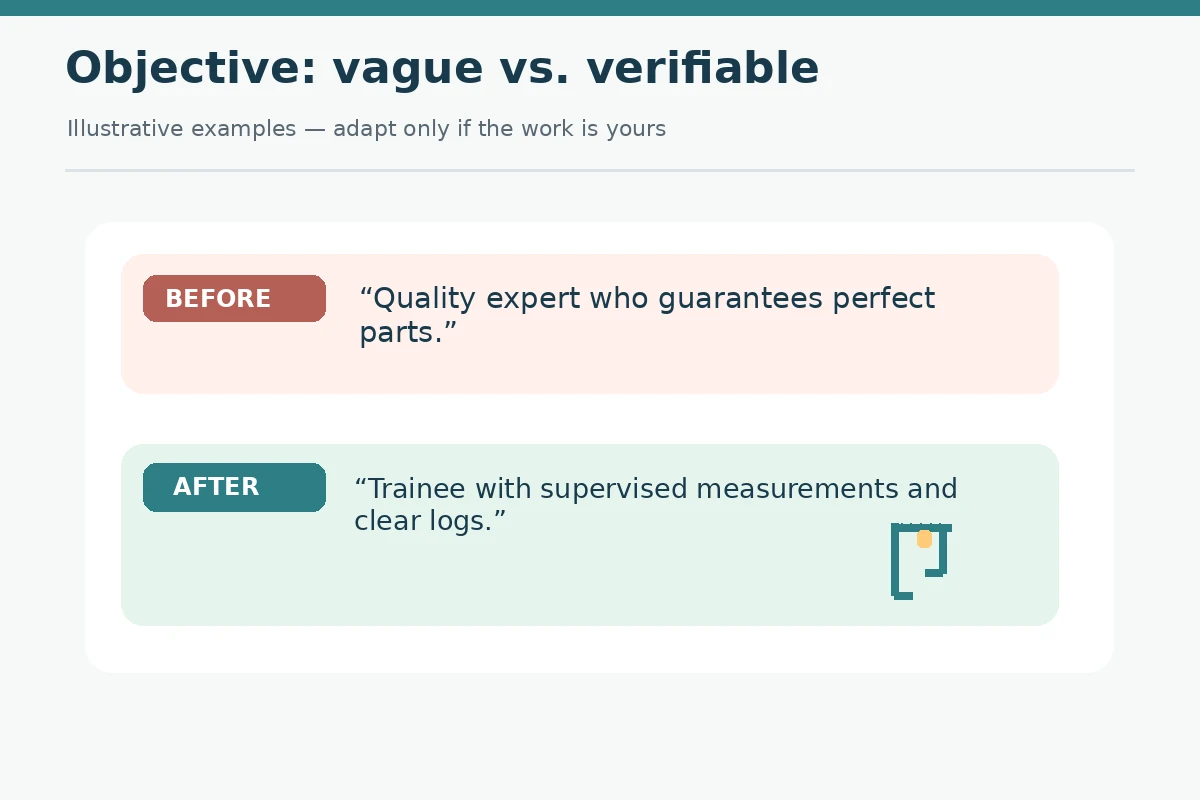
Illustrative objective: “Manufacturing trainee seeking an entry-level quality control inspector role; practiced basic dimensional checks and recorded results against instructor-provided specifications during technical coursework.” This example is not a credential and should not be copied unless both the training and measurements happened. The point is its tight connection between target role, performed action, and source of oversight. Replace “manufacturing trainee” with your real background and adjust the instruments to those you can demonstrate.
A weaker version would say, “Detail-oriented perfectionist seeking to ensure 100% defect-free production.” That sentence promises a result no applicant controls, omits any method, and can falsely imply responsibility for final product quality. A revised version might emphasize documenting anomalies and alerting an assigned inspector. Hiring managers can assess such evidence in the work-history bullets: inspected which items, using which procedure, and passed concerns to whom. Numbers belong only where you kept reliable counts.
Write a transition objective from production or warehouse work
If your experience comes from assembly, packing, or inventory, find the overlap without renaming the job. Accurate labels, item counts, production instructions, and careful reporting may be relevant, but not all are quality-control inspection. A reasonable transition objective is: “Assembly associate moving toward quality inspection, with experience following written product instructions, recording count discrepancies, and notifying the shift lead about exceptions.” Adapt it only when those tasks were yours.
Put the proposed transition in the objective while reserving the evidence for the experience section. “Seeking to learn controlled measurement techniques” is appropriate when you lack them; “skilled in calibrated instrument verification” is not. If a job requires documented training, ask about eligibility instead of claiming you already meet it. Check whether your prior company let operators stop a line, segregate an item, or merely notify the quality team, and describe that boundary exactly.
Show documentation without pretending to own final decisions
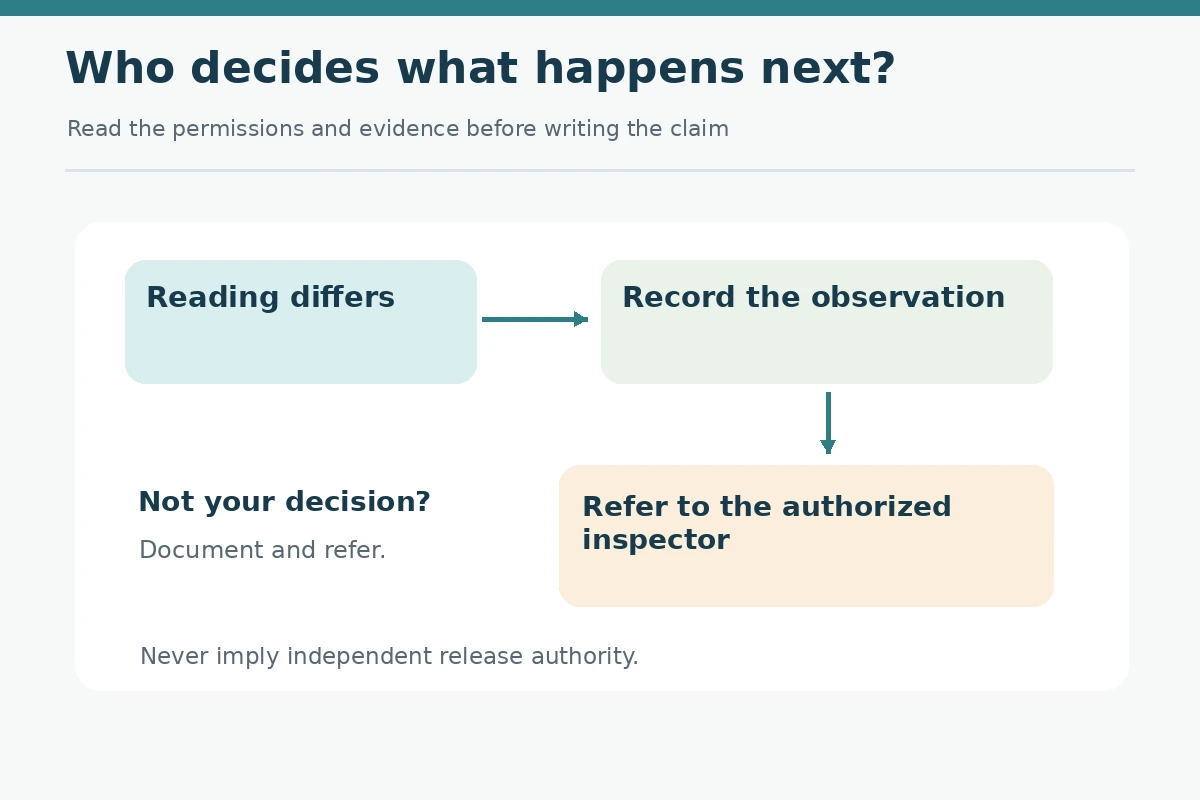
Measurement is only one part of credible quality work. Records often capture an item identifier, specification, actual result, date, and a person responsible for review. If you maintained such notes, describe the record format and your role in it. The ability to repeat a measurement and flag an unclear reading is useful; the right to accept, reject, or release production units may rest with designated personnel. Do not collapse those responsibilities into “managed quality assurance.”
A good bullet underneath the objective may read, if true, “Entered dimensional readings from supervised training checks into a worksheet and flagged discrepancies for instructor review.” It gives a reviewer something concrete to verify. An unsafe exaggeration would be “approved production for shipment” when you only organized paperwork. The objective can point to accuracy and orderly reporting, but claims of policy ownership, root-cause leadership, or audit certification require separate supporting experience.
Decide whether an objective or summary fits your history
CareerOneStop describes an objective as useful when you are newly graduated or moving toward a particular target and a summary as a way to highlight existing professional experience. If you already worked several years as a qualified inspector, a summary with your verified equipment, product types, and documented responsibilities may be clearer. An objective still helps if you are switching industries, applying for a trainee role, or changing from production into inspection.
Keep the opening to one to three short sentences. Put recognized certifications in the proper credentials section, with exact issuing body and status. Avoid padding the objective with every tool named in a vacancy. Relevance matters more than density: the recruiter should recognize the role sought and one or two substantiated capabilities quickly. If you cannot show proof elsewhere on the page, reconsider whether the claim belongs in the opening.
Run a final fact-and-scope check
Read each phrase as if a supervisor will ask for an example. Can you name the device you handled? Did you use it independently or under instruction? Did you record a reading, observe an operator, or make an acceptance decision? Replace verbs accordingly: “assisted,” “documented,” “checked under supervision,” and “referred” often carry more truth than vague language about leadership. Delete claims of a zero-defect history unless you have a defensible record and the claim is actually yours.
Finally compare the objective against the specific job’s required credentials and work environment. If training is expected, explain your readiness to learn rather than saying it is completed. Save the resume as the requested file type, inspect the exported document for broken lines, and ensure the evidence appears immediately below the opening. A precise objective is a pointer to verifiable tasks, not a substitute for qualifications.
How We Research and Verify Resume Claims
We reviewed the Bureau of Labor Statistics occupational profile for the tasks and role boundaries discussed above. For resume opening guidance, we checked CareerOneStop’s special resume tips for recent graduates and top-of-resume guidance. These resources do not confirm individual employers’ requirements or establish a candidate’s credentials. Compare the actual posting and your own documents before deciding what to claim.
All proposed resume lines and work scenarios in this guide are illustrative, not descriptions of real applicants or guaranteed hiring outcomes. We do not verify your credentials or imply employer endorsement. Source descriptions are paraphrased. Review the site’s affiliate disclosure; this article does not claim any paid employer placement or affiliate partnership.
More Resume and Cover Letter Guides
Yes, if the vacancy permits beginners. Use actual technical coursework, careful recordkeeping, or related shop duties and state the training context plainly.
No. Separate observation from operation. You can describe supervised exposure without claiming proficiency.
Not automatically. Describe whether you gathered data, reported an exception, or were personally authorized to accept or reject the item.
Avoid unverified guarantees. Show accurate measurement and documented escalation instead.
When you already have relevant, verifiable inspection experience and want to foreground that history rather than a new career direction.