
Quality inspector resume skills should describe the kinds of materials you checked, the method you used, and what happened to exceptions. An employer learns more from “compared received components with an approved drawing and recorded mismatched dimensions” than from a list that says only “quality assurance, detail-oriented, inspections.” Start by writing down the product or work area, the reference specification, and your personal part in the workflow. Do not claim the work of the engineer or supervisor who approved the final disposition.
Start with the exact inspection you performed
Inspection roles vary sharply by product and employer. Receiving checks, in-process sampling, visual defect review, packaging checks, and dimensional measurements are not interchangeable. O*NET lists inspecting, testing, measuring, sampling and recording as occupational tasks, but an individual applicant should select only the tasks actually performed. If you have observed a measuring station in class but never used its instruments at work, place that experience under training or a project rather than paid employment.
Build a skills list around tools and standards
Choose a few concrete skills tied to the vacancy: visual inspection, checklist completion, lot identification, basic dimensional measurement, defect classification, traceable records, or escalation under a documented procedure. List an instrument such as a caliper, gauge or micrometer only if you can explain how you used it and its limitations. An equipment name copied from an occupational description is not proof of hands-on competence. Name any method exactly as it appeared in your work or training instructions.
The same caution applies to specialized standards, controlled documents, calibration, audits and release decisions. A person who entered readings into a log should not describe themselves as a certified auditor or as the person who established acceptance tolerances. If a vacancy asks for procedures you have not used, distinguish related experience from required training. A targeted, short skills section is usually easier to defend in an interview than an encyclopedic list of quality acronyms.
Separate measurement from authority to release
A useful test for every resume bullet is to draw a line between observation and disposition. Perhaps you measured a sample, flagged a value outside a tolerance, placed the part in a designated hold location, and notified a lead. Those actions may be substantial work. They do not automatically mean you rejected an entire shipment, approved a deviation, signed a certificate of conformance, or released products for customer use. Name the actual decision maker when necessary to keep the boundary clear.
For example, compare “authorized production release after failing quality tests” with the narrower, hypothetical line “recorded out-of-spec readings on receiving checks and routed affected parts for supervisor disposition.” The latter has a check, an evidence trail, and an honest escalation. If you did have written authority to accept or reject a product, you can state that authority accurately, but it should be anchored to the site procedure and scope you actually held.

Write evidence-rich bullets without invented rates
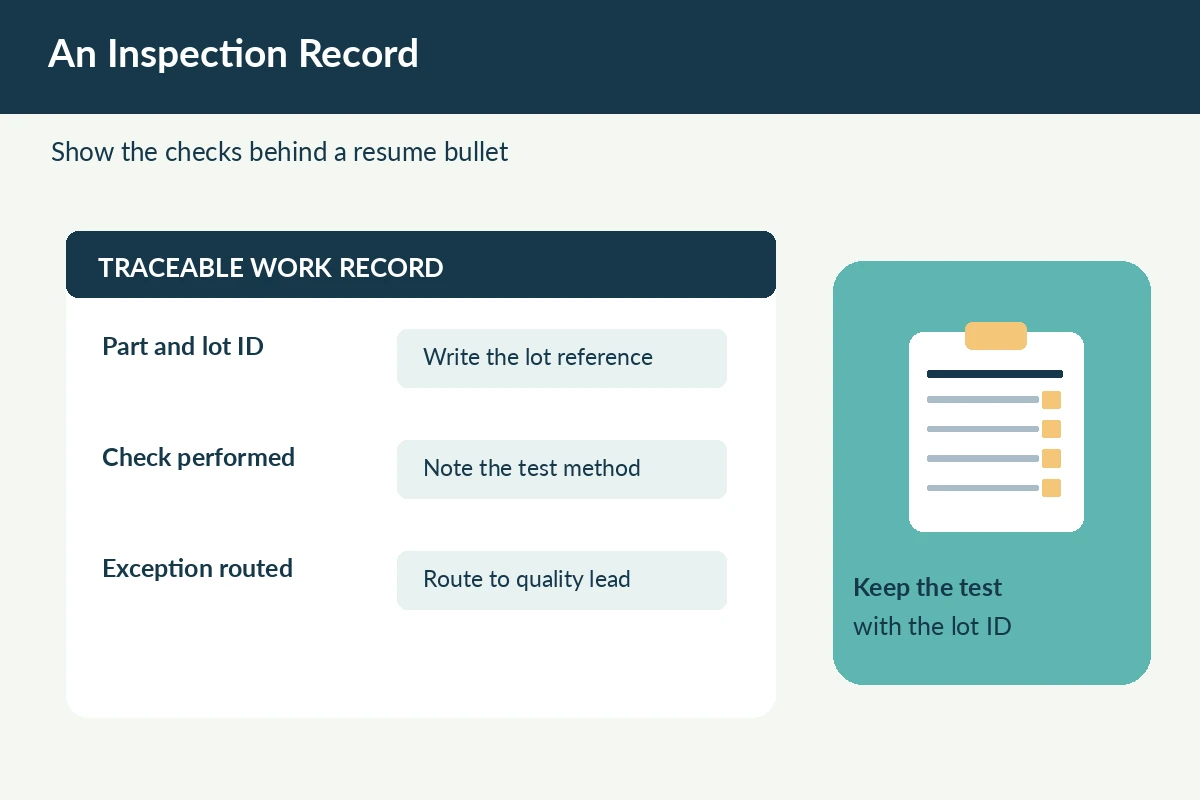
An illustrative bullet for someone who performed receiving inspection could read: “Checked incoming parts against purchase-order specifications, logged visible defects by lot, and notified purchasing of discrepancies.” Another for a manufacturing line might read: “Performed assigned visual checks during assembly, updated shift inspection logs, and escalated repeated issues to the quality lead.” Both are examples to customize, not statements about real employees or verified production outcomes.
Numbers help only when they are traceable. If you did not track the number of samples, defect frequency, rejection percentage, or time saved, do not invent a convincing metric. You can describe documented frequency, part type, work area or escalation route instead. Avoid phrases such as “achieved zero defects,” “ensured full compliance,” or “eliminated all mistakes” unless you have reliable records and directly attributable responsibility for the claim.
Present training and projects with accurate labels
A classroom project, supervised lab, or short course can demonstrate understanding of inspection vocabulary. Describe it under a clearly labeled Projects, Training, or Education section: for example, “Compared a practice set of dimension readings to a supplied tolerance sheet and marked exceptions for instructor review.” The words “practice” and “instructor review” protect against a false implication that the candidate made decisions about live production inventory.
If you used a demonstration instrument, do not upgrade that experience into production calibration, independent equipment maintenance, or regulatory certification. For licensed or high-risk tasks, follow the actual job description and employer procedure. Employers may value a new applicant who understands how to ask for a second check more than someone whose resume claims independent authority that cannot be verified.
Match the evidence to the vacancy
A receiving-inspection posting may emphasize incoming materials and purchase-order checks. An in-process inspection posting may emphasize shift checklists, work instructions and escalation. A final-product role may require a different mix of measurement techniques, documentation and authorization. Highlight the overlap between the posting and your genuine experience rather than transplanting every task from an occupational profile into your skills section.
Use the employer’s precise terminology only when you understand it. If the posting says “nonconformance report” and your workplace used a basic discrepancy log, you can explain how the log functioned without asserting that it was a formal nonconformance management system. Keep product names and protected specifications confidential. A strong resume is specific about your work while leaving the employer’s proprietary inspection details out.
Audit an example before submitting
Consider the hypothetical statement “Managed the entire QA system and improved inspection accuracy by 35%.” It makes a broad organizational claim and cites an unsupported metric. A more defensible alternative is “Reviewed assigned incoming shipments against a check sheet, documented mismatched labels, and passed exceptions to the quality supervisor.” The new statement shows the process and decision boundary. It should still be used only if those events actually happened.
Before submitting, check each action verb. “Inspected” should mean you did the check, “documented” should mean you created or updated the record, “trained” should mean you were assigned to teach, and “approved” should mean you really had decision authority. If you cannot answer which product, document, tool or supervisor was involved, revise or remove the claim.

Prepare a short interview proof story
For each listed quality skill, prepare a brief example: the instruction received, the check performed, the unusual finding, who reviewed it, and the record left behind. You can explain an error without naming customers, exposing drawings or displaying real product specifications. If the only example comes from coursework, say so at the start rather than inviting the interviewer to assume it was a job duty.
This approach works for people applying from warehousing, assembly or lab support, too. The transferable skill is not merely “attention to detail”; it is following a defined comparison, recording an exception and respecting the approval process. Make the resume concise, use genuine evidence, and be ready to describe the point where your responsibility ended.
How We Research Resume Skills
This guide was prepared for a U.S. audience using occupational task descriptions from the U.S. Bureau of Labor Statistics and O*NET alongside university career-center advice on honest, relevant experience bullets. Sources were checked on November 10, 2026. The scenarios and resume bullets are illustrative, not quotes from a real candidate or claims about a particular employer. Occupational profiles describe possible tasks across an occupation; they do not prove that a given applicant performed those tasks or held decision-making authority. Compare every resume claim with your own records, supervisor guidance, and the target vacancy. We do not promise that any applicant-tracking system or employer will accept a particular format.
Authoritative sources reviewed November 10, 2026: www.onetonline.org (O*NET occupational tasks include testing, measuring, sampling, defect reporting and comparing items with specifications.) www.bls.gov (BLS describes quality-control inspection duties and typical use of measurement and reporting procedures.) careers.ucsd.edu (UC San Diego explains action verbs, specific tasks, and purpose or result in resume bullets.) careers.uiowa.edu (University of Iowa recommends describing what was actually done and how the action supported work.) These examples are educational and must be replaced with the reader’s own verified duties and results. No supplier, career service, or employer has endorsed these examples. See the JobAsk affiliate disclosure.
More Resume and Cover Letter Guides
Yes, if clearly labeled as classroom or supervised training and described at the level you actually used. Do not imply production qualification or independent calibration.
Only if you have a reliable record and can explain your role and calculation. A traceable task and escalation may be stronger than an invented rate.
Not necessarily. Quality assurance can include broader systems and process oversight. Describe inspection activities accurately instead of borrowing an inflated job title.
Only if that was your authorized decision. Otherwise describe flagging, documenting, segregating or forwarding the shipment for disposition.
Use Projects, Training or Education and state it was a practice or supervised activity. Keep paid experience separate from class demonstrations.