
In a nonprofit interview, ask how the position advances a specific program goal, what resources support that work, who approves priorities, and how success is assessed. A compelling mission statement alone does not tell you how the role functions day to day. Select questions that match your likely responsibilities: a program coordinator, fundraiser, operations assistant and executive will interact with funding and the board in different ways. Read the relevant source explanations below and treat every example as hypothetical, not as a real employer interview.
Choose Questions Based on the Actual Position
Before the interview, identify the duties in the exact job posting, underline the unanswered expectations and decide what an honest answer would help you evaluate. General questions can be useful, but the best ones clarify responsibilities that affect your decisions. University of Alabama career guidance recommends tailored questions about role success, supervision and next steps, rather than simply repeating facts already available on the employer website.
Connect the Mission to a Specific Program Outcome
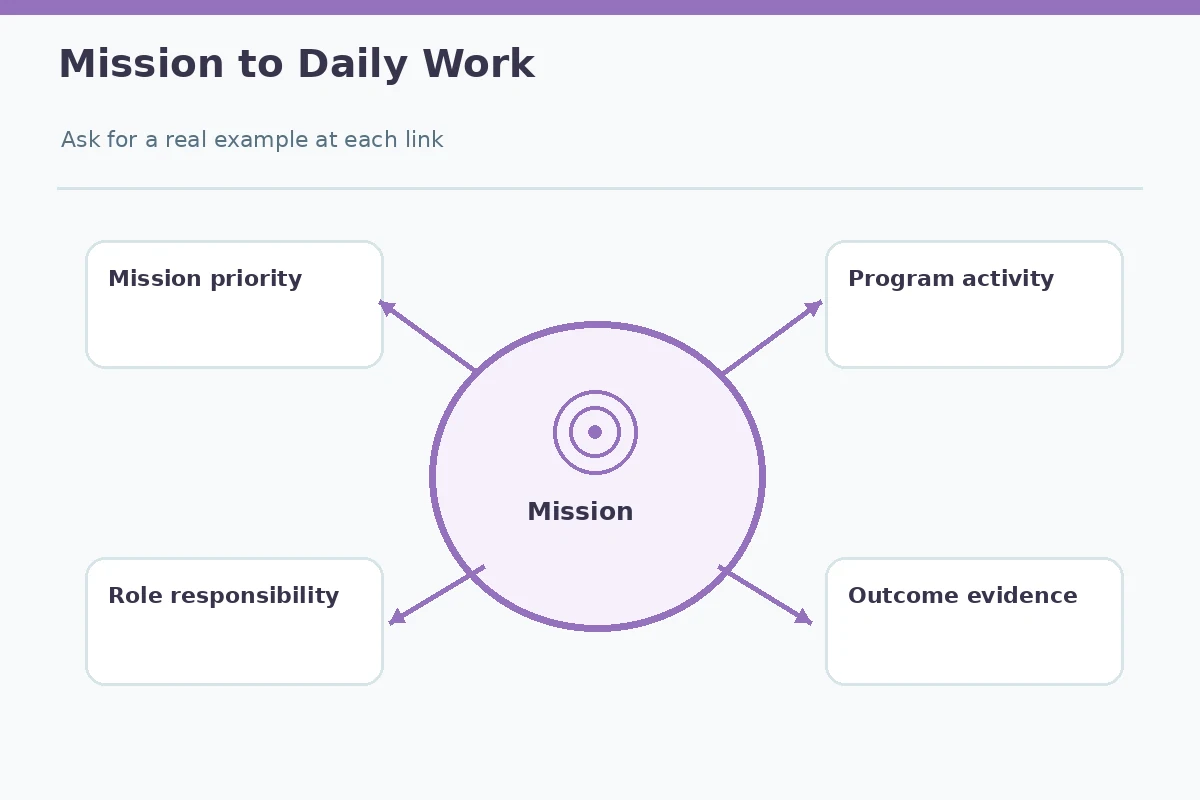
Ask “Which program goal will this role help advance during the first six months, and how will the team know if its approach is working?” A nonprofit may have broad goals such as education, housing support or environmental protection, but a new employee needs specific responsibilities. The National Council of Nonprofits describes strategic planning as selecting mission-aligned priorities and measurable goals that should be revisited.
Invite the interviewer to describe how goals become day-to-day tasks: serving participants, handling partner requests, preparing accurate reports or coordinating events. Do not equate a social media post or attendance count automatically with a long-term community outcome. Ask which measures are activity indicators and which reflect a program’s intended results. This distinction will help you judge whether the position has clear expectations.
Ask Which Resources Support the Position
A useful question is “What staff time, systems and budget are allocated to the work described in this job?” It is more actionable than asking whether the nonprofit has enough money. A program that requires travel, events or reporting needs a realistic way to cover those expenses. The National Council of Nonprofits budget guide describes how budgets help organizations plan and compare financial expectations with actual activity.
If an employer mentions restricted grants, ask whether those funds limit the activities you may charge or perform. Do not claim a particular grant covers your salary without written evidence. A prospective employee generally will not be entitled to detailed confidential donor records, but can reasonably ask whether the position is project-funded, time-limited or tied to a specific deliverable when the posting makes that relevant.
Clarify Board Oversight Versus Staff Decisions
Ask “Which decisions are made within this team, which need executive approval, and when is the board involved?” The National Council of Nonprofits explains that boards provide governance and oversight rather than performing all daily management. Actual decision pathways depend on the organization’s structure and governing documents.
A program assistant might assemble an agenda, but that does not mean they can approve expenditures. A manager might make routine scheduling choices while major strategy and budget changes require executive or board review. Ask who owns decisions about program changes, purchasing and external commitments. Clarity makes it easier to report realistic accomplishments and avoid taking responsibility for promises you cannot authorize.
Understand How Impact Evidence Is Gathered
Ask “What evidence does this team use to decide whether a program should continue or change?” The answer may include participant feedback, service completion, outcome measures, partner observations or funder reporting. Each has limitations. A count of activities can show volume but may not demonstrate that participants benefited in the intended way. Discuss how the organization interprets the numbers and protects the dignity or privacy of people served.
A hypothetical applicant for a youth-program coordinator job might ask how staff record attendance, capture feedback with consent and escalate safeguarding concerns. They should not claim professional evaluation credentials merely because they have created charts in class. In the interview, note whether the organization separates data collection, program decisions and the authority to share sensitive information.

Identify Workload and Funding Dependencies
Mission-driven roles can involve busy periods for grant reporting, fundraising campaigns or community events. Ask “Which deadlines are predictable, and what work tends to increase unexpectedly?” Then ask how additional responsibilities are prioritized. Avoid assuming nonprofit staff should accept unlimited hours because a cause matters; the schedule and employment terms require the same practical examination as any other job.
If a role is funded by a time-limited award, clarify whether the listing says so and when the employer expects to review continuation. Do not ask for assurances that future contributions will definitely materialize. A factual answer about currently budgeted activity is more useful than a guarantee that the organization will never restructure. Record what was confirmed and what still needs written clarification.
Adapt the Questions to Program and Support Roles
Program staff can ask about participant needs, partners, case escalation and outcomes. Development staff can ask about stewardship systems, approval of donor communications and roles in grant submissions. Operations employees can ask about procurement, records retention and coordination across teams. An executive candidate may appropriately discuss strategy, finance and board relationships at greater depth. The right question depends on authority, not prestige.
Use the vacancy and organization’s public annual reports where available. Do not invent financial ratios, staff turnover rates or partner endorsements. Ask the interviewer which information is public and which can be discussed later with an authorized decision-maker. A specific answer about how the role works will serve you better than a rehearsed statement that you are passionate about every aspect of the mission.
Compare Mission Fit With Operational Reality
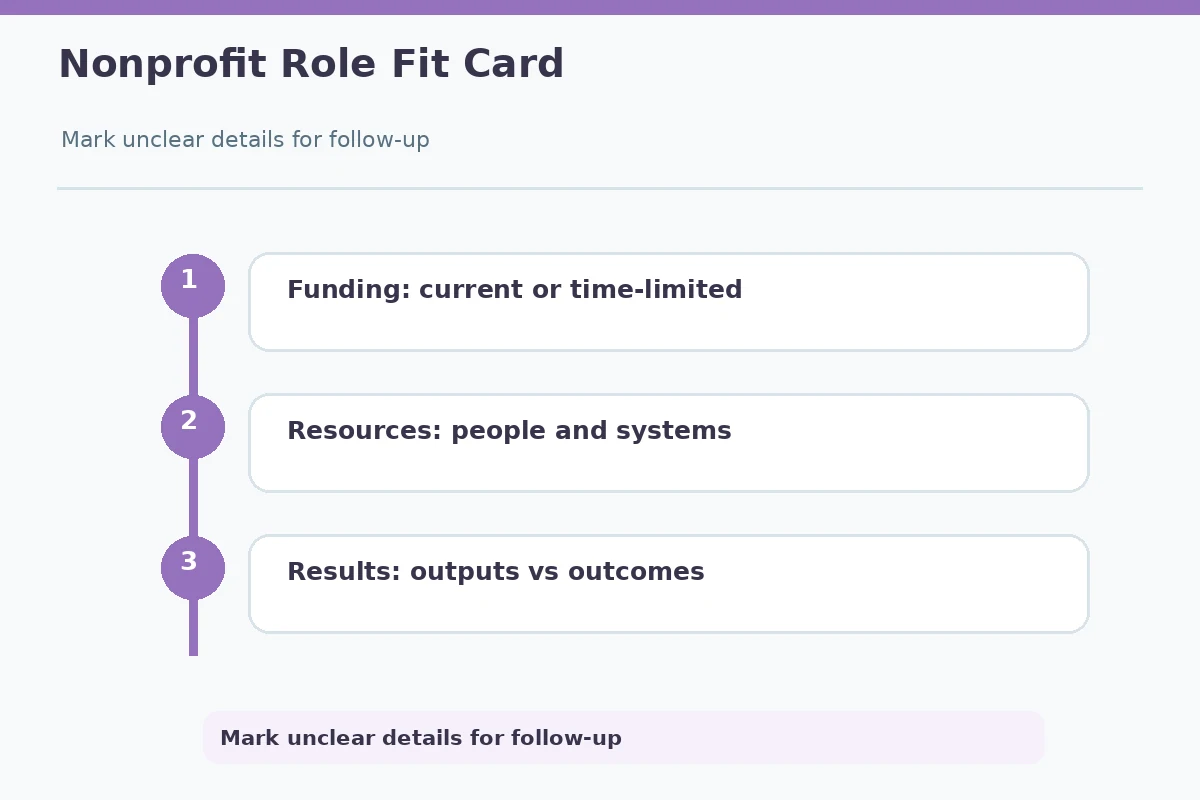
Create a five-part note: mission-to-task connection, decision owner, resources, outcome evidence and workload. Mark each as clear, partly clear or unknown. A strong emotional connection to the mission cannot replace workable expectations. Conversely, a modest budget is not proof a program is ineffective. Your notes should reflect answers given in the interview and the organization’s actual documentation.
A hypothetical note might say, “Program goal clear; reporting duties specific; travel costs and grant duration not yet discussed.” That is a useful follow-up list, not a verdict on any real nonprofit. Refer unanswered material questions to the hiring contact before deciding. Keep job-search safety basics in view and verify that the listing is associated with the actual organization.
How We Research Interview Questions
We reviewed the publicly accessible, linked university career resources and primary professional or government guidance on 2026-10-27. The questions in this guide are suggested ways for a candidate to learn about a role, not claims that a particular employer follows any named procedure. We compared this topic with available JobAsk article packages and earlier interview-question clusters to keep the reader’s decision task distinct. No unpublished WordPress posts or employer-specific internal procedures were accessible; the examples remain explicitly hypothetical.
Source: councilofnonprofits.org. National Council of Nonprofits distinguishes board oversight from daily staff management.
Source: www.councilofnonprofits.org. National Council of Nonprofits explains annual budgeting, planning and periodic comparisons of budgets with actuals.
Source: www.councilofnonprofits.org. National Council of Nonprofits describes mission-aligned strategies, measurable goals and ongoing review.
Source: career.sa.ua.edu. University career advice supports tailored questions on role outcomes, supervisors and organizational direction.
No university, agency, or professional organization mentioned here endorses JobAsk or any employment result. We do not claim an affiliate arrangement. Read our affiliate disclosure. Verify all offer-stage or employer-specific details directly with the hiring organization.
More Interview Preparation Guides
- Questions to Ask in a Construction Interview About Site Safety and Training
- Questions to Ask in a Healthcare Interview About Orientation and Patient Safety
- HR Interview Questions to Ask: Confidentiality, Hiring Process, and Scope
- Questions to Ask in a Graphic Design Interview About Briefs and Feedback
- Questions to Ask in an Engineering Interview About Design Reviews and Teamwork
No. Ask tactfully about resources and whether a position is time-limited or tied to specific funded work.
No. Ask about the resources and reporting requirements relevant to the position without seeking private donor information.
Not generally. Boards oversee governance while staff manage day-to-day operations; confirm the employer’s real delegation structure.
Ask what outcomes the program tracks, how evidence is interpreted, and which activities are within this role’s control.
Yes. Ask about expected scheduling, seasonal workload and how changes are communicated.