
In a healthcare job interview, ask how a new team member learns the unit or service workflow, who can help when a patient-care concern arises, how handoffs occur, and which activities are outside the advertised role. For nursing positions, questions about orientation, staffing and clinical support are especially relevant; for medical reception or support roles, the boundaries are different. Focus on what the employer can actually explain, not a universal staffing or credential rule. Read the relevant source explanations below and treat every example as hypothetical, not as a real employer interview.
Choose Questions Based on the Actual Position
Before the interview, identify the duties in the exact job posting, underline the unanswered expectations and decide what an honest answer would help you evaluate. General questions can be useful, but the best ones clarify responsibilities that affect your decisions. University of Alabama career guidance recommends tailored questions about role success, supervision and next steps, rather than simply repeating facts already available on the employer website.
Ask How Orientation Changes With the Role
Begin with “What does orientation look like for someone entering this specific position, and how is readiness for independent tasks assessed?” A newly licensed nurse, experienced nurse switching specialty, and nonclinical front-desk employee may require different learning plans. Ask about the work actually assigned to your role instead of assuming one orientation length applies to the entire organization. The American Nurses Association suggests asking about the content and length of orientation and access to professional support.
Listen for the difference between observing, practicing with supervision and performing a task independently. A hypothetical new hire might shadow an experienced coworker before using a workflow without help; that is only an illustration, not a promised training sequence. If the interviewer speaks generally about onboarding, ask for a concrete example of how the team confirms someone is ready for a particular responsibility.
Clarify Handoffs and Information Boundaries
Ask “What information must be handed over when responsibility for a patient or request moves to another staff member?” A clinical team may discuss patient status and care priorities through approved systems; a receptionist may transfer scheduling or referral details and should not assume clinical authority. The BLS registered-nurse profile describes patient assessment, records and care coordination, which are different from administrative duties.
A strong answer identifies a secure workflow and the receiving person or team. If a request is urgent, ask how staff tell ordinary routing from escalation. Do not request private examples involving identifiable patients during an interview. The goal is to understand roles and communication, not to obtain details from real medical records or to bypass professional judgment.
Ask About Help During Busy or Unexpected Periods
A nursing candidate may ask “When staffing demands change, who helps prioritize safe care and what support is available?” The ANA guidance discusses how staffing input, supplemental resources and concerns can be raised. Do not reduce this to a magic nurse-to-patient ratio: applicable rules, specialties and patient acuity differ. A medical assistant or support worker can adapt the question to supervisory coverage and which tasks can be deferred.
Listen for a named escalation route, clear communication among roles, and a way to revisit workload. “Everyone pitches in” may be encouraging but leaves process unclear. Follow up respectfully: “Could you describe how the team handled a high-volume day without sharing patient details?” The quality of the explanation matters more than a blanket assurance that the workplace is always calm.
Understand Incident Reporting Without Demanding Case Details
Ask “How are safety concerns or mistakes reported, and how does a new employee learn that process?” A suitable answer may describe reporting channels, designated supervisors and training. You are not asking whether the organization has never experienced an incident, nor requesting confidential investigations. For a role with no clinical duties, focus on whom to notify and what information may be passed along.
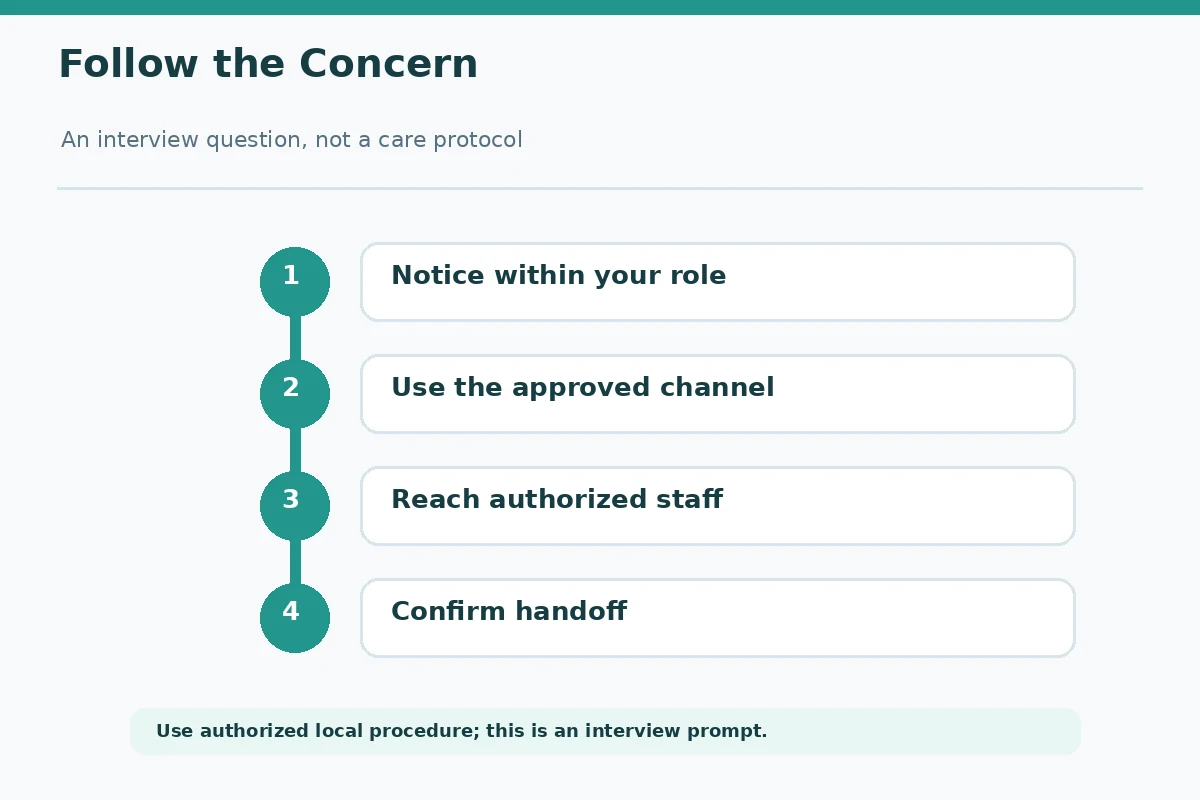
Separating observation from action is useful: notice a concern, follow the role-specific procedure, contact the appropriate person, and document only as authorized. Avoid presenting a diagram as a universal clinical algorithm, because care protocols depend on the facility, profession and situation. The article’s visual is an interview planning aid—not instructions for delivering treatment or overriding licensed staff.
Distinguish Licensed Work From Support Tasks
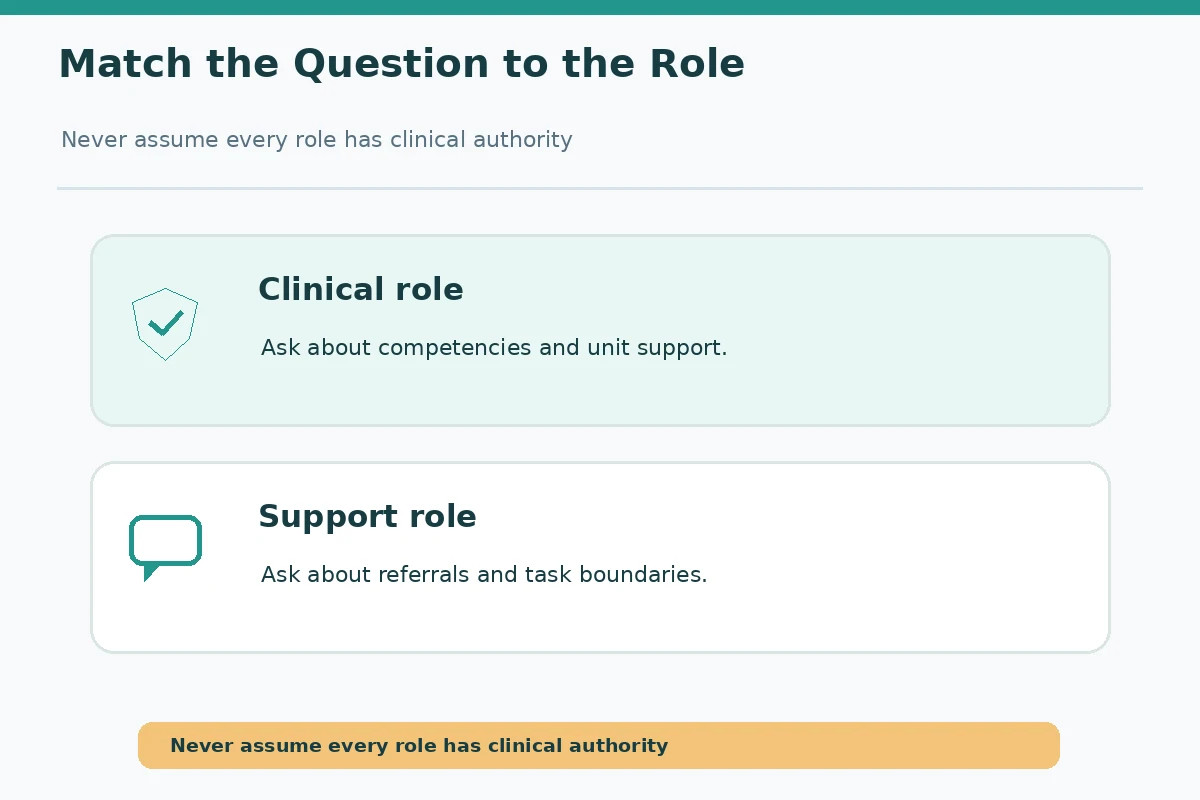
Ask “Which responsibilities require licensure, certification, a delegated instruction or direct oversight in this position?” Requirements vary across professions and jurisdictions. A pharmacy technician, nurse, aide, medical assistant and receptionist are not interchangeable. Do not assume a job title grants permission to assess patients, administer treatments or independently change clinical instructions. Employers should clarify the actual tasks and applicable supervision.
If an advertisement combines clinical and administrative duties, ask which tasks are recurring, which are conditional and which another professional must approve. The employer may be able to provide a written job description or orientation plan. You are evaluating whether the role fits your current credentials and the employer’s expectations; never imply a universal shortcut to a license or qualification.
Select Questions for the Right Interview Stage
A clinical leader may answer questions about handoffs, escalation, team coverage and training. A unit peer may explain daily collaboration, and a recruiter may know the advertised schedule and basic onboarding process. When talking to several people, ask them different but compatible questions and compare their answers. A discrepancy deserves a polite clarification rather than a sudden conclusion about staff quality.
Prepare three priority questions based on your largest uncertainty. For an RN role, the ANA list offers areas worth exploring such as orientation, staff participation and support. For a scheduling or reception position, prioritize communication paths, private-information handling, call flow and authorized referrals. Keep the focus on your specific job, not every activity the facility performs.

Write a Responsible Offer-Stage Checklist
Before deciding on an offer, record confirmed orientation arrangements, task boundaries, supervision, shift expectations and how concerns are reported. Mark uncertain answers for a follow-up with an authorized employer representative. Some details may be supplied only after an offer or during formal onboarding; do not invent them and do not ask for patient-level data to prove a policy exists.
A hypothetical comparison might note: “Training contact identified; weekend coverage explained; competency review timing still unclear.” This avoids making one impressive interview answer stand in for a complete work arrangement. Consider whether the role’s documented conditions match your credentials and needs, and consult the employer’s written policies for decisions that require formal confirmation.
How We Research Interview Questions
We reviewed the publicly accessible, linked university career resources and primary professional or government guidance on 2026-10-27. The questions in this guide are suggested ways for a candidate to learn about a role, not claims that a particular employer follows any named procedure. We compared this topic with available JobAsk article packages and earlier interview-question clusters to keep the reader’s decision task distinct. No unpublished WordPress posts or employer-specific internal procedures were accessible; the examples remain explicitly hypothetical.
Source: www.nursingworld.org. American Nurses Association lists concrete questions on nurse staffing, orientation, escalation and professional support.
Source: www.bls.gov. BLS describes registered nursing duties and coordination of patient care, which differ from nonclinical support roles.
Source: career.sa.ua.edu. Career-center guidance recommends clarifying supervision, schedule and position expectations in interviews.
No university, agency, or professional organization mentioned here endorses JobAsk or any employment result. We do not claim an affiliate arrangement. Read our affiliate disclosure. Verify all offer-stage or employer-specific details directly with the hiring organization.
More Interview Preparation Guides
- Questions to Ask in an Engineering Interview About Design Reviews and Teamwork
- Questions to Ask in a Nursing Interview: Unit Support and Escalation
- Questions to Ask in a Nonprofit Interview About Mission, Funding, and Role Scope
- Questions to Ask Future Coworkers in a Peer Interview
- HR Interview Questions to Ask: Confidentiality, Hiring Process, and Scope
Yes. Ask how workload and support are managed in the relevant unit, recognizing that staffing policies and applicable rules vary.
Yes. Ask how orientation is tailored to your experience and how readiness for responsibilities is assessed.
Focus on task boundaries, escalation, privacy-aware communication and the training for your actual position.
Ask about reporting and learning processes; avoid requests for confidential patient or investigation details.
No. Scope, supervision, licenses and employer policy must be checked for the specific profession and jurisdiction.