
Nurse job application email: An RN job application email should identify the nursing position, describe your actual licensure status, and give one relevant unit or clinical example without disclosing patient information. “Licensed,” “license pending,” “graduate nurse,” and “student clinical rotation” do not mean the same thing. Follow the employer’s official application process, attach only requested documents and avoid claiming specialty authority based solely on supervised training.
Identify the nursing role and the correct application route
Hospitals may have several registered nurse openings with similar names but different units, shifts, patient populations and experience expectations. Include the exact position and unit if listed. A generic “nursing vacancy” subject can misroute a message meant for a medical-surgical unit, outpatient clinic or telemetry team. If the application belongs in a recruitment portal, complete that process first; a direct recruiter email does not necessarily count as a submitted application.
Before writing, compare the requirements for nursing license, state or compact practice privileges, specific certifications and relevant experience. BLS notes that registered nurses are licensed; requirements and verification steps depend on jurisdiction. The applicant, not the email template, is responsible for confirming that the listed role is within their qualifications. Never use a license number copied from an example or imply approval that has not been issued.
State license status without ambiguity
If your license is active and you are eligible to practice in the relevant jurisdiction, state it plainly and accurately: “I hold an active RN license in [state],” if that is true. If an application asks for a license number, provide it only through the legitimate channel specified by the employer. NCSBN provides information on license verification through Nursys for participating jurisdictions. An employer may conduct its own credential checks; an email statement is not official verification.
If you are awaiting results, an initial license, an endorsement or permission to practice, say “pending” with the correct context instead of writing “licensed RN.” Do not assume that holding a license in one state automatically grants every privilege in another. Check applicable state board rules and any relevant compact provisions. The exact terminology is more important than an upbeat headline when the position involves regulated patient care.

Describe unit experience within your real scope
Give one short example tied to the unit: documenting observations, participating in a supervised handoff, educating patients under a defined role, or coordinating with the nursing team. Distinguish a paid RN position from clinical rotations completed as a student. “Completed a supervised rotation in an adult medical-surgical setting” is materially different from “worked as a medical-surgical RN.” Neither line should claim independent procedures you did not perform.
Avoid inserting patient ages, diagnoses, medical record screenshots, dates of admission or staff names from actual cases. A de-identified description of your own general duties is enough for an introductory email. If the posting involves specialty care, do not equate classroom exposure with validated specialty competence. State what you observed or assisted with and what was performed under a preceptor’s direction.
Use a concise RN application email template
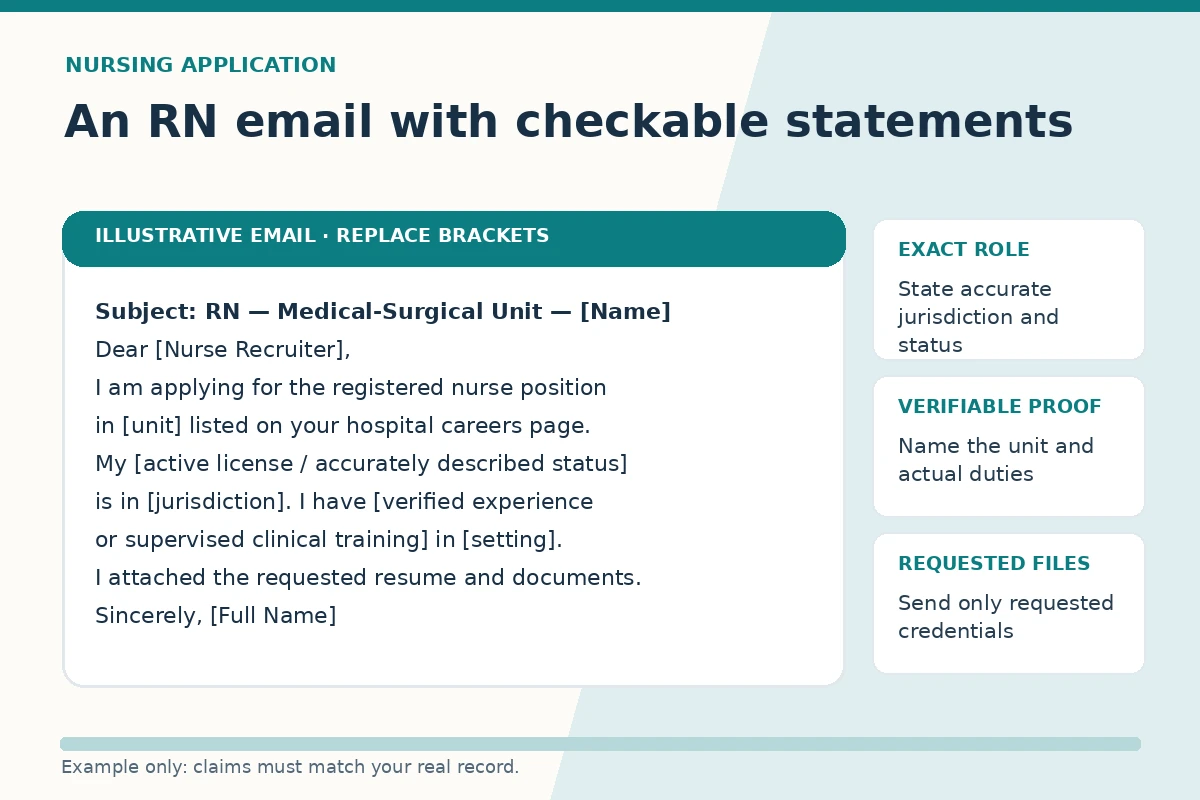
The following is a fictional template and must be edited to match the candidate’s true record. Subject: RN Application — [Unit / Requisition] — [Full Name]. Message: Dear [Recruiter or Hiring Team], I am applying for the [exact RN position] posted on your careers site. My RN license status is [accurate status and jurisdiction]. My experience includes [relevant paid duties or supervised training, clearly labeled], where I [one verified task] within my assigned responsibilities. I have attached [requested files]. Thank you for reviewing my application. Sincerely, [Full Name].
An experienced nurse may use a concise unit-specific handoff or documentation example. A new graduate should not hide that clinical learning occurred under supervision. The body of the email does not need a complete career biography or a list of every procedure. Employers can assess detailed experience from the resume and formal credential process. If the posting requires an application form, link the email to that submitted application without claiming it was received unless confirmed.
Handle certifications and attachments cautiously
Certifications such as BLS or ACLS should be listed only when current, genuinely held, and relevant to the opening. “Training scheduled” is not “certified.” Attach proof only when requested and use an approved method, especially for credentials that carry personal information. Some hospitals may ask for transcripts, references or immunization documentation later in a formal process; do not attach those to a first unsolicited message.
Review the resume for consistency in unit names, employment dates and titles. A cover note that calls an elective course “ICU experience” while the resume labels it as classroom observation creates an avoidable credibility problem. Consider a straightforward file name such as “[Name]-RN-Resume.pdf” if the employer has no stated naming rule. Read the final export on a phone or a second screen to catch broken formatting and missing pages.

Follow up without disrupting the hiring process
Nursing recruiters may handle multiple positions, and timing varies by employer. Keep your own record of the role, unit, requisition number, application confirmation and date. If the hospital provides a candidate portal, rely on its status rather than assuming that an email or read receipt proves review. Use a recruiter contact only when the organization permits that channel and follow any stated waiting period.
If someone replies requesting a license verification, ask for or use the approved secure process. Never send protected patient information as work samples. Once an interview is offered, prepare examples that separate what you independently performed, what you completed under supervision and what required an RN or another clinician’s authorization. Honest scope description should remain consistent from the first email through onboarding.
How We Research Job Application Emails
We reviewed University of Minnesota guidance on sending job applications by email and University of San Francisco career-service guidance for submission instructions, concise subjects and attachments. For this scenario, we also checked the relevant occupation, verification, or employment-safety material listed in the article sources. All email examples are fictional and illustrative: they do not confirm a real vacancy, a candidate’s qualifications, or employer acceptance.
Employers and licensing bodies may set additional rules that a sample cannot replace. Review the exact posting and current official requirements. No referral, employer partnership or affiliate arrangement is implied. See our affiliate disclosure for the site’s policy.
Related Job Search Guides
No. Use the accurate student, graduate or licensure-pending status. Do not say licensed until you actually hold the applicable license.
Only if the legitimate employer specifically instructs you to use that channel. Follow approved credential verification procedures.
Yes, label them supervised clinical rotations and describe the unit and tasks accurately; do not present them as paid RN employment.
Only fully de-identified, general descriptions if relevant. Do not share records, screenshots or patient identifiers.
No. Check the relevant board and applicable practice privileges; do not assume universal interstate authorization.