
Quick answer: To find a legitimate remote customer service job, search for the actual support channel (phone, email, or mixed), confirm scheduled coverage and training, then independently locate the position on the employer’s career website. A remote label does not guarantee flexible hours, chat-only work, or permission to work from any location. Use this checklist to compare roles, not as a list of purported current openings.
Separate Phone, Chat, and Mixed-Channel Responsibilities
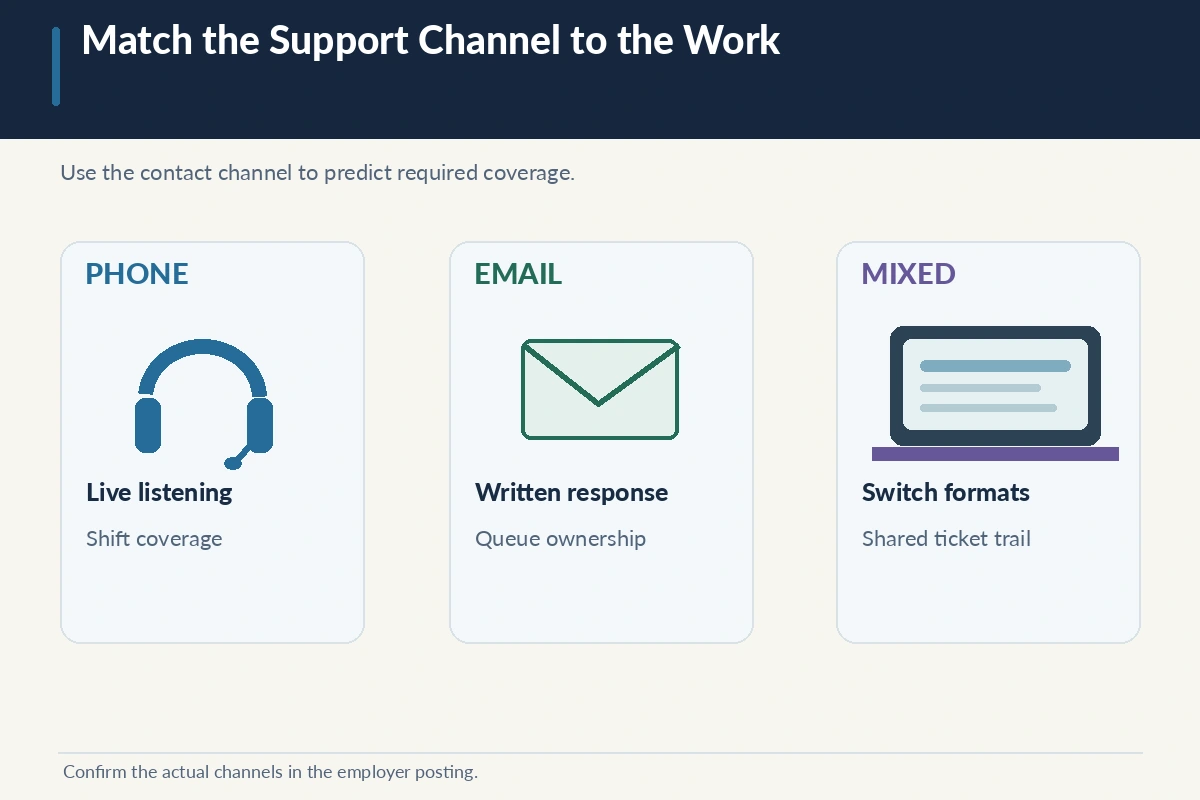
The first useful distinction is not “remote versus office”; it is how customers reach the team. Phone-heavy support requires live listening, accurate summaries, and often scheduled coverage. Email support emphasizes written replies and queue management; mixed-channel jobs may switch among phone, email, and chat during one shift. A posting that says “customer care” without naming channels deserves a clarifying question. Chat-only roles are a separate narrower topic and should not be assumed from a remote label.
The O*NET customer service profile includes responding to inquiries, documenting transactions, checking follow-through, and referring unresolved matters. These are occupation-level examples, not proof of what a particular employer allows. Build a three-column comparison for each verified vacancy: customer channel, common requests, and tasks requiring a supervisor or another department. Never claim refund authority, account changes, or privileged access based only on an occupation title.
Read the Schedule as Carefully as the Job Title
Remote customer support may operate on fixed shifts, rotating schedules, weekends, or a coverage window tied to a specific time zone. Write the exact schedule from the posting rather than using “flexible” as a substitute. If coverage is described only as business hours, ask which business time zone applies, whether shifts are assigned, and whether training takes place at different hours. A remote job can still require punctual live availability.
Make a fit grid with rows for workdays, start and end times, training, break coverage, and any stated home-office requirements. Note an unanswered condition rather than silently guessing. If the employer requires particular equipment, confirm the policy with a verified HR channel before sharing financial data or purchasing anything. The FTC work-from-home scam guidance warns against paying to obtain a job or handling purported equipment checks.
Match Your Actual Experience to Support Tasks
Choose one example for listening, one for keeping records, and one for a safe handoff. Paid work is useful but not the only relevant evidence; approved volunteer reception duties or a class-group coordination task may show communication and follow-through. Label the context clearly. A fictional applicant who organized club questions could explain how they collected requests and passed complex issues to the club leader, without claiming to have worked at a call center.
Use a truth-preserving microexample: “During a volunteer event, I wrote down visitor questions, clarified unfamiliar requests with the coordinator, and shared the next contact.” That example demonstrates careful routing, not customer-account handling. Replace it with something you actually did. Never include private customer information, fabricated satisfaction scores, or an invented resolution percentage to make a resume bullet look stronger.
Verify the Employer Before Sharing Sensitive Data
Start from a job board result or search result, then search for the employer independently and navigate to its official careers page. Check that the job title, geographic eligibility, requisition or team, and application flow match. A familiar logo inside a direct message is not proof of authorization. If the position cannot be located, contact the employer using a phone number or form from its independently verified website—not the contact supplied by the sender.
The FTC remote-job alert documents impersonators who advertise roles on familiar platforms, hold text-only interviews, and request bank details or fake equipment purchases. Pause if a recruiter rushes you to messaging apps, requests money, or wants forms containing sensitive identity data before you can verify who they are. Report suspected fraud; a plausible workplace vocabulary is not a substitute for independent verification.
Use a Channel-Specific Application Checklist
For a phone support opening, demonstrate a calm question-and-summary routine; for written support, use a short, plain-language response example; for mixed channels, show that you can keep consistent notes while changing format. Mention software only if you have used it. If a company names a platform you do not know, say which transferable tools you have practiced and whether you would need training. Do not claim certification or access from watching a tutorial.
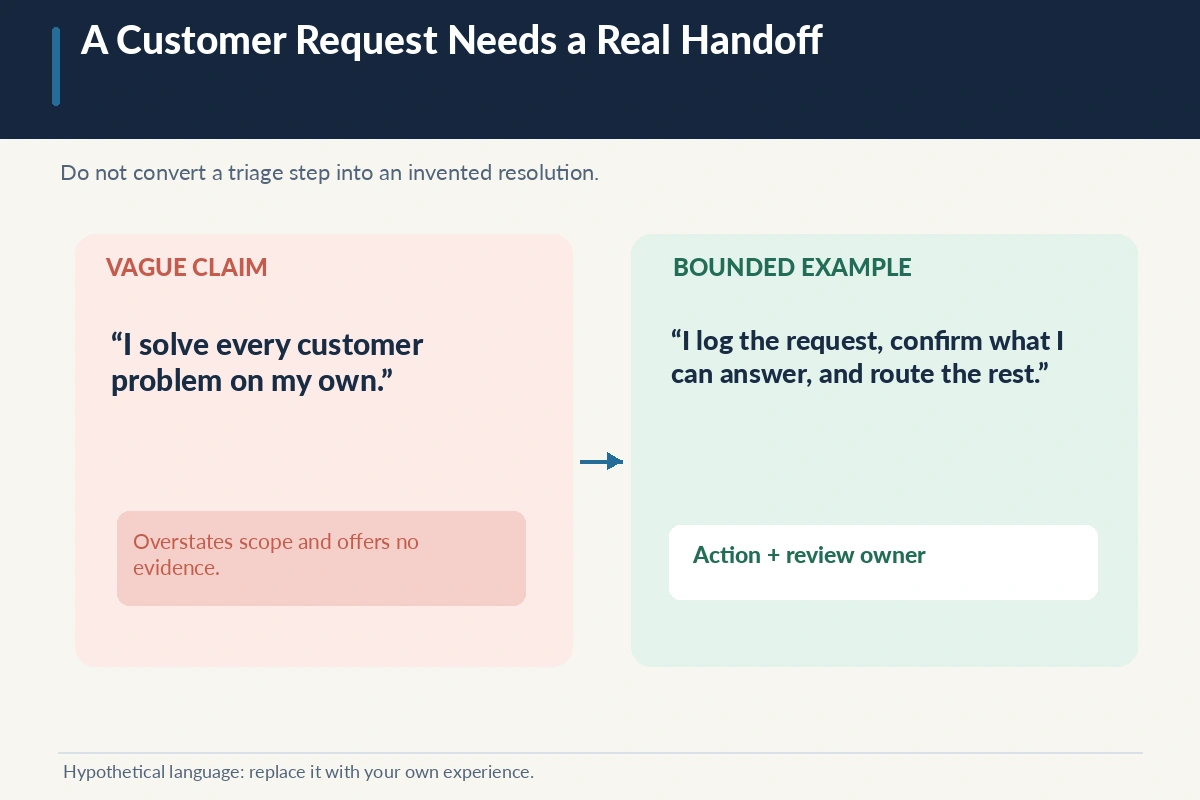
Compare a fictional vague line—“Excellent remote customer service; handled everything”—with a bounded alternative: “Logged volunteer inquiries, confirmed who owned unresolved requests, and followed up when the coordinator asked.” The second is stronger only if true. Select details aligned with the exact vacancy rather than copying keywords from a generic remote-support advertisement.
Ask About Training, Escalation, and Secure Work
Before accepting a role, ask how the employer trains remote staff, who approves account adjustments, how support tickets are reviewed, and what channel you use when a customer request is beyond your authority. Also confirm the official policy for handling private records at home and whether there is an approved device or workspace requirement. A real job description may not spell out every procedure; training should fill that gap.
Do not represent remote work as an invitation to use personal email, record calls on a private device, or send screenshots to yourself. Those actions may violate employer rules and expose private information. A good applicant can say, “I would follow approved identity checks, document the request, and escalate when outside my scope,” without inventing the organization’s exact security or refund procedure.

Make a Final Role-and-Fraud Decision
Keep a short tracker: employer and official posting link, channel, days, time zone, training, equipment policy, application date, and unanswered questions. Mark each item “verified,” “needs confirmation,” or “stop.” A role that requires phone coverage when you can only work asynchronously is a mismatch even when genuine. A role that demands money or a fake check should be stopped rather than negotiated.
If you decide to apply, use the authenticated employer portal and keep a record of what you submitted. Never treat a job board listing or application receipt as an employment offer. For broader location-limit questions use the JobAsk job search category; this article specifically evaluates customer support duties, channels, and schedules.
How We Research and Verify Remote Roles
Sources checked on October 28, 2026: O*NET occupation data, FTC consumer guidance, FTC consumer guidance. We compared the topic with the transferred JobAsk slug index and public search results. These sources support duties and security cautions, not particular live vacancies, salaries, job offers, or hiring outcomes. Fictional examples are explicitly hypothetical. Private WordPress draft inventory was not available for an exhaustive canonical check. Our editorial links do not imply affiliate compensation; read the affiliate disclosure.
Related Guides
- Remote Medical Billing Jobs: Compare Claim Tasks, Records, and Privacy Rules
- Remote Part-Time Customer Service Jobs: Verify Hours, Tools, and Hiring
- Entry-Level Customer Service Jobs: Show How You Solve Problems
- Evening Part-Time Jobs: Compare Shifts, Duties, and Commutes
- Customer Service Interview Questions: Answer With Care and Evidence
No. Some use phone, email, or mixed channels. Check the actual posting; do not assume a role is chat-only because it is remote.
Not necessarily. Live support often has assigned coverage. Confirm shift days, time zone, training hours, and break rules.
Do not deposit a check and forward funds or buy equipment on instructions from an unverified contact. Verify directly with the employer; see FTC scam guidance.
It can show communication or coordination if you clearly label the volunteer setting and do not claim paid call-center experience.
No. Discuss tasks in de-identified terms and follow confidentiality rules; never send restricted customer data to a prospective employer.