
Remote part-time customer service is not one universal job. Telephone support, email queues, live chat, order inquiries, and appointment support all have distinct pace, privacy, equipment, and shift demands. Some legitimate employers offer remote schedules, but a listing must still describe a real service task, supervised training, and a verifiable hiring process. A remote title alone does not mean flexible hours or independent work.
The BLS customer service profile notes that some representatives work part time and that evening, weekend, or busy-period coverage can be necessary. The FTC also cautions that fake work-from-home offers may seek personal information or upfront payments. Your first step is therefore two screens: can you cover the actual support hours, and can you independently confirm that the employer and recruiter are genuine?
Identify the Customer Contact Channel
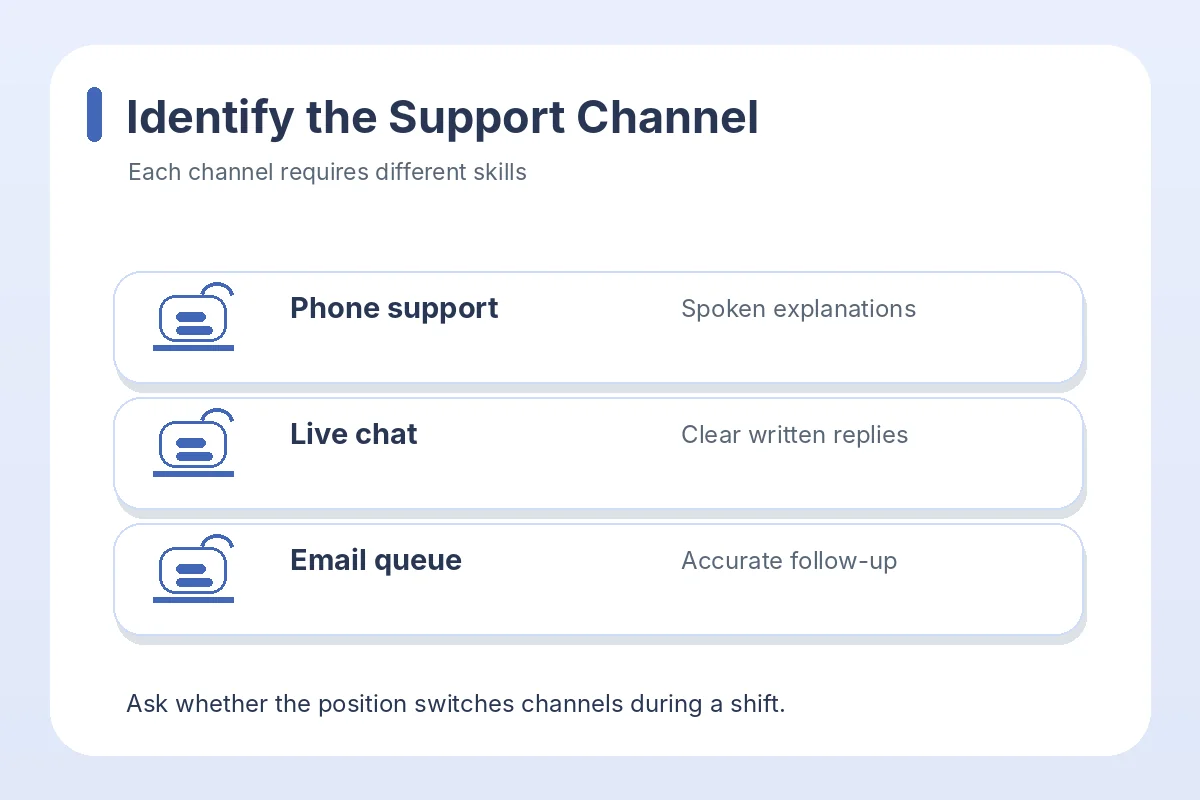
Phone roles require a quiet calling environment and clear spoken explanations; chat or email work relies on accurate writing and managing conversation context. Some jobs switch channels during a shift. Read whether the advertisement says inbound calls, outbound follow-up, live chat, order support, account questions, or another named service. Ask what training is provided before you handle unfamiliar inquiries. Avoid applications whose duties are described only as “easy online tasks” without a business purpose.
A legitimate listing should allow you to discuss who customers are, what types of requests are handled, and when to escalate difficult cases. Customer support can include refunds or account updates, but these must follow employer rules and authorization. Do not offer confidential account access or claim experience with a particular support platform unless you have genuinely used it.
Screen the Schedule Before the Perks
Remote does not automatically mean self-scheduled. A queue-based team may need continuous coverage during assigned shifts, fixed break times, and availability for training. Ask for the time zone, exact start and end of shifts, minimum weekly commitment, weekend rotation, and whether training occurs at different hours from regular service. If you are caring for family members during the workday, make sure you can actually maintain the concentration and response coverage required.
For a hypothetical applicant available Tuesday and Thursday from 6 to 10 p.m. Eastern, a “flexible remote” job requiring weekday mornings would still be a mismatch. Put your time zone in communications to avoid confusion. Also ask whether shifts are published in advance and whether calls can run past a scheduled end time. Do not assume a location-independent arrangement permits working from another state or country; employer rules may limit where work can be performed.
Clarify Equipment and Secure Access
Confirm what the employer provides and whether you must meet specific internet, computer, headset, or private workspace requirements. Legitimate businesses can have equipment policies, but applicants should receive them through a verified hiring channel. Never buy devices with instructions to forward part of a deposited check or pay someone to unlock an interview. The FTC work-from-home scam notice explicitly warns that such arrangements can involve counterfeit checks and financial loss.
Ask who handles technical support if your connection drops, what systems are used to document contacts, and how customer information is protected. Follow the employer’s actual security rules; do not use personal files or unsecured shared accounts to store customer records. If the job involves financial or health information, the requirements may be especially specific. These questions help evaluate readiness, not bypass company security controls.
Verify the Recruiter Through Independent Channels
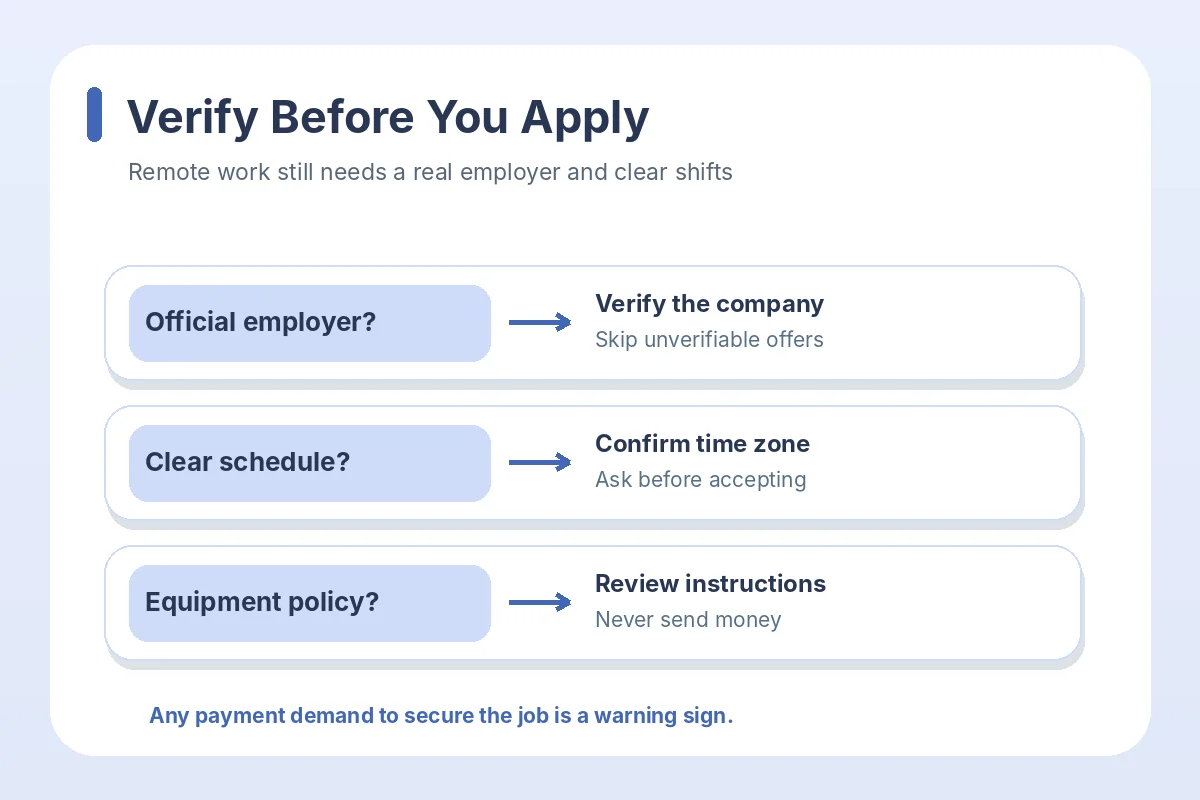
Find the company website yourself instead of trusting only a link in an unsolicited text. Look for the exact role on its official careers page and confirm the application domain. A genuine-looking logo, meeting invitation, or email signature can be copied. The FTC’s remote-job impersonation guidance describes fake postings and recruiters who rush candidates into sharing financial or identity information.
Warning signs include unexplained fees to be hired, equipment checks that require sending money onward, and task schemes that ask you to deposit your own funds to unlock earnings. If a contact claims the role exists but cannot be found through official sources, verify directly with the employer’s published contact details. Do not interpret a fast offer from a stranger as proof of suitability or a reason to hurry.
Show Support Skills Without Inflating Claims
A strong application can explain the service channel you know, the questions you handled, how you documented outcomes, and when you escalated requests. Classroom help desks, volunteer email responses, community phone trees, and in-person customer service may offer transferable examples. Describe the actual setting. Do not turn “helped a friend troubleshoot” into formal IT support employment, and do not invent ticket volumes or customer satisfaction ratings.
A hypothetical application statement might say: “Responded to event questions by email and referred registration issues to the coordinator.” It becomes useful evidence only if it describes real experience. For remote work, also show how you handle written updates and punctual attendance when appropriate. Your goal is to demonstrate a responsible service routine, not to claim every customer issue was solved independently. Our guide “Entry-Level Customer Service Jobs” goes into more detail.
Decide Whether to Apply, Verify, or Skip
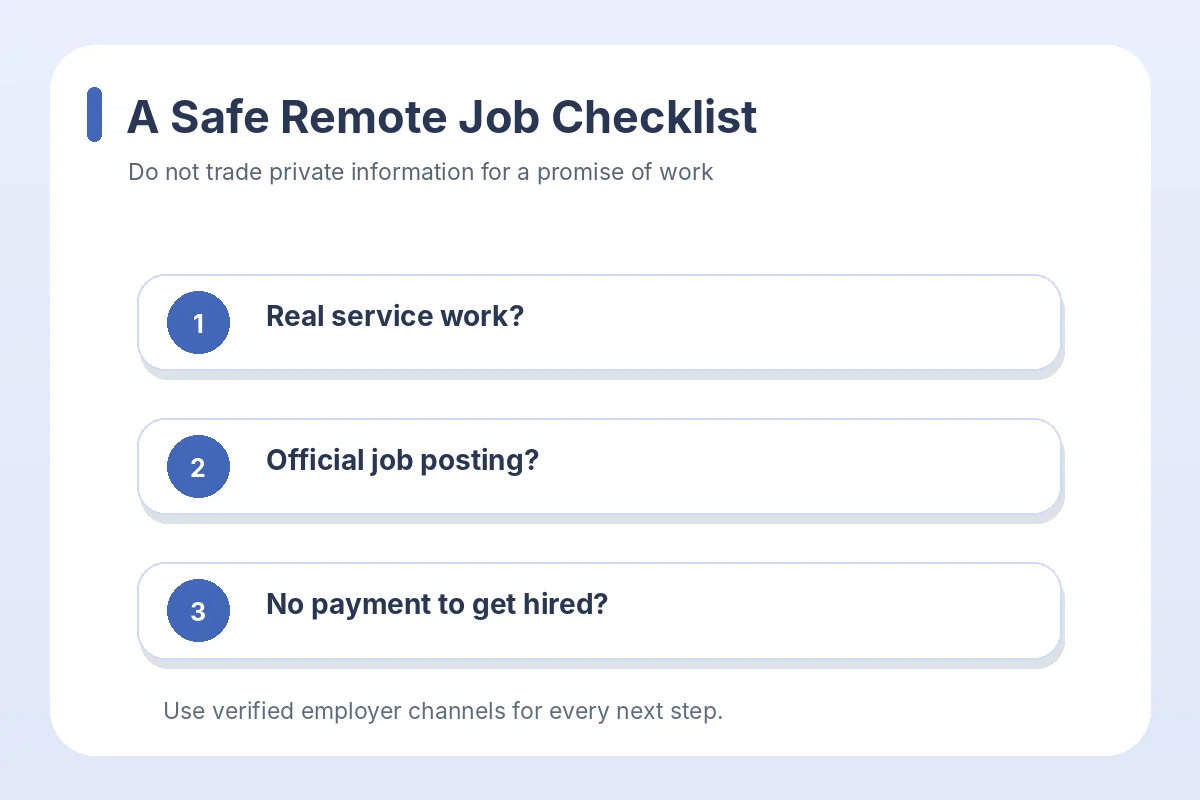
Use a three-way decision. Apply when duties, fixed or published shift hours, training, employer identity, and equipment expectations are sufficiently clear. Verify when an important condition is missing but the employer is real and reachable. Skip when a recruiter requests money, hides the actual business task, or refuses independently verifiable information. This is a practical search method, not a guarantee against every scam. Our guide “Remote Part-Time Jobs” covers how to verify the role before you apply.
Keep a tracking record of the posting URL, job title, time zone, contact channel, and application confirmation. Avoid saving passwords, bank details, identity documents, or customer records in the tracker. If a recruiter asks you to move into personal chat apps immediately, validate the company first. Then prepare one example each of clear communication, documentation, and a careful escalation.
How We Research These Job Options
This guide uses U.S. occupation descriptions as background evidence and adds an applicant-side decision framework. It does not represent a live vacancy list, guarantee work, or assume a particular employer’s schedule. Examples marked hypothetical illustrate a method only; candidates must replace them with their own verified details. Sources consulted on 2026-10-23: BLS occupational profile, FTC consumer guidance, FTC consumer guidance. Affiliate relationships are not asserted; see the affiliate disclosure.
Related Guides
- Remote Customer Service Jobs: Compare Phone Shifts, Duties, and Employers
- Entry-Level Customer Service Jobs: Match the Channel and the Skills
- Part-Time Barista Jobs: Café Shifts, Customer Service, and Training
- Questions to Ask in a Remote Job Interview: Hours, Tools and Trust
- Customer Service Interview Questions: Answer With Care and Evidence
No. Many service teams require fixed coverage hours, training, or weekend shifts even when work is remote.
Equipment policies vary. Verify any requirements with the real employer and do not follow suspicious check or advance-payment schemes.
Not necessarily. Employers may restrict approved work locations, time zones, privacy conditions, and network access.
Confirm the role through independently found company channels and avoid fees, money transfers, and demands for sensitive data from unverified contacts.
Use truthful examples of phone, email, chat, recordkeeping, or customer assistance from paid work, projects, or volunteering.