
Remote data science jobs vary widely: a team may need experimental analysis, predictive modeling, data preparation, model evaluation or communication of findings. Search titles alone do not tell you which work you will own. Compare every vacancy with a task map that identifies data access, the kind of model or analysis involved, quality checks and who uses the conclusions.
The Bureau of Labor Statistics describes data scientists collecting and cleaning data, creating and validating models, and presenting findings. Remote teams add questions about access to sensitive datasets and collaboration across locations. None of those tasks requires claiming ownership of an entire production system when your experience is limited to a supervised project or a public-data portfolio.
Distinguish Scientist, Analyst, and Machine-Learning Roles
A data scientist posting may emphasize exploratory work, statistical inference, experimentation or predictive modeling. A data analyst role may center on reporting and dashboards. A machine-learning engineer may be responsible for building reliable production services, while a research scientist may need specialized experimental or academic experience. Read the “deliverables” section and identify which tasks are essential, rather than applying to every title containing “AI” or “data.”
Create three columns for your own evidence: datasets you prepared, methods you evaluated and findings you explained. If you have used Python notebooks and visualizations but have not deployed a model, target roles that match the actual level. Avoid claiming experience with production monitoring, distributed systems or governance merely because you tried a tutorial. A credible boundary is more useful in a technical interview than an inflated tool list.
Identify the Data and Access Environment
Ask what categories of data the job uses and whether the work requires an approved corporate environment, a secure virtual desktop or restrictions on local downloads. Employers need not publish sensitive architecture details in a job advertisement, but the hiring team should be able to explain the broad access model. A job requiring protected customer information should not rely on candidates copying live records into personal notebooks for a screening test.
Look for how data quality is handled: missing values, duplicate records, feature definitions, labeling consistency and review of assumptions. If the position asks for data collection, clarify authorized sources and relevant approvals. In a portfolio, use public, licensed or synthetic datasets and state limitations. Do not upload proprietary training data, unpublished models or credentials from a former employer to show that you can work remotely.
| Role signal | Question to ask | Project proof |
|---|---|---|
| Analysis | Which decisions use findings? | Clear assumptions |
| Modeling | What validation is expected? | Metric and error analysis |
| Production | Who approves deployment? | True scope of contribution |
| Remote data | How is access controlled? | Public or synthetic work |

Separate Model Building From Validation and Monitoring
A posting may ask for a prototype, a defensible baseline, cross-validation, error analysis, model interpretation or support after deployment. These responsibilities differ. If the job values experimentation, describe how you selected a comparison and addressed leakage. If it values monitoring, ask which team tracks performance and how issues are escalated. Avoid promising that a model will be “accurate” without defining the relevant metric and data context.
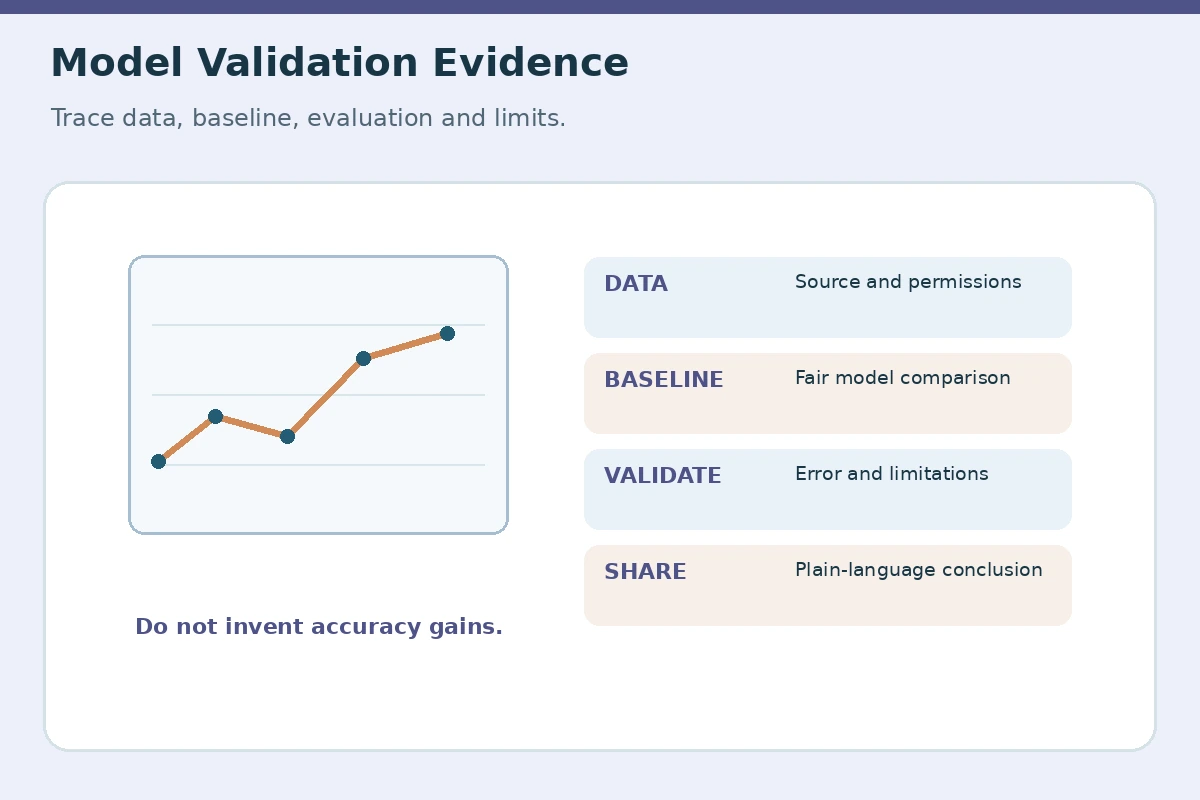
A truthful project write-up should describe the problem, data origin, split strategy, metric rationale and what failed. Include caveats such as small sample size, biased collection or missing production validation. Do not invent percentage improvements. An employer can assess your judgment from an honest explanation of why you changed a feature or rejected a method, even if your portfolio is not a production system.
Evaluate Remote Collaboration and Stakeholder Contact
Some remote roles have live collaboration sessions with data engineers, product managers or subject-matter experts; others rely more on documented asynchronous review. Ask when analysts can get a question answered, how methods are reviewed and how a conclusion becomes a business recommendation. Location restrictions and overlapping hours still apply even when the core analysis is independent.
Prepare an example of translating a technical finding into a plain-language decision note. Include what was uncertain and what additional data would have helped. If you contributed one chart to a team report, describe that contribution instead of claiming you set the company strategy. Ask whether a data scientist is responsible for deployment decisions or provides a recommendation to another authorized owner.
Build a Portfolio That Survives Technical Review
Choose two or three real projects with distinct purposes: an exploratory analysis, a validated predictive model, and an explanation for a nontechnical audience. Provide reproducible code where permissible and a short README that distinguishes original work from borrowed tutorials. A polished plot without the data provenance or method description is weak evidence. Keep all shared inputs legally and ethically available for public use.
If a hiring test asks for an analysis, confirm the deadline, allowed packages, source of data and expected output. Do not supply ongoing free consulting work under the guise of an assessment without understanding its purpose. Your report can include limitations, not just a score. If you have only classroom experience, state that clearly and emphasize careful validation rather than suggesting you ran models for paying clients.
Verify the Vacancy and Track Practical Fit
Use the official employer career page to confirm the open position and any geographic restrictions. Compare the role against your task map: statistics, modeling, data engineering, product collaboration, deployment and permissions. Write down the application date, technical assessment expectations and whether the role requires certain industry knowledge or a seniority level you can demonstrate. Do not treat scraped or stale listings as proof that a position remains open.
At interview, ask what success is judged by, who owns data quality, how model risks are reviewed and which outputs are read by stakeholders. If a recruiter cannot identify an employer, asks for payment, or requests confidential datasets before a verified hiring process, stop and check independently. A relevant, verifiable opening with scoped responsibilities is worth more than an exaggerated “remote AI” promise.

How We Research Remote Work Openings
We checked source guidance on 2026-11-14: BLS data scientists (BLS lists data selection, cleaning, algorithm validation and communicating findings as data science duties.); FTC remote job scam guidance (FTC warns that remote-work scams can involve fake upfront charges and fake equipment checks; verify an employer independently.). This article offers an evergreen method for evaluating opportunities, not confirmation that any employer is hiring now. The original JobAsk production plan, supplied WordPress post-title exports, prior batch topics, and public search results were reviewed for overlap. Employer requirements can change: verify vacancies and employment location on the official career site. Any application examples are hypothetical and should be adapted only to real work. Please read the JobAsk affiliate disclosure; no partnership or affiliate approval is claimed.
Related Job Search Guides
It depends on the vacancy. Some positions focus on experimentation or analysis while others expect production model ownership.
Not fully. Some tasks overlap, but modeling, statistical inference, dashboards and engineering ownership vary by position.
Only if authorized and not confidential. Public or synthetic projects are safer portfolio examples.
A source or permission statement, problem framing, validation choices, results with limitations and an honest explanation of your contribution.
Not necessarily. Confirm geographic eligibility, time-zone overlap and secure-access requirements with the employer.