
A resignation text message can communicate an urgent departure or ask your boss for a conversation, but it is not always the right final record of resignation. If possible, speak directly with your manager and follow your workplace’s required notice process. When text is the practical channel available, include a clear decision and an exact last working date, then confirm receipt and send the formal written notice your employer requests.
This is a communication guide, not a claim that every employer legally accepts SMS notice. UNLV Career Services recommends a professional letter with the resignation date; career guidance on telling your boss you are quitting favors a private direct conversation when practicable. The method you choose should reflect your actual circumstances and workplace policy.
Choose Text Only When It Fits the Situation
If you already use text with your manager for scheduling or urgent operational updates, a short message might be the fastest way to reach them when you cannot call. But messages can go to the wrong phone, arrive when the recipient is unavailable, or fail to satisfy an HR reporting requirement. Check whether your employer specifies email, a resignation form, a designated contact or a written letter.
For an ordinary departure with time to plan, a brief private conversation plus email often creates less uncertainty. If a safety issue or serious personal circumstance makes a meeting impractical, prioritize the appropriate urgent support or reporting channel rather than forcing an in-person conversation. This article cannot determine the legal effectiveness of text notice in a particular jurisdiction or contract.

Write the Date, Decision and Next Step
A complete text uses plain language: “Hi [Manager], I need to let you know I am resigning from [role]. My last working day will be [Month Day, Year]. I will follow up by email with the formal notice. Please confirm you received this.” The sender should be identifiable, and the request for acknowledgment should be polite. If the manager is away, check the correct alternative recipient.
Hypothetical message: “Hi [Manager], this is [Name]. I am resigning from my [Role] position, and my final scheduled shift is [date]. I will email the formal notice to you and HR today. Please let me know when you receive this.” This example is fictional and not a guaranteed valid notice. Do not include an invented explanation, another person’s contact details or sensitive medical circumstances.
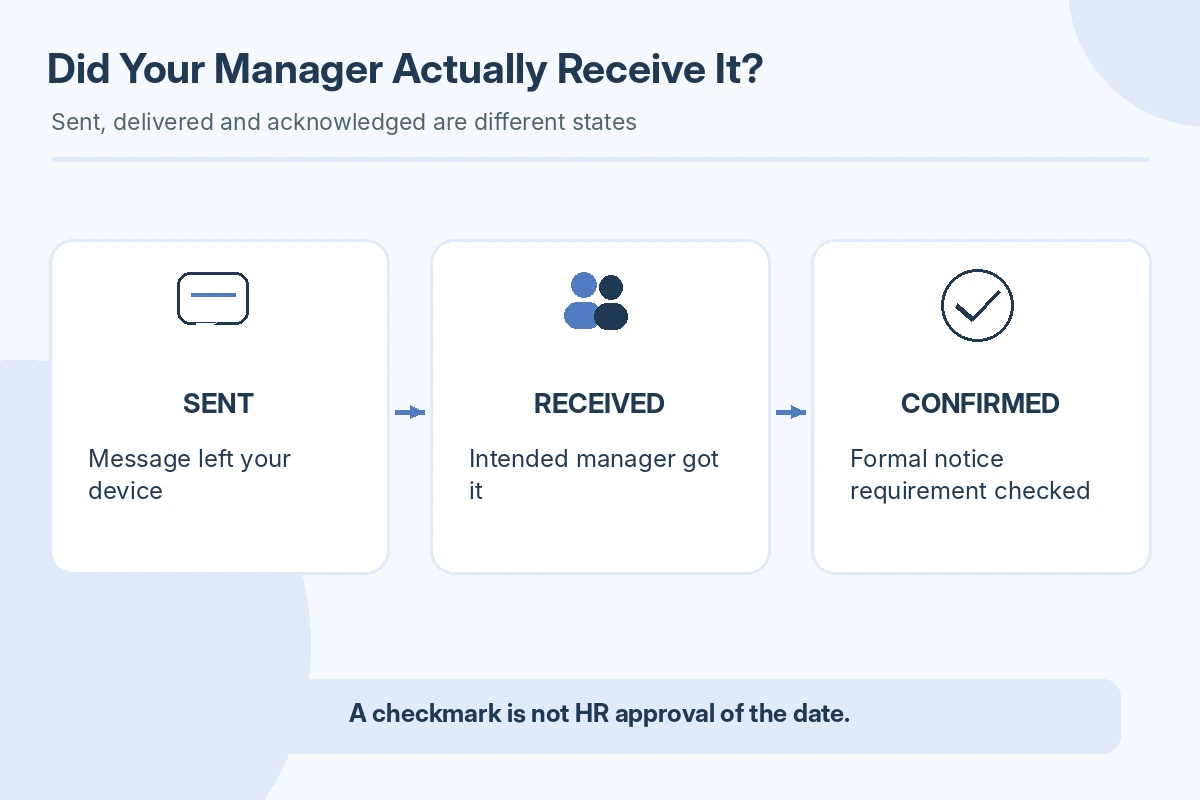
Treat Sent, Delivered and Acknowledged as Different
A message visible in your phone’s outbox proves only that you attempted to send it. A device delivery indicator does not necessarily prove the correct person reviewed it; silence does not equal agreement about the final shift. If you receive no response and the timing is important, use the employer’s other established contact route, such as a business email address or HR line.
Keep a factual record of what was sent and when, without surreptitiously collecting unrelated private data. A simple acknowledgment such as “Received; please send the letter to HR” helps identify the next action. Do not treat an acknowledgment as a signed agreement about benefits, payroll or a disputed notice clause; those may require separate communication with the appropriate office.

Follow With the Correct Formal Notice
The follow-up email or document should match the text on the position, resignation decision and final date. If the date changes after discussion, confirm the amended date in writing rather than leaving two contradictory versions. State only tasks you can hand over during remaining shifts. Make no unsupported guarantee that your team will be fully covered after departure.
Use the University of Wyoming resignation-email examples for a concise structure and short-notice guidance when the timeline is compressed. A message that casually says “I think I might be done” is ambiguous; a formal notice must make clear whether you have made a decision or are merely requesting a meeting. If you are still undecided, ask to talk without representing the conversation as a resignation.
Avoid Texts That Create Extra Confusion
Do not post your resignation in a group chat, leave it as a public comment, send it to a former manager, or include criticism and accusations to make a point. Resist sarcasm or vague shorthand like “won’t be back after this week” when scheduled shifts run across multiple dates. Do not attach screenshots of client lists, credentials, protected records or internal documents as proof that you completed work.
If you need to discuss an incident, unpaid time, unsafe work or an accommodation, those issues may deserve their own confidential process. Keep the notice message focused on what you can confirm. Never assume an instant messaging app’s “delete” function removes all copies. A professional message should make sense even if later read in an employment record.
Use a Two-Channel Confirmation Checklist
Before closing the conversation, ask: did the correct manager receive the date, did HR receive the required formal notice, is the final shift recorded consistently, and are outstanding work items assigned? This practical checklist is a communication aid rather than a company-approved procedural form. Where you do not know an answer, record the open question and ask the responsible person.
You do not need a dramatic farewell text. A clear resignation statement plus a respectful follow-up is more effective communication than a long emotional narrative. The goal is to reduce avoidable errors in who was told, what date was given and what the next administrative step is—not to promise that text alone will satisfy every employer’s rules.
How We Research Professional Resignation Guidance
This guide draws on career communication guidance, UNLV Career Services, University of Wyoming career resources, short-notice career guidance. These sources support practical communication, notice structure or, where applicable, clinical responsibility. They do not confirm an individual contract, a legal notice period, a facility policy or an invented candidate’s experience. Public source pages were checked on October 26, 2026.
All templates and scenarios are explicitly hypothetical and must be rewritten with your actual dates, duties and recipients. Treat the original diagrams as decision aids, not legal or clinical directives. This site makes no claim of a paid referral or affiliated employer. Review the affiliate disclosure.
Related Guides
- How to Tell Your Boss You Are Quitting: What to Say and How to Handle Reactions
- Resignation Email to Your Manager: Subject Lines and Templates
- How to Write a Resignation Email: Subject Line, Date, and Follow-Up
- How to Decline a Job Offer by Phone and Confirm It in Writing
- Resignation Letter Due to Relocation: Explain the Move Without Oversharing
A text may communicate the decision, but whether it is an acceptable formal notice depends on the applicable workplace processes and circumstances.
State your name if needed, the decision, exact last working day and how you will provide formal follow-up.
Use another approved contact channel, such as employer email or HR, and avoid assuming silence confirms receipt.
A private message to the correct recipient is generally clearer and protects other people from unnecessary involvement.
Where required or practical, yes; keep the decision and date consistent and follow the employer’s actual procedure.