
Quick answer. To tell a supervisor you are quitting, request an appropriate private channel, state that the decision is made, give the proposed last working day, and ask who will coordinate the transition. Prepare short responses to surprise or pressure without guessing how any particular manager will react. This is a conversation rehearsal guide, not a substitute for the workplace’s formal notice process or for an actual employment agreement.
Choose a short private communication channel
If it is practical and safe, request a brief one-to-one meeting with your direct manager rather than sharing the decision through office gossip. A calendar request such as “Could we talk privately about a work transition today?” gives context without turning the invitation into a public announcement. For a remote supervisor, a telephone or video conversation may work equally well.
The manager may be busy or unavailable, so know which official channel to use if a meeting cannot happen. You are informing them of a decision, not asking them to evaluate the worth of your future plans. Avoid opening with a long critique of the business or a rehearsed apology; clarity is more respectful than making someone guess why you asked to talk.
Rehearse three sentences that do the work
Prepare the conversation around three parts: the decision, the proposed date and the transition. A hypothetical script: “I have decided to leave my role. My proposed last working day is [date]. Thank you for the experience; I would like to agree on which work should be handed over first.” The wording is illustrative and should be adapted to your real circumstances.
Try the script aloud without unnecessary additions. If you begin with “I have been wondering whether I should maybe go,” the manager may hear a request to negotiate rather than notice of a decision. If the decision is not final, have a different conversation about role fit or workload before announcing resignation. Decide which meeting you are actually having.

Prepare for three different reactions
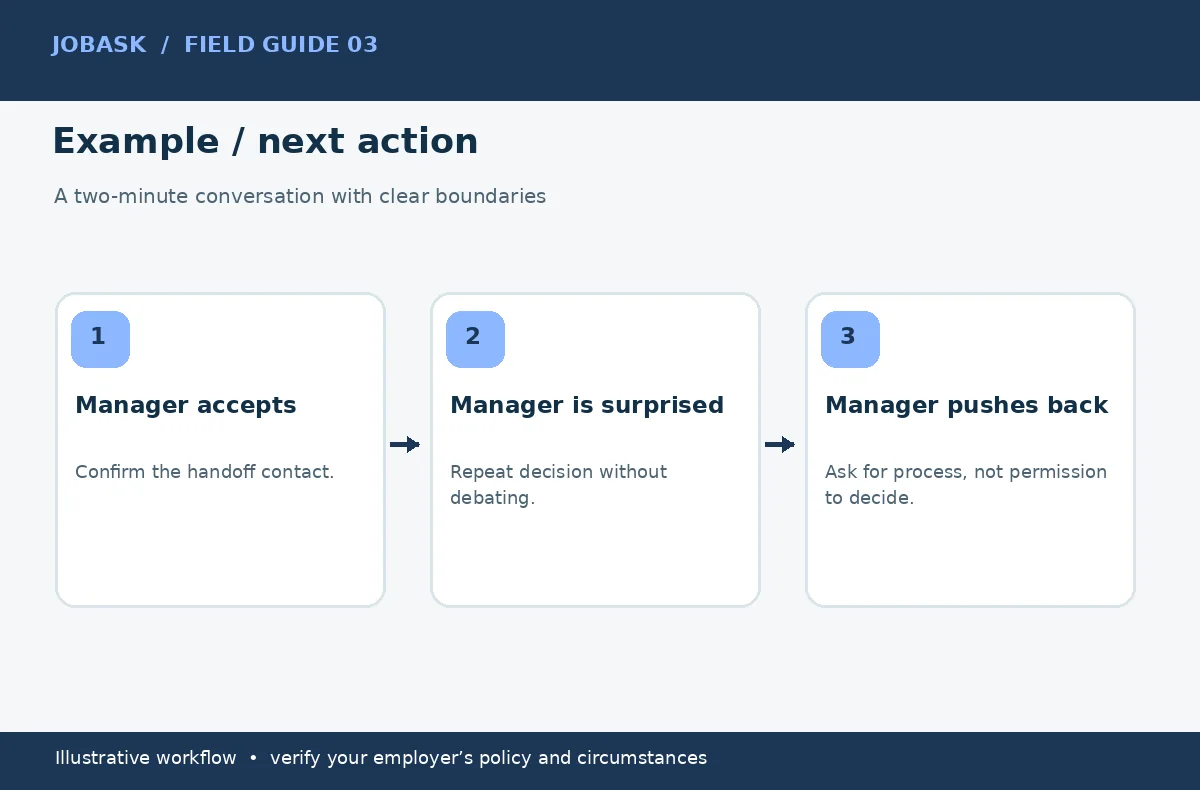
A supportive manager might ask about your plans and offer congratulations; thank them and move to logistics. A surprised manager might need a moment and ask what happened; acknowledge the surprise while calmly repeating the final date. A manager who asks you to reconsider may be discussing a counteroffer or short-term workload problem. You do not have to improvise an immediate answer to every proposal.
A possible truthful reply is “I appreciate you discussing alternatives. My decision to leave is made, and I would like to focus on a clear transition.” If you genuinely want to consider an alternative, say when you will respond and avoid making a promise during an emotional meeting. No conversation script can guarantee your manager’s reaction, and role-specific agreements may require separate review.
Keep personal details inside your boundaries
You can be warm without giving a full explanation. “I am moving in a different professional direction” is different from telling a false story about receiving an offer. If you are leaving for personal reasons, consider whether the information is actually necessary to complete the resignation process before disclosing it. When a workplace requires certain information, ask what is needed and who is authorized to receive it. If you want the full process, read how to quit a job you just started without inventing an excuse.
Avoid comparisons such as “everyone here is unhappy” unless you are prepared to support a separate complaint in the appropriate channel. A resignation discussion is usually not the best place to litigate grievances or confidential personnel matters. Where serious misconduct or rights issues exist, seek appropriate specialist guidance rather than copying an internet script.
Separate notice from handoff decisions
Your manager may ask you to finish several competing projects before departure. Do not promise all of them. Offer a short inventory of deliverables, owners, deadlines and dependencies, then ask which items should be prioritized. This moves the discussion from an emotional reaction to concrete operational decisions. A useful phrase is “I can document the status of A and B; which one should I complete first?”
A hypothetical team member is leaving with three unfinished reports. Rather than commit to finalizing every report, they flag which data has been checked, which draft needs review and who can approve remaining work. That preserves accuracy without pretending that two weeks—or any other notice interval—automatically provides enough time to finish all tasks.
Follow the conversation with a written record
After the meeting, use the employer-approved notice method. A short original example: “Following our conversation, I am resigning from my position as [role]. My proposed final working day is [date]. I will document open tasks in our approved workspace and confirm handoff priorities with you. Thank you, [name].” Include other required details only if your workplace process calls for them. If you want the full process, read how to tell your boss you are quitting.
If your manager responds with a different proposed date or offboarding process, clarify that difference rather than silently updating coworkers. Keep written communications factual. Do not say someone accepted an arrangement before they actually confirmed it, and do not treat a private script or emailed template as legal advice about your obligations.
Decide who hears the news next
Agree on the sequence for informing colleagues, project partners or customers. Some teams prefer that a manager update the group; others invite the departing employee to tell colleagues directly. Ask who should handle external communication and what is approved to say. A farewell note to teammates is a separate task from formal notice, and it usually makes more sense after the manager knows. Our guide “Farewell Letter to Colleagues” covers what to say after notice is shared.
Be especially careful in group chats, shared calendars and client-facing channels. A rushed message can create uncertainty over who will manage ongoing work. If colleagues ask where you are going, give only truthful information that you choose to share. Treat any internal files, documents or customer records according to workplace rules throughout the exit.

Close the meeting with one next step
Before ending, ask for a specific practical action: “Who should receive my project list?” or “Which HR channel records the notice?” Make a private note of what was actually decided, including any date still awaiting confirmation. You do not need a dramatic farewell speech; a clear next step is what makes the discussion operationally useful.
Finally, review your follow-up message for spelling, recipients and ambiguous language. If the meeting went badly, do not rush to send an emotional account to the entire team. Take time to produce a calm factual notice. This article deliberately covers the conversation; longer letter templates and handoff documentation belong in separate tools.
How We Research This Resignation Question
For the manager conversation, we used UNLV correspondence and email-professionalism instructions plus university-provided resignation resources. Our conversation-response diagram presents possible choices rather than predicting a supervisor’s actions. The article keeps spoken notification separate from the written record and avoids unsupported claims about acceptance or employment consequences.
Sources and Transparency for Readers
Sources reviewed on 2026-10-20: UNLV Career Services. UNLV Career Services. University of Wyoming career resources. The linked campus material supplies general workplace courtesy and follow-up email principles. Our example conversation is invented to illustrate possible manager reactions, not to portray research interviews or forecast behavior. This guide does not establish legal notice requirements or an employer’s approval of a date. There is no confirmed affiliate arrangement associated with these recommendations. Read JobAsk’s affiliate disclosure for relationship transparency. This article is educational content, not individualized legal advice.
Explore Related Career Guides
- Resignation Text Message to Your Boss: Say It Clearly and Confirm in Writing
- Resignation During Probation: Check Notice Terms and Write a Clear Letter
- How to Resign From a Job Professionally and Plan a Clean Handoff
- Resignation Email Format: Subject Line, Last Day, and Reply Check
- How to Give Two Weeks Notice: Confirm the Date and Plan the Handoff
A private live conversation may help when safe and feasible, followed by the employer-approved written process. Use official channels when a live talk is impractical.
Keep the decision and proposed date clear. Avoid debating motives, and move to concrete handoff and HR procedures.
Usually the basic conversation can focus on your departure and transition; verify any specific workplace requirements before sharing private information.
You can ask for time to consider a genuine proposal, but do not promise to stay or change dates unless you decide to do so.
Coordinate the sequence with the appropriate manager or team process so unfinished work and external contacts are not left confused.