
Quick answer: Learn to introduce management experience with real shift decisions, guest-service actions, and accurate boundaries around food safety and approvals. Start with the setting you genuinely know, choose one relevant action, describe your own contribution and connect it to the specific role. Treat examples in this guide as hypothetical practice material, never as statements about a real candidate.
An opening answer is a professional introduction, not a complete biography. Employer responsibilities vary; use the actual posting, avoid invented employers or figures, and be ready to explain every claim in a follow-up. This guide uses job-related interview guidance and occupation-specific sources where applicable.
Lead With the Level of Restaurant Work You Owned
Restaurant manager titles vary across employers. A shift lead, assistant manager and general manager may coordinate the same rush but hold very different responsibility for hiring, ordering, pricing and payroll. Start your introduction with the position you actually held, the type of operation you worked in and one task you were accountable for. BLS and O*NET identify staffing, service, supplies and sanitation as areas relevant to food service management, not as a guarantee that every manager personally approves each one.
If you were a supervisor rather than a general manager, say so. An interviewer can value someone who handled team coverage and operational handoffs without needing to hear that the candidate “ran the entire restaurant.” An applicant moving up from a server role can describe leading a station handoff or training peers when that genuinely occurred. Never convert coworker assistance into formal managerial authority.
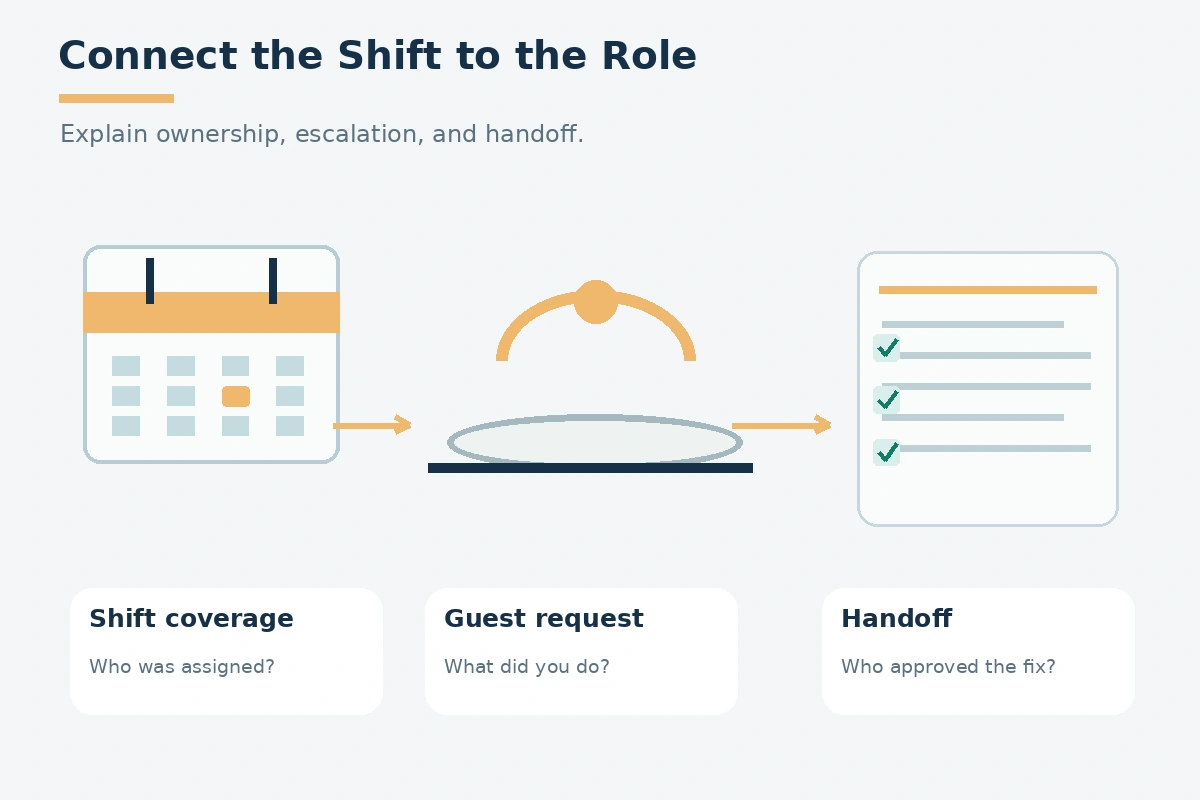
Use One Busy-Shift Example With a Clear Decision
The strongest introductory story often begins with a predictable service challenge: a schedule conflict, a rush with uneven station coverage, or an order that required communication between dining room and kitchen. State the part you controlled. A hypothetical shift supervisor might have noticed two uncovered stations, checked who was available, and asked the manager to approve a revised assignment before announcing it.
Describe an observable outcome rather than a fabricated sales or satisfaction metric. If the team covered service after the adjustment, say the change clarified coverage. If sales numbers are not verified, do not claim revenue growth. This kind of example helps the interviewer understand how you assess a problem and work through the organization’s real approval chain.
Show Food-Safety Judgment Without Overclaiming
Food safety deserves careful language. An introduction may say that you followed the employer’s training and reported a suspected quality problem through the assigned escalation route. It should not imply you independently certified a kitchen, waived a control or had authority that belonged to a trained manager or regulator. Use current, real certifications only, with the exact name and status.
If an interview asks how you handled a guest raising a food concern, explain what you did first, whom you notified and what you documented. Do not disclose private guest details or repeat unverified medical claims. Food safety requirements differ by role and jurisdiction, so a candidate should discuss approved procedures rather than universal rules. The objective is to show cautious, reliable judgment under pressure.
| Operational responsibility | Evidence that fits | Authority question |
|---|---|---|
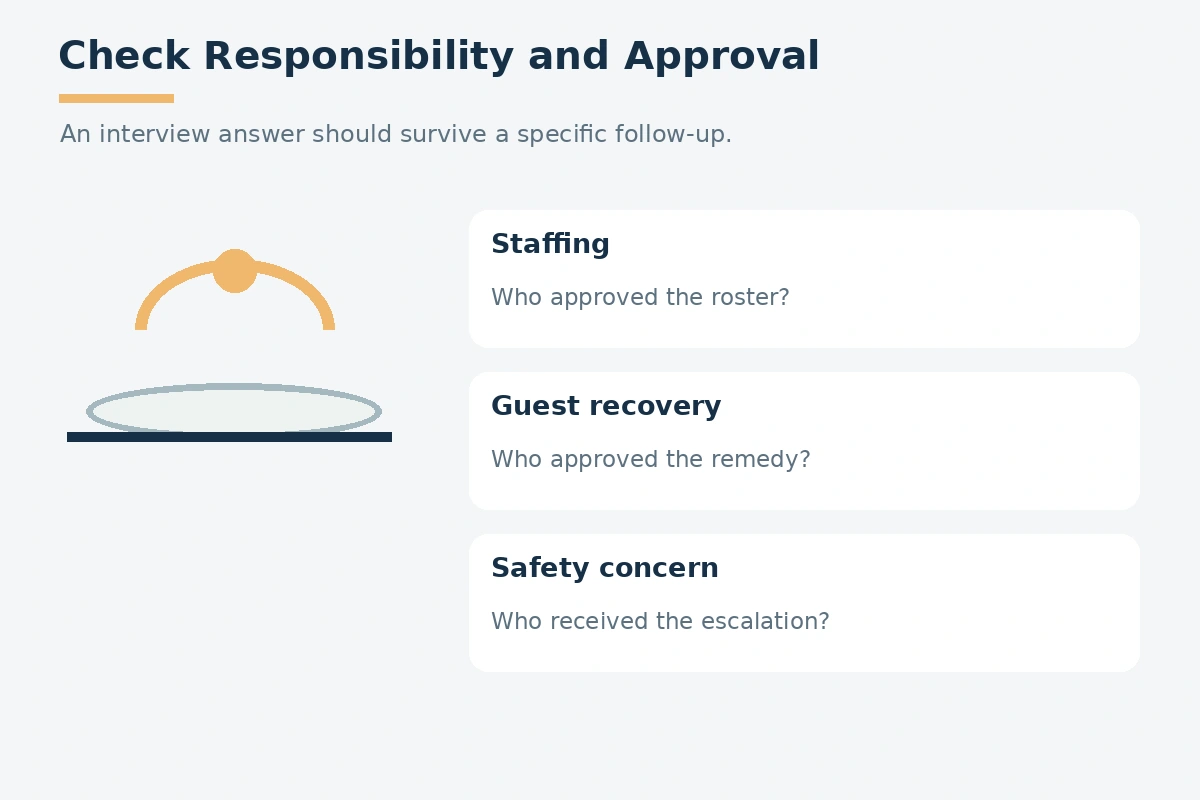
| Staffing | Adjusted an approved shift roster | Who may authorize overtime? |
| Guest concern | Listened, documented and escalated | Who approves refunds or remedies? |
| Food safety | Followed reporting procedures | Who makes final safety decisions? |
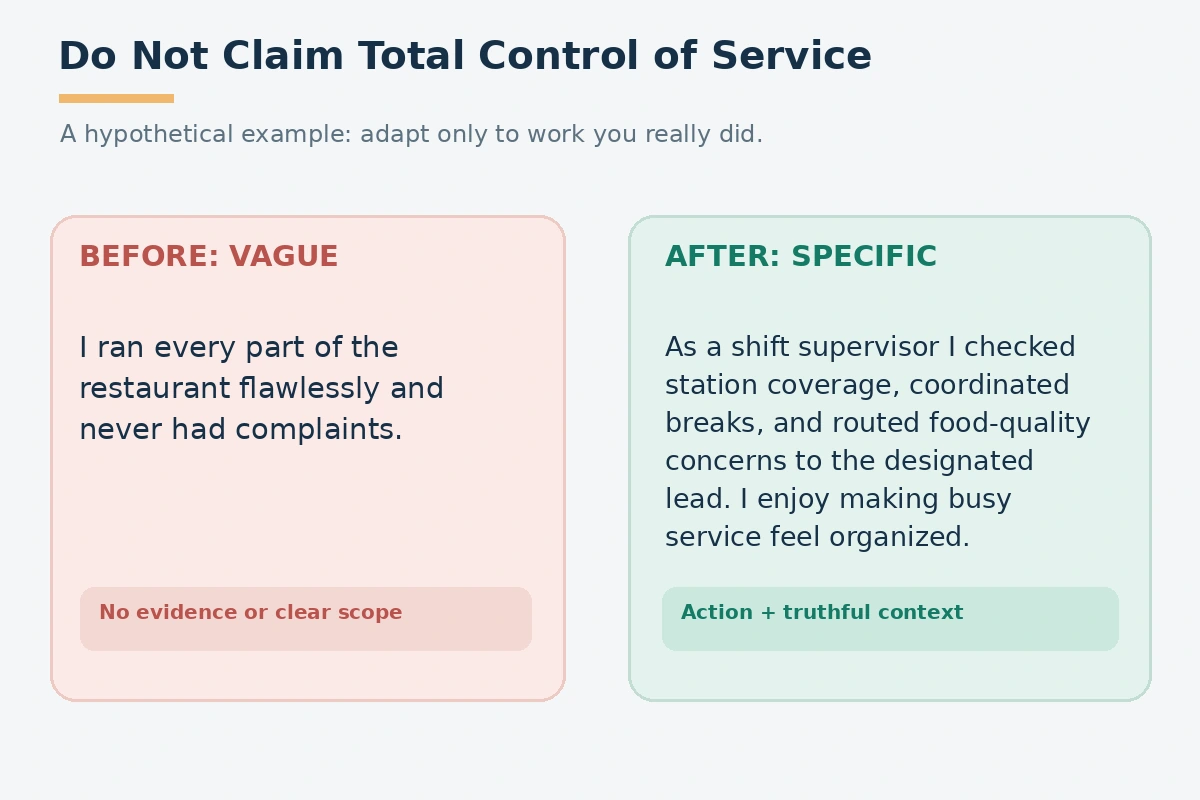
Separate Service Recovery From Refund Authority
A guest complaint offers an opportunity to show communication rather than heroic improvisation. You might describe listening without interrupting, clarifying what happened, checking the ticket or order record and involving the person authorized to decide on a remedy. If you personally approved a replacement or refund, name that only if it was within your documented role.
Many applicants use phrases like “I always made every customer happy,” but no manager can prove that universal result. A better statement is that you recorded concerns, explained available options and closed the loop with the responsible staff. Such evidence connects the interpersonal part of restaurant management to repeatable operational work.
Explain Scheduling, Inventory and Team Development
If the posting emphasizes cost control, select one verified example involving counts, ordering support, deliveries or waste logs. Explain whether you reviewed a record, reported a discrepancy or made a purchase decision. Those are separate responsibilities. If the role is more staff-facing, describe how you assigned approved shifts, clarified training steps or handed unresolved work to the next supervisor.
Do not claim that training one new employee makes you the owner of a formal training program. You can say you coached a coworker on a documented routine and the manager reviewed their readiness. Likewise, assisting with a weekly inventory count is not the same as approving supplier contracts. Precise language gives employers a clearer view of your management readiness.
Close With the Operation You Want to Support
Finish by naming the job’s focus: coordinated service, consistent handoffs, careful standards or team development. A hypothetical candidate could say, “I have learned to keep station coverage and guest communication clear during busy shifts, and I want to bring that practice to a restaurant where managers coordinate both kitchen and dining teams.” The sentence expresses a relevant goal without promising an unmeasured business result.
Before the interview, verify titles, shift responsibilities, reporting lines and any genuine metrics. Identify one example you can explain in detail, including who authorized decisions. Then speak naturally. A restaurant manager introduction should sound like the account of a responsible operator, not a list of exaggerated claims about perfect service or absolute control.
How We Research Interview Advice
We checked primary interview guidance and occupation-specific information on October 29, 2026. The relevant references are Source 1, Source 2, Source 3. These sources help identify a credible answer structure and typical tasks; they do not certify any individual experience or guarantee an employer outcome.
All sample introductions are hypothetical and should be rewritten from your own verified experience. JobAsk does not claim any paid interview-coaching partnership for this guide. Read our affiliate disclosure for site-wide information about possible relationships.
Related Guides
- Restaurant Manager Resume Format: Show Staffing and Service Scope
- Tell Me About Yourself for a Restaurant Server: Orders and Guest Care
- Tell Me About Yourself in a Product Manager Interview: Decisions and Trade-Offs
- Tell Me About Yourself in 30 Seconds: Build a Focused Interview Pitch
- IT Manager Interview Questions: Incidents, Priorities, and Decision Rights
Yes, but state the shift-supervisor title and actual duties, then explain how they prepare you for the advertised role.
Yes if you hold the accurately named and current credential. Do not imply a license or inspection authority you lack.
Yes when it shows listening, documentation, authorized remedies and handoff without exposing guest details.
Describe confirmed responsibilities and observable outcomes instead of making up percentages or revenue.
Explain which shifts you coordinated, who approved changes and how coverage was communicated to the team.