
An Additional Information section is useful only when it adds verified, job-relevant facts that do not fit better under Skills, Experience, Education, Projects, or Certifications. It is optional, not a box every applicant must fill. Choose a descriptive heading whenever you can, and leave out personal details that do not help the employer evaluate your fit.
The sample descriptions in this guide are hypothetical unless explicitly labeled as source examples. Do not copy a claimed outcome, date, title, or credential that does not describe you.
Ask Whether the Fact Solves a Hiring Question
Review the job posting and your existing resume before adding another section. If an employer needs language fluency, a current credential, a software tool, or scheduling eligibility, the information may matter. If the detail simply repeats a bullet you have already written, it is not additional. Princeton career guidance provides optional headings for training, achievements, associations and portfolio links, so a catchall title is not the only option.
A hypothetical applicant to a bilingual receptionist role might include “Languages: English and Spanish — professional working proficiency” only if that description is honest. A different applicant might show required shift availability in an application form rather than on the resume. Use the section for evidence that helps answer the position’s actual screening questions, not for a biography.

Choose the Most Accurate Heading First
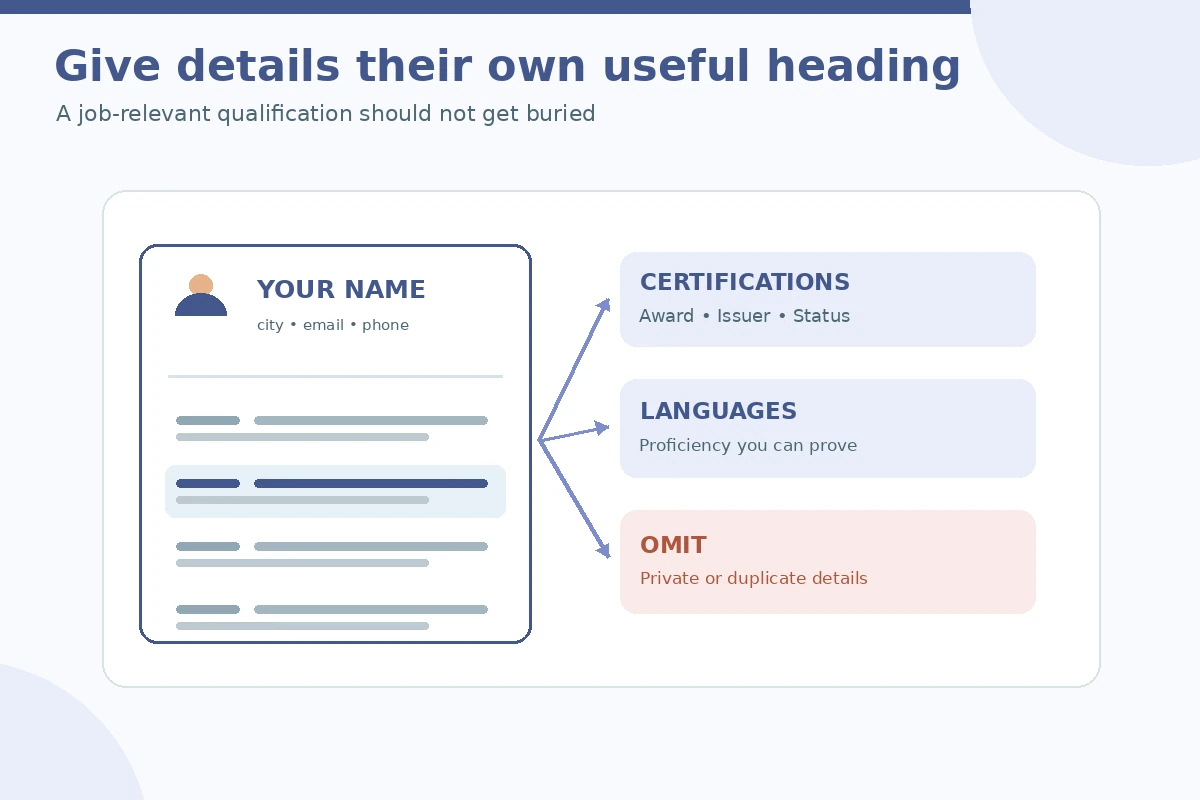
The heading “Additional Information” is broad and can hide information that deserves clearer labeling. Use “Languages” for language abilities, “Certifications” for earned awards, “Professional Affiliations” for genuine memberships, or “Presentations” for relevant talks. Separate headings need not be long; one concise line can be enough.
UConn lists certifications, publications, community activities and related coursework as possible resume sections. That is permission to select, not an instruction to include all of them. An empty section is less useful than removing it. For a role where a technical license is required, avoid burying that information under “Other.” Put it where the reader will recognize the qualification immediately.
Use Extra Space for Verifiable Professional Facts
Appropriate examples include a genuine professional association membership, an accessible work portfolio, relevant presentations, or a workshop whose completion you can confirm. Give enough detail to identify the item: organization, role or output, and a date when it helps. Do not use initials or unexplained badges to create an impression of authority.
A hypothetical example might read “Presentations — Co-presented a student research poster on inventory labeling, 2025,” assuming the event and contribution really happened. Avoid invented conferences, fake job titles and unverified endorsements. Distinguish a personal blog from a peer-reviewed publication and a meeting attendance certificate from a professional license. A precise label is part of your credibility.
Keep Work Eligibility Claims Within Known Facts
If a job posting or application form asks about travel, shift availability or work authorization, answer within the employer’s requested process. Legal eligibility is not something a resume adjective can establish. Do not promise immediate relocation, unrestricted travel or schedule flexibility if you cannot meet those conditions. Use concise truthful statements only when clearly relevant and appropriate.
For remote work, location eligibility can depend on employer policy. A phrase such as “Open to remote work nationwide” may be misleading when you are not eligible in every jurisdiction or cannot meet required work hours. When uncertain, use the official application form or ask the recruiter for the necessary details. Avoid blanket legal advice or statements about immigration status on a general resume.
Treat Language and Tool Proficiency Honestly
A language line should reflect actual speaking, listening, reading or writing ability relevant to the role. Do not convert a beginner course into “fluent.” Likewise, listing advanced Excel, design software or a specialized platform implies you can use it in the job. If you learned the tool only in a classroom, say so where context is needed.
The CUNY resume guide shows optional information and meaningful proficiency distinctions. Give enough detail to help a recruiter ask a fair question. For example, “Spanish — conversational; written responses reviewed before sending” is more specific than “Bilingual expert” if the latter is inaccurate. Never share private customer records or employer documents as proficiency proof.
Exclude Personal Information and Repeat Claims
Personal interests, family status, age, photographs, full home address and confidential identifiers ordinarily do not improve a U.S. resume. Nor does a list of generic adjectives such as honest, hardworking and friendly. Repeating “organized” in an optional section when scheduling examples already show it adds noise. Make each item earn its space.
If a hiring process legitimately requires identity documents, provide them through the verified official channel at the appropriate step, not as resume attachments. Be cautious about links to personal social media or unmoderated portfolios. An optional section should not expose more data than the applicant wants widely circulated among recruiters and job boards.
Perform a Remove, Rename, or Retain Audit
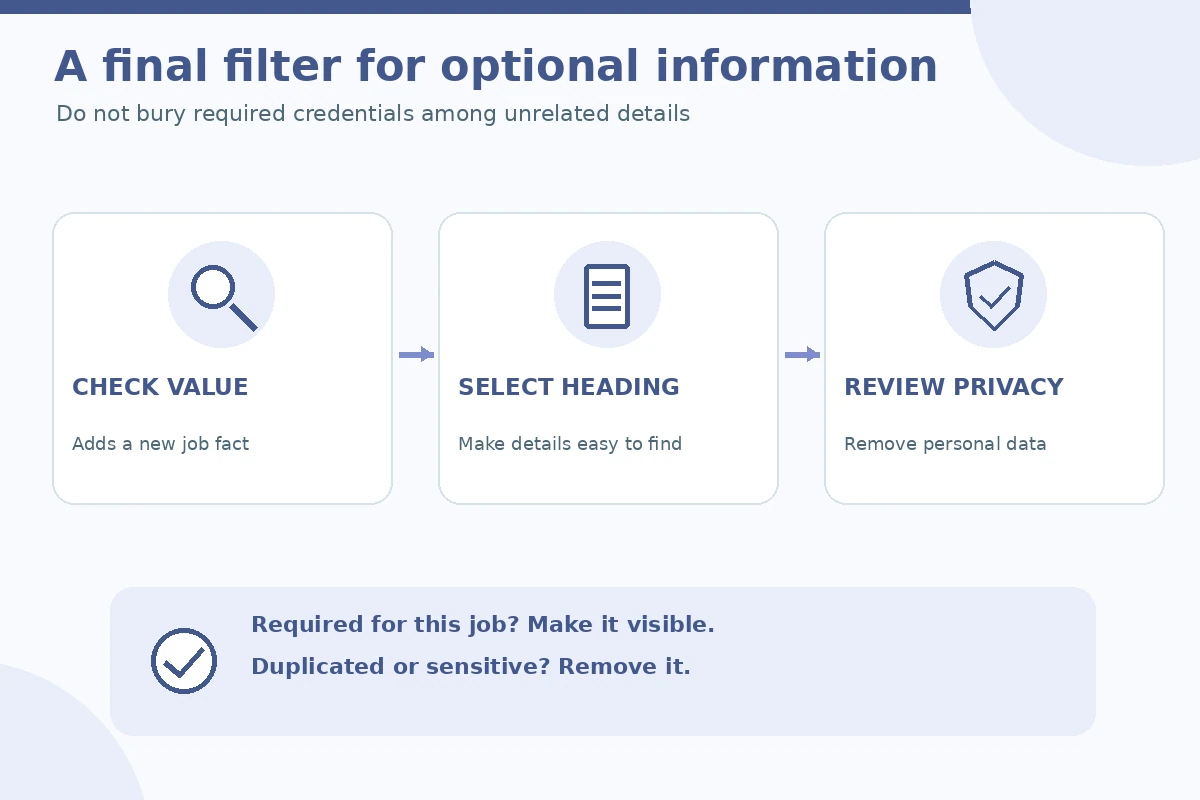
Read each proposed line and choose one action. Remove it if irrelevant or unverified. Rename the section if a meaningful heading describes all its content. Retain a small Additional Information block only if the items are genuinely useful and do not warrant separate headings. Then check for duplicated credentials, inconsistent dates or claims that contradict the main resume.
Consider the first screen: if the most important qualification sits below a long “Additional Information” list, the ordering is wrong. Move essential facts up and compress minor extras. Your finished resume should answer the employer’s questions faster, not require them to decode a miscellaneous section.
How We Research These Resume Recommendations
We examined the relevant resume guidance from Princeton, UConn, CUNY on October 27, 2026, and cross-checked the distinction between required qualifications and optional resume details. These institutions give career advice, not rules imposed by every U.S. employer. The original diagrams explain decisions; fictional examples are labeled hypothetical rather than represented as candidate outcomes.
JobAsk does not guarantee an interview, hiring outcome, employer endorsement, or software-screening result. For information about potential commercial relationships elsewhere on the website, read the affiliate disclosure. This article does not claim any paid referral.
More Resume and Cover Letter Guides
- AI Resume Writer: Fact-Check Every Claim and Protect Your Information
- What Awards to Put on a Resume: Choose Proof, Not Padding
- How to Format a Resume Reference Sheet and Protect Contact Details
- How to Put Internship Experience on a Resume With Accurate Role Details
- Leadership Experience on a Resume: Prove Actions, Not Titles
No. Use it only for relevant details that do not fit better under a clear, familiar heading.
Only when they are genuinely relevant; a short Interests section or omission may be more appropriate.
You can, but a dedicated Certifications or Licenses heading is clearer when the credential matters for eligibility.
Follow the actual employer application requirements and avoid unnecessary personal legal details or unsupported blanket claims.
If it crowds out employment evidence or repeats existing sections, trim or remove it.